Regions Bank Asks Judge to Reopen Mabel Amos Settlement, Rejecting Terms Drafted by AG’s Office
Regions Bank and two former Mabel Amos Memorial Fund board members have asked a Montgomery judge to reopen settlement talks, rejecting key terms of a Sept. 24 order drafted by the attorney general's office. The bank offers a package it says matches the state's proposal if the court finds no material breach of the trust.
UPDATE, Oct. 14: Regions Bank and two of its former representatives on the Mabel Amos Memorial Fund board are now objecting to the Mabel Amos settlement order that Montgomery County Circuit Judge Greg Griffin signed Sept. 24 and are asking him to reopen negotiations. Details are in the “Latest developments” section below.
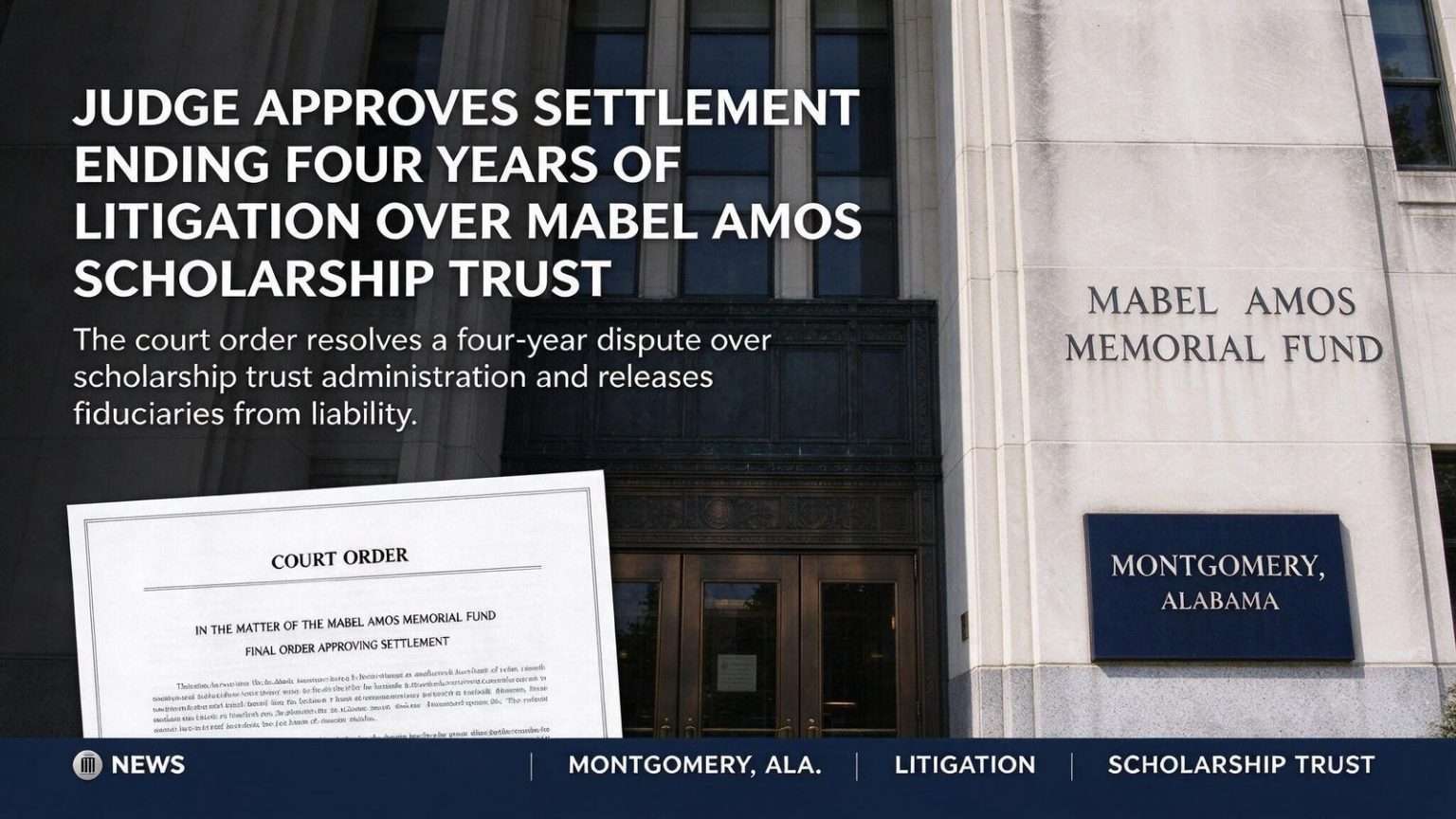
MONTGOMERY, Ala. — A judge has approved a settlement ending four years of litigation over the Mabel Amos Memorial Fund, a scholarship trust, according to the court’s order.
That order is now being challenged. Regions Bank, Bell and McNees filed a motion Oct. 12 asking Montgomery County Circuit Judge Greg Griffin to reopen settlement talks, arguing several of the order’s terms conflict with Alabama trust law.
Latest developments: Regions asks judge to reopen settlement talks
The Mabel Amos settlement that appeared to close a four-year legal fight may not be final after all. In an Oct. 12 filing, Regions Bank and its two former representatives on the Amos board, John Bell and Drew McNees, rejected terms of the court’s Sept. 24 settlement order and asked Judge Greg Griffin to reconvene a settlement conference or order mediation. The order had been drafted by the office of Alabama Attorney General Steve Marshall.
The bank’s motion offers a package that it says matches the attorney general’s proposal — but only if the court finds the bank committed no material breach of the trust. The motion also requests oral argument and renewed negotiations before the court or a mutually agreeable mediator.
What Regions objects to
The motion takes issue with three parts of Marshall’s settlement: requiring the defendants to reimburse the scholarship trust for certain distributions, making them pay the expenses of the court-appointed special fiduciary, and having them cover the attorneys’ fees of the three private plaintiffs. Regions’ attorneys argue those provisions conflict with Alabama trust law.
The bank’s counteroffer, by the numbers
According to the filing, the attorney general’s proposal to make the fund “whole” totaled $1,266,910. Regions says its offer matches that, though the motion itself values the bank’s combined contribution at $1,226,910, made up of $676,910 in payments and $550,000 in waived fees. Under the proposal:
- Regions would pay $500,000 to the Amos Fund.
- Regions would waive $550,000 in attorneys’ fees it says it would otherwise be entitled to have the fund pay on its behalf as trustee. Because that money would be waived, it would not actually be paid into the fund.
- Alabama Ethics Commission Executive Director Tom Albritton, a former board member, would pay $176,910.
- Payments of attorneys’ fees to the private plaintiffs proposed by the attorney general would be eliminated; the motion says the court could instead authorize payment from the trust.
Regions conditions its fee waiver on a finding that it committed no material breach of the trust. Albritton’s contribution carries a similar condition.
The motion reads that Defendant Albritton proposes to contribute $176,910 to settle the proceedings on condition the court enters an order finding no material wrongdoing by him, including due to his reliance on professional accounting advice.
Beginning in 2012, the fund awarded $135,000 in scholarships to Albritton’s children. The motion does not make clear whether the difference between that amount and what he would pay represents interest. When first asked about the awards in 2021, Albritton said he had not taken part in the votes and that his children were selected by the other two board members at the time, Bell and Rick Clifton, who had been a partner in Albritton’s law firm. Albritton has admitted in court papers that a $15,000 scholarship listed on the fund’s 2012 IRS Form 990 as going to “Martha A. Hunter” actually went to his daughter, Martha Hunter Albritton; court records show he has denied that the transposed name was meant to hide who received the money.
Disputes over scholarships, endowments and fiduciary costs
The private plaintiffs — Megan Carmack and Leigh Gulley Manning, Mabel Amos’ great-grandniece and grandniece, and Tyra Lindsey, a Conecuh County student — have argued that all four criteria in Amos’ will had to be met for a student to qualify, and that many recipients with ties to Albritton had no financial need. They have alleged the board steered scholarships to children of Albritton law firm employees, firm clients and other prominent residents of Covington County and Andalusia.
From 2014 to 2024, more than $3 million in scholarships went to people whose names were not listed on the IRS forms Regions filed for those years. A full list of recipients compiled by Special Fiduciary James C. White Sr. was made public Sept. 3.
Regions’ attorneys dispute the plaintiffs’ objections, arguing the recipients were not “disqualified persons” under federal private-foundation rules and that the awards did not violate the trust or justify making the defendants repay the money.
White’s report also flagged nearly $470,000 given to colleges and universities as “endowed scholarships,” which he wrote was not in keeping with the articles that formed the fund. Regions counters that surging oil revenue sharply raised the trust’s required annual distributions, leaving the board to direct money to public educational institutions to meet a minimum distribution requirement and avoid an excise tax. The bank argues that money still served Amos’ scholarship purposes and should not be replaced out of the defendants’ pockets.
White billed the fund more than $557,000 for auditing its expenses and overseeing scholarship distributions, and Marshall’s settlement sought to have the defendants repay those costs. Regions argues the expenses belong to the trust itself and that shifting them to the defendants would require findings of misconduct the bank disputes. The bank also points to recommendations that it remain trustee as support for its position that it did nothing to warrant financial penalties.
Background: how a small scholarship fund became a big case
The fund was created by the will of Mabel Amos, a former Alabama secretary of state and personal secretary to several governors, who died in 1999 at age 99. She left roughly $500,000 to provide scholarships based on four criteria: the individual’s character, above-average intelligence, scholastic record, and financial need.
For its first decade, the fund awarded fairly small scholarships, and recipients’ names appeared on its IRS Form 990 filings. Oil was discovered in 2011 on Conecuh County property Amos had owned, and by 2012 millions of dollars in royalties began flowing into the fund. Scholarship amounts rose quickly. The 2013 form lists a $15,000 scholarship to Martha H. Albritton with the notation Daughter of Board Member, and similar notations accompanied all of the awards to Albritton’s children, even from 2014 to 2019 when the forms no longer listed recipients’ names. Those scholarships first brought public attention to the fund.
No court has found any of the defendants liable, and all of them dispute the plaintiffs’ allegations. If Griffin grants the motion, the case — which had appeared to be winding down — could return to negotiations or mediation instead of ending under the Sept. 24 order.
Earlier coverage: the Sept. 24 settlement order
Fiduciaries Released From Liability
Under the order, the trust fiduciaries, including Regions Bank, John Bell, Drew McNees, and Thomas Albritton, will be absolved and held harmless from all liability, known or later discovered, arising from their administration of the trust from its inception in 2002 to the date of the final order. Albritton is the director of the Alabama Ethics Commission.
Petitioners’ Proposal
Petitioners Carmack, Manning and Lindsey had proposed that the defendants, Regions, Albritton, Bell and McNees, who replaced Bell as Regions’ representative in 2020, pay $1.325 million back to the fund. The petitioners said that amount would make the fund whole for money they said was improperly distributed to individuals and institutions, and would account for fees they believe Regions overcharged the fund. The proposal did not specify how the repayment would be divided among the defendants.
The petitioners’ proposal also called for the defendants to pay $300,000 in attorneys’ fees for the plaintiffs and would have allowed Regions to remain as trustee if it adjusted its fee calculations.
The Court’s Reasoning
Judge Griffin wrote in the order that the court has carefully reviewed the parties’ positions and the special fiduciary’s audit report, considered facts and arguments from counsel, and the cost of further discovery if the case proceeds to trial. The court concludes that ending the litigation through a settlement would best serve the interests of the trust, its beneficiaries, and justice.
The order states that the litigation has been pending for four years, with extensive litigation costs and judicial resources expended. The cost to the trust for the special fiduciary’s work, though necessary and reasonable, has drained assets that could have been used for scholarships, and the trust needs to return to normal administration.
Reaction
Byron Mathews, an attorney representing petitioner Tyra Lindsey, said the petitioners believe the decision was fair and equitable.
Mathews said settlements always involve compromises, and the judge did his best to balance the equities of the parties’ positions. He said the litigation needs to end and the trust return to normal administration, hoping Regions Bank and the other fiduciaries agree.
Special Fiduciary’s Report
A report by the special fiduciary in the civil case stated that board members engaged in self-dealing by awarding scholarships to relatives and friends. The list of scholarship recipients, which had not been publicly available for the previous 12 years, included many prominent Andalusia residents. The settlement order releases the fiduciaries from liability, and no court has found them liable.
Related coverage from South AL News
- Special Fiduciary's Report Finds Self-Dealing in Mabel Amos Scholarship Fund, Lists Recipients
- Attorney General Alleges Ethics Commission Director Tom Albritton Improperly Benefited From Scholarship Trust
- Attorney General's Office Asks Court to Remove Student From Mabel Amos Memorial Fund Lawsuit
- Mabel Amos Scholarship Fund Draws Scrutiny Over Regions Fees and Awards to Trustee's Children