Macaulay Culkin’s Pizza Underground Brings Velvet Underground Parody to the Alabama Music Box
Macaulay Culkin's Pizza Underground turned Velvet Underground songs into pizza odes at the Alabama Music Box, with a $10 cover and a packed undercard.
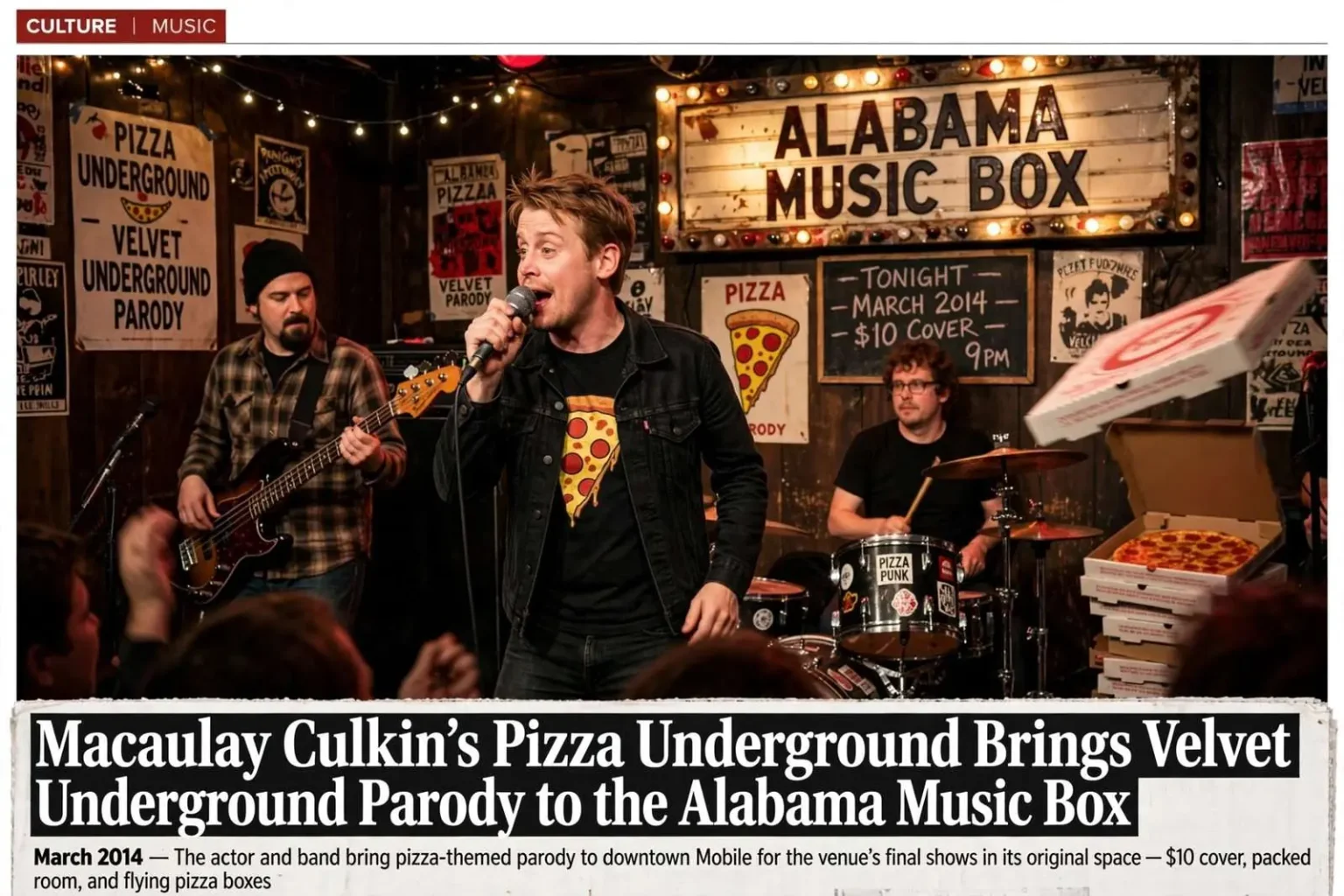
The Alabama Music Box hosted one of its more unlikely bookings in March 2014: the Pizza Underground, a New York band devoted equally to pizza and to the Velvet Underground, with actor Macaulay Culkin among its members. The 9 p.m. show carried a $10 cover, and it brought to downtown Mobile one of the strangest pop-culture phenomena of the moment — a comedy-music project whose fame rested entirely on the collision between a legendary rock band and a beloved food.
The band’s concept is exactly what it sounds like — the group performs Velvet Underground songs with the lyrics swapped out for fond commentary on pizza. “I’m Waiting for the Man” becomes a song about waiting for a delivery; Lou Reed’s deadpan drawl is recast as a meditation on cheese and toppings. The joke sounds thin on paper and, by all accounts of the band’s run, was exactly as ridiculous in practice — which was the point. The Pizza Underground was not a tribute act but a parody, delivered with just enough musical competence to make the absurdity land.
The gimmick made the group a national curiosity, and rumors swirled before the Mobile show that boxes of pizza might go crowd-surfing through the venue during the set. The anticipation fit the band’s live reputation: shows that doubled as comedy performances, audience participation baked in, and an atmosphere where the line between concert and party dissolved. For a downtown Mobile club, the booking promised a night unlike anything else on the spring calendar.
How the Pizza Underground happened
The project grew out of New York’s downtown comedy and music scene, where Culkin — best known for the “Home Alone” films that made him one of the most famous child actors in movie history — had been circling back toward creative work on his own terms. The Pizza Underground assembled around him a group of musicians and comedians, and the band’s early videos and live performances spread quickly online, propelled by the sheer improbability of the premise and the genuine affection for the source material underneath the jokes.
Parody of the Velvet Underground carries a particular charge. The original band — Lou Reed, John Cale, Nico and company — is one of rock history’s most revered institutions, a group whose small recorded catalog cast a shadow over decades of alternative music. Sending up a band that solemn is a high-wire act: the parody works only if the audience can hear the original underneath it, and only if the performers’ affection for the material is evident. The Pizza Underground’s national attention came from managing both, at least for the stretch of shows that made up its moment.
Culkin’s presence was, of course, the engine of the attention. A former blockbuster star performing in clubs at a $10 cover is a story in itself, and his willingness to appear in small rooms — Mobile among them — gave the tour an every-night-is-intimate quality that bigger productions cannot replicate. For the Alabama Music Box, having him on the stage was the kind of booking that generates talk for years afterward.
A stacked undercard
A stacked undercard rounded out the night, including Toby Goodshank, the Jackblind Band and the Super Nice Bros, the latter known for live shows that never go the same way twice. Goodshank, a New York singer-songwriter and guitarist with roots in the anti-folk scene, shared scene connections with the headliners and brought the kind of clever, unpolished songwriting that suits a room built for discovery rather than spectacle.
The undercard’s depth mattered for the local audience. Club shows built around a novelty headliner can feel like a one-act evening, but a bill with three additional acts turned the night into a full program of independent music — the kind of lineup that rewards arriving early and staying late. The Super Nice Bros’ reputation for never repeating a show gave regulars a reason to treat the night as unrepeatable, which, as it turned out, fit the venue’s own situation exactly.
The end of an era for the Alabama Music Box
The date also carried some local significance: it was one of the last shows scheduled for the Alabama Music Box’s original venue space, giving Mobile fans a final chance to catch a show in the room before the change. Venues accumulate memory the way bands accumulate catalogs — night by night, show by show — and the closing of an original room is a genuine event for the community that spent its weekends there.
For downtown Mobile, the Alabama Music Box had functioned for years as the place where touring indie and alternative acts actually stopped — a mid-sized room willing to book acts that bigger venues passed on, from national touring bands to the strange and small. Its booking history read like a map of two decades of independent music, and its impending move out of the original space gave every remaining date a valedictory air: regulars came not just for the bands but to say goodbye to a room where they had seen them.
The Pizza Underground was, in that light, a fitting sendoff act — a show that no one would describe as ordinary, in a room that had made its name by not being ordinary. The $10 cover kept the door accessible, the 9 p.m. start made it a proper late night, and the rumor mill about flying pizza boxes gave the closing stretch of shows exactly the energy a farewell run wants: the sense that anything might happen and frequently would.
What the crowd got for ten dollars
A $10 cover for a bill featuring a nationally famous actor, a New York anti-folk veteran, and three additional acts is the kind of value that defines small-venue culture. Club economics run on thin margins: door splits, bar sales, and the willingness of touring bands to play for gas money and a place to sleep. Nights like this one worked because the acts wanted to play the room and the room wanted to host them, and because enough local fans understood that showing up is what keeps such bookings coming.
The crowd that filled the Music Box that night got the full small-club experience: comedians between songs, bands watching each other from the back of the room, and the possibility — rumored, at least — of pizza boxes sailing overhead during the finale. Whatever actually flew, the show delivered what the venue had always traded in: a night that could not have happened anywhere else, at the very end of the room’s run on its original address.
Mobile’s small-venue tradition
The Alabama Music Box’s original space belongs to a long local tradition of rooms that punch above their weight — downtown clubs and bars that give touring acts a reason to route through the Gulf Coast and give local bands a stage to grow on. Every city that keeps original music alive does so through venues like it, and their comings and goings are the true measure of a scene’s health. The original room’s final shows, with the Pizza Underground among them, closed one chapter while the booking calendar promised another.
For the fans who attended, the March 2014 date has aged into exactly the kind of show people claim to have been at: the movie star singing about pizza, the national curiosity in a small Mobile room, the last nights of a beloved space. Some of that is the glow of hindsight, but the underlying facts were real — a stacked bill, a ten-dollar door, a packed room, and a venue change that made the ordinary act of seeing a show feel like an occasion. Not a bad way for a room to go out.
Macaulay Culkin’s second act
Part of what made the night compelling was the figure at its center. Culkin’s path — from the most famous child actor of his generation to a semi-retired presence in New York’s downtown scene — had already been the subject of years of public fascination by the time the Pizza Underground toured. Rather than attempt a conventional comeback, he leaned into projects that treated his own fame as material: small bands, comedy stages, and cameos that traded on the audience’s memory of him without being imprisoned by it.
For audiences in cities like Mobile — markets that national tours often skip — the tour brought a genuinely surreal experience: a household name, on a small stage, a few feet from the crowd, singing reworked Velvet Underground lyrics about cheese. The intimacy is the point of club shows, and it is rarely more pronounced than when the performer is someone the audience grew up watching on screen. The $10 cover bought that proximity, which is the kind of memory a small venue can deliver and an arena never can.
The Velvet Underground connection
The choice of the Velvet Underground as the parody target also connected the Mobile show to a broader musical lineage. The Velvet Underground’s influence runs through punk, indie, and alternative music — the famous observation that the band sold few records but everyone who heard one started a band captures the point. Its songs’ simple structures and dry delivery made them unusually parodiable, and generations of comedians and bands have bent them to comic ends. The Pizza Underground was the most widely seen of those efforts, precisely because of who was performing it.
For younger fans in the crowd, the show may even have served as an introduction — a doorway through which the original band’s music became worth hearing. Parody has always worked that way, from “Weird Al” onward: the joke brings the audience in, and some of them stay for the source. If a Mobile crowd walked out of the Music Box that night with “I’m Waiting for the Man” stuck in their heads — in either version — the show did its cultural work twice.
A night that summarized the room
Looking back, the March 2014 date compressed everything the Alabama Music Box’s original space stood for into a single evening: adventurous booking, a national act in an intimate room, a deep undercard of touring and local talent, and a crowd that showed up because the city’s independent music scene asked it to. The venue’s move from its original space did not end the institution — the Music Box continued under new arrangements — but it ended a place, and places are what music memories attach to.
The Pizza Underground’s own run, like the room’s original incarnation, proved finite: the band toured its novelty hard, drew headlines both amused and hostile, and eventually wound down as Culkin moved to other projects. But on that March night in Mobile, the joke was fresh, the room was full, and the cover was ten dollars — one of the last, strangest nights in the history of a venue space that Mobile’s music community had filled for years, and one it remembered long after the last box of pizza stopped flying.