
Manta Ray Makes Rare Appearance Near Dauphin Island
A roughly 30-foot manta ray was spotted gliding through the Gulf of Mexico about five miles south of Dauphin Island, delighting a father and daughter on.
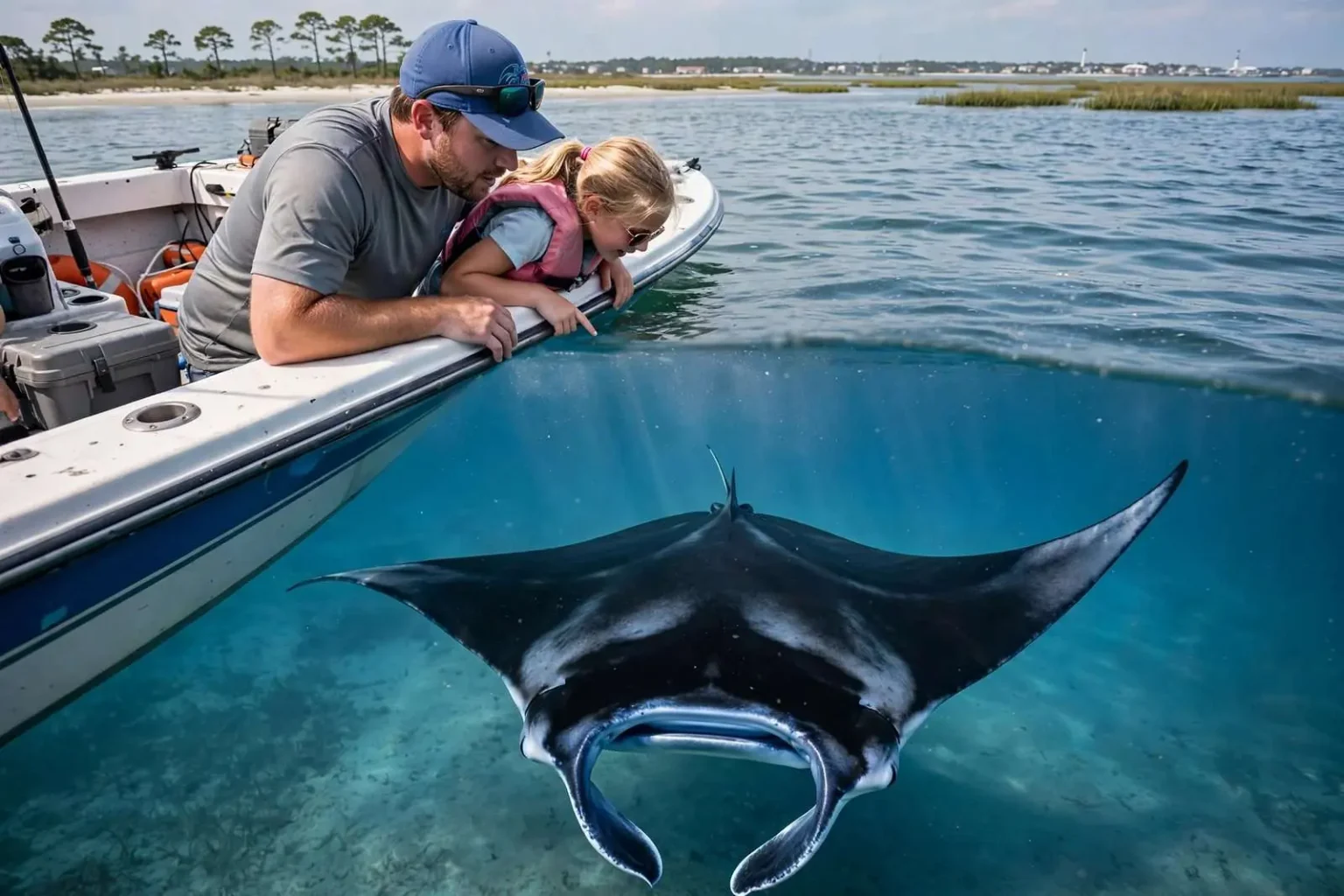
A manta ray measuring an estimated 30 feet across was seen gliding through the Gulf of Mexico about five miles south of Dauphin Island on Monday. Camden Brown and his daughter, Braylee, were out on the water around noon when they spotted the animal, an encounter they are unlikely to forget anytime soon.
Video captured from their boat shows the giant ray moving through the Gulf as the pair reacted in amazement, the animal’s massive wings unfurling as it slipped through the clear coastal water. “We were shocked to see such a huge ray,” Brown said. “It was definitely a day to remember.”
Manta rays are rarely seen so close to Alabama’s barrier islands, making the sighting a memorable one for the father and daughter enjoying a day on the water. While the species does range throughout the Gulf of Mexico, encounters close to shore along the Alabama coast are uncommon enough that boaters who spend years on the water may never see one.
A remarkable animal of the open Gulf
The manta ray is the largest species of ray in the world, and among the largest of all ocean fish. Adult mantas can reach wingspans that rival small boats, with broad, wing-like pectoral fins, a wide terminal mouth at the front of the head, and two cephalic fins that curl forward to help funnel food. Their topsides are typically dark black or charcoal blue, contrasting with white undersides that can carry distinctive spot patterns unique to each individual.
Despite their enormous size, manta rays pose no danger to people. They are filter feeders, swimming with their mouths open to strain plankton, small fish and tiny crustaceans from the water. They have no barbed stinger like the stingrays more familiar to Gulf beachgoers, and no means of attacking anything larger than the microscopic prey they pursue. Their size alone is their principal defense.
Mantas are found in tropical and subtropical waters around the world, and the Gulf of Mexico sits within their broader range. They are most often spotted in open water or near productive feeding areas where currents concentrate plankton, which helps explain why an encounter five miles off Dauphin Island would stand out even to seasoned anglers and boaters.
Unlike many fish, manta rays give birth to live young, usually one pup at a time after a gestation that lasts about a year. They are known for their curiosity around boats and divers, sometimes approaching slowly to glide through bubbles or investigate swimmers, and they can leap fully out of the water — a behavior scientists still do not entirely understand.
Scientists consider manta rays a slow-growing, vulnerable species. They mature late, produce very few young over their lifetimes and are protected in a growing number of jurisdictions. Sightings by boaters and fishermen are of genuine interest to researchers, who use photographs and videos — including the distinctive spot patterns on each animal’s underside — to track individuals and better understand where the rays travel.
The waters off Dauphin Island
Dauphin Island sits at the mouth of Mobile Bay, a barrier island that shields the Alabama mainland from the open Gulf. The waters just south of the island drop off toward deeper Gulf water, and the mixing of bay outflow, coastal currents and open Gulf creates a rich environment for marine life, from bait schools and game fish to sea turtles, dolphins and, on rare occasions, large visitors like the manta ray spotted Monday.
The island has long been Alabama’s front-row seat to the Gulf. The Dauphin Island Bridge carries residents and visitors across the sound from the mainland, and the Audubon Bird Sanctuary on the island’s east end makes it a stop for migratory birds as well as marine life watchers. Fort Gaines, guarding the eastern tip of the island, has watched over the same waters since the Civil War era, when the Battle of Mobile Bay played out within sight of its walls.
The island itself is a familiar destination for Mobile-area families, with a public beach, fishing pier, historic Fort Gaines and a tight-knit community of year-round residents. Boating out of the island’s ramps and marinas toward the Gulf is a routine pastime, and a weekday trip like the Browns’ — out around noon on calm water — is the kind of outing that fills the summer calendar for coastal families across south Alabama.
Five miles offshore, boaters leave the busy near-shore zone behind and reach water where larger pelagic life is more likely to appear. Anglers working that depth regularly encounter sea turtles, tarpon, cobia and sharks; a manta ray, though, is a sighting most boaters would classify as exceptional.
A father-daughter day on the water
The Browns’ encounter was captured entirely by chance, and it is the kind of moment that boaters along the Alabama coast describe as the reward for simply being out there. Mobile Bay and the nearshore Gulf are working waters as much as playgrounds — commercial fishing boats, charter captains, research vessels from the Dauphin Island Sea Lab and recreational anglers all share the same stretch of water — but an animal the size of the ray seen Monday stops everyone in their tracks.
The video of the animal shows the ray moving with unhurried, almost weightless grace, the kind of footage that marine educators often use to illustrate how little most people see of the Gulf’s open-water life. For every dolphin pacing a boat’s wake, there are far more elusive animals — whale sharks, manta rays, billfish — passing through the same waters largely unseen.
Rare but not unprecedented along the northern Gulf Coast
Large ray sightings along the northern Gulf Coast do occur, particularly in warmer months when plankton-rich conditions draw feeding activity closer to the coast. Fishermen working around shrimp boats and surface bait schools occasionally report giant rays gliding past the boat, and underwater cameras deployed near artificial reefs have documented mantas passing through Alabama’s offshore waters.
Still, the vast majority of residents and visitors will only ever see manta rays in aquariums or documentary footage, which is why the Browns’ video is likely to draw wide attention. The animal appeared healthy and unbothered by the boat’s presence, gliding on its way after the pair had their look.
The sighting also lands in a stretch of the year when Dauphin Island’s waters are at their busiest. Cobia migrate past the island each spring, shrimp boats work the nearshore grounds, and the ferry that links the island to Fort Morgan crosses the mouth of the bay daily. Every one of those vessels passes through water that can, without warning, produce a sight like the one the Browns captured.
Boaters who do encounter large marine animals are encouraged to keep their distance, avoid chasing or encircling the animal, and cut their engines if a ray or whale surfaces nearby. Disturbing protected marine life can carry federal consequences, and calm, slow observation is both the legal approach and the one most likely to produce the best encounter — and the best video.
The rays’ feeding behavior adds to the spectacle when it happens near the surface. A manta in feeding mode will swim with its cephalic fins flared wide, scooping plankton-dense water into its mouth and out through its gill plates in a steady current. When currents and tides concentrate food, the animals can linger in an area for hours or days before moving on with the flow.
Monday’s visitor, by all appearances, was simply passing through.
Why encounters like this matter
Sightings like Monday’s give researchers a small but valuable data point about the presence of large marine life in Alabama’s nearshore Gulf. The Dauphin Island Sea Lab, the state’s marine science facility located on the island, has long studied the Gulf’s coastal ecosystems, and public reports of unusual animals often help scientists fill gaps in what is known about species’ movements.
For everyone else, the sighting is a reminder of what swims through the waters just beyond the sandbars of Alabama’s coastline. The Gulf off Dauphin Island supports an extraordinary range of life, from the speckled trout and flounder in the bay to the giants of the open water, and on a mild Monday afternoon a Mobile-area father and daughter got to see one of its largest residents up close — no aquarium ticket required.
As for the Browns, they have the video to prove their story, and a memory Braylee can carry with her: the day a 30-foot manta ray came gliding out of the blue, five miles south of Dauphin Island, and turned an ordinary family boat ride into the kind of day people fish and cruise these waters for years hoping to have.


