

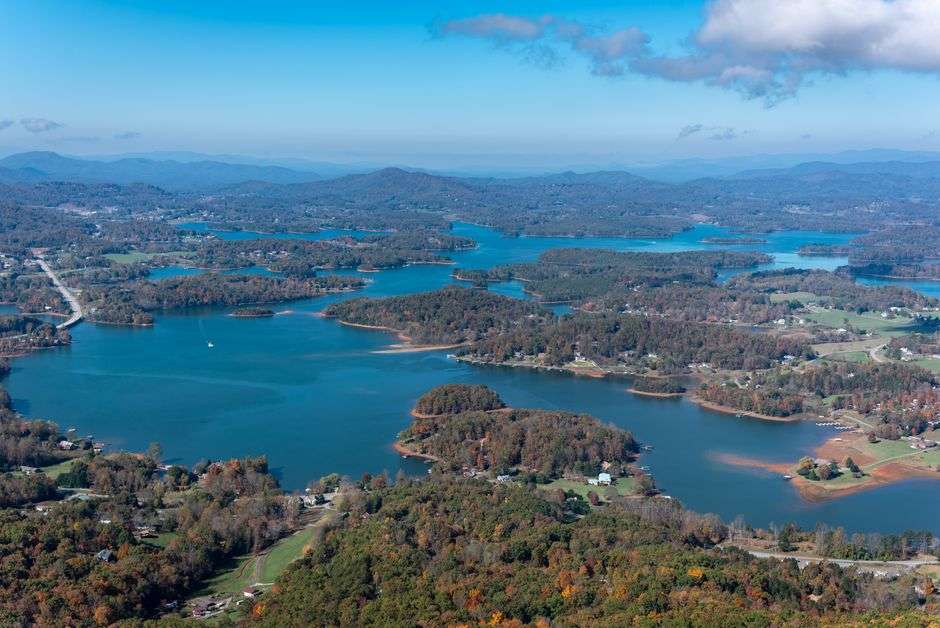
Six and a half hours north of Fairhope, tucked into the folds of the north Georgia mountains, there is a town whose very name is an invitation to slow down. Ellijay is an anglicized form of a Cherokee word often rendered as “many waters,” and it is an apt description: the town sits at the spot where the Ellijay and Cartecay Rivers meet to form the Coosawattee. Water is everywhere here, moving fast and cold through the mountains, and it shapes nearly everything a visitor does.
I went to Ellijay with a simple goal: give my grandchildren a week of out-of-the-ordinary experiences. I rented a cabin through Mountain Oasis, a local rental company, perched above the Coosawattee River, and invited my family to join me. What followed was a week of fishing, tubing, orchards, small-town squares, and more wildlife than any of us expected, in a corner of Georgia that rewards travelers who make the drive.
A Town Built Where the Rivers Meet
It is impossible to understand Ellijay without starting with its water and its first people. The area was a Cherokee village long before it was a town, a trading center at the confluence of the two rivers. The name Ellijay is thought to derive from the Cherokee word Elatseyi, which various sources translate as “new ground,” “place of green things,” or “many waters.” All three feel right in a landscape this lush.
Gilmer County was carved out of the original Cherokee County in 1832, and on December 29, 1834, Ellijay was officially incorporated and designated the county seat. The town remained a fairly remote mountain community until the railroad arrived in 1884, bringing growth, hotels, and industry. A fire in 1912 destroyed much of downtown, and the brick buildings that replaced it still ring the courthouse square today. By the 1920s, apples were shipping out of the county in volume, and the region’s reputation was sealed.
That reputation has a name locals wear proudly: Ellijay is Georgia’s Apple Capital. Gilmer County’s rolling orchard country produces the majority of the state’s commercial apple crop, and heritage apple orchards are everywhere once you start looking. Each October the town hosts the Georgia Apple Festival, a celebration that draws thousands of visitors for crafts, food, and, of course, apples in every conceivable form. Former President Jimmy Carter even kept a log-cabin second home in the area, a detail locals mention with quiet pride.
The Cabin on the River
The cabin itself turned out to be half the experience. It belongs to my cousin’s wife, Amanda Bacon, who owns The Garage, a boutique in Point Clear, and her flair for design shows in every room. The decor is earthy and warm, the kind of space that makes you want to sit down with a cup of coffee and stay a while. Every amenity we could have wanted was there, but honestly, the porch did most of the work.
We spent long stretches of our week simply sitting on that huge porch, watching the river move below us and letting the week’s accumulated stress drain away. There is a name for this that has migrated from Japanese wellness culture into American travel vocabulary: forest bathing, or shinrin-yoku. Developed in Japan in the 1980s as a preventative health practice, it is the simple art of spending deliberate, unhurried time among trees. Researchers have linked it to lower stress levels, improved mood and concentration, and even measurable benefits for blood pressure and immune function. Whether or not you call it anything, the effect is real. By day three, everyone in the family had visibly exhaled.
Wildlife Neighbors
The cabin came with company. Each morning and evening, gentle white-tailed deer emerged from the trees to feed on corn we put out for them, close enough to watch from the porch. My two grandchildren, ages 9 and 6, appointed themselves the official naming committee, and their choices were memorable: Deerie, and a doe they dubbed Betty Whitetail. Beyond the porch, we spotted fawns, does, and bucks all over the mountain, along with Canada geese, ducks, and one bear cub that my oldest daughter was lucky enough to glimpse. In this part of north Georgia, black bears are a normal part of the landscape, and seeing one from a safe distance became the trip’s biggest bragging right.
Fishing Lake Blue Ridge
For the centerpiece of the week, I booked a fishing trip on Lake Blue Ridge with Lake and Stream Guide Service. Captain Eric spent four hours with our crew, working the water for walleye and trout and keeping three generations of anglers entertained the whole time. Lake Blue Ridge is a 3,290-acre Tennessee Valley Authority reservoir stretching eleven miles through the Chattahoochee National Forest, with roughly 65 miles of shoreline, most of it undeveloped forest land. It is one of the most strikingly clear lakes in Georgia, with water that reads almost aquamarine on a sunny day.
The lake is a genuinely famous fishery. Anglers come for walleye, largemouth and smallmouth bass, bream, perch, catfish, and trout, and the town of Blue Ridge has been called Georgia’s trout capital. The dam that creates the lake has history of its own: built on the Toccoa River in 1930 by the Toccoa Electric Power Company, it was the largest earthen dam in the Southeast at the time, and the TVA purchased it in 1939 for hydroelectric power production.
Our results were better than any of us had a right to expect. Each of my grandchildren boated a huge channel catfish, and my youngest daughter and I each landed a walleye. Captain Eric made the children feel like world champions, telling them their catch-and-release catfish were among the biggest in the lake and probably record-setting. Whether or not the record books will ever agree, the memory certainly will. The filleted walleye came home with us and made a fine dinner, which might be the most satisfying way possible to end a fishing day.
Tubing the Toccoa
If the fishing trip was the trip’s centerpiece, the tubing run was its loudest, splashiest highlight. About 45 minutes from Ellijay, Toccoa Valley Campground outfitted our crew with bright pink tubes and shuttled us to the put-in on the Toccoa River. The Toccoa is the headwater of the famous Ocoee River, whose whitewater rafting course hosted the 1996 Olympic Games; the name simply changes when the river crosses the Tennessee state line. Above the Blue Ridge impoundment, it runs like a large, lively trout stream, and it has become one of the region’s favorite tubing, kayaking, and canoeing rivers, with TVA-controlled dam releases keeping the flow reliable through the summer.
For more than two hours we laughed and screamed every time the current dropped us into a rapid or pinned a tube against a boulder. The river is fast-running and cold, and the water was high enough to keep things interesting without ever feeling dangerous for a family trip. My granddaughter delivered the definitive review: it was more fun than a roller coaster, and she has ridden plenty of them. When you are planning a summer outing that will occupy both a 6-year-old and a 9-year-old for an entire afternoon, that is exactly the endorsement you are looking for.
Apples, Peaches, and Hand Pies
On the drive back to Ellijay from the river, we stopped at R and A Orchards, a family-run farm with 60 acres of apples and 10 acres of peaches. We left with a jug of fresh apple cider, a bag of Georgia peaches, and a stack of peach hand pies that did not survive the trip back to the cabin. Farm markets like this one are scattered all across Gilmer County, and in September the orchards begin their slow shift from summer to harvest season. If you can time a visit to October, the Georgia Apple Festival adds crafts, music, and fried pies to the mix; if you cannot, the roadside orchard stands are reward enough.
Downtown Ellijay and Blue Ridge
Ellijay’s historic downtown is small and endearing, with shops and restaurants gathered around a courthouse square, all of it walkable in an afternoon. We had lunch one day at Cantaberry Restaurant, a local favorite, and dinner another evening at The Roof Ellijay, which looks out over the town. Coffee shops, ice cream parlors, and pizza places round out the options, the essential infrastructure of any town that takes tourism seriously. What the downtown lacks in size it makes up for in charm, and the brick storefronts rebuilt after the 1912 fire give it a cohesion newer towns cannot fake.
Twenty minutes north, the town of Blue Ridge offers a bigger stage. Its downtown has developed into a genuine destination, with a thriving artistic community, craft breweries, and restaurants dotting the walkable center. Antique trains depart from the restored 1906 depot, carrying passengers along the Blue Ridge Scenic Railway through mountain countryside to the twin towns of McCaysville, Georgia, and Copperhill, Tennessee. We simply ran out of week before we ran out of things to do, and the scenic railway went untried, which is as good a reason as any to plan a return trip.
Planning Your Own Escape
Between the cabin rental companies, guide services, tube outfitters, and orchards, Ellijay has quietly built a complete mountain-getaway economy without losing its small-town feel. Autumn is the signature season, when the hills turn and the apple harvest peaks, but our late-summer week proved the case for the warmer months: cold rivers, full lake days, and porches made for doing nothing at all.
The north Georgia mountains are an easy getaway from the Alabama Gulf Coast, only about six and a half hours from Fairhope by car, and the route rolls beautifully once you leave the interstate behind. I came home with cider and peaches, grandchildren who now consider themselves veteran anglers and tubers, and a list of things we saved for next time, including the hiking trails and waterfalls we never got to. For more ideas on where to go and what to see, Explore Georgia is a good starting point for planning an adventure-filled holiday in the mountains.