Matisyahu Brings a New Look and Spark Seeker Material Back to Mobile’s Soul Kitchen
Matisyahu brought his Spark Seeker tour to Mobile's Soul Kitchen Music Hall on Aug. 27, 2012, with a clean-shaven look plus The Dirty Heads and Moon Taxi.
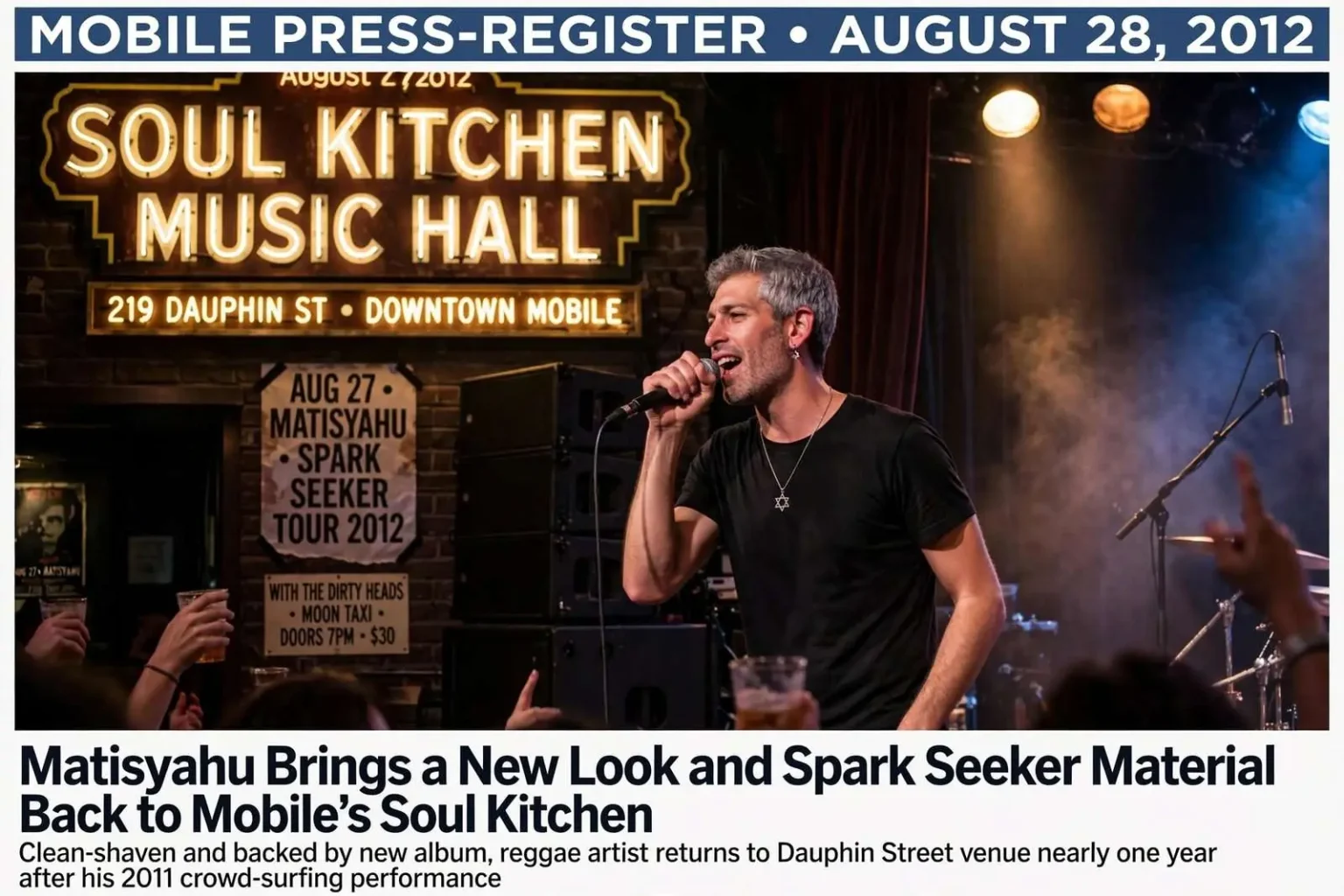
Reggae artist Matisyahu returned to the Soul Kitchen Music Hall in downtown Mobile on Monday, August 27, 2012, nearly one year to the day after a packed 2011 show at the Dauphin Street venue that ended with the singer riding atop the audience to touch the disco ball on the ceiling. The return gave the club one of its most anticipated bookings of the year, and it came at a moment of visible change for an artist whose look had long been as recognizable as his music.
For Mobile audiences, the timing carried its own significance. The 2011 performance had become the kind of show regulars retell — an intimate room, an artist willing to blur the line between performer and crowd, and a finale that literally reached for the ceiling. When the 2012 date was announced, fans who had been in the room the year before, and plenty who had only heard about it, made sure the return did not pass quietly.
How Matisyahu broke through
The performer first broke through nationally in 2005 with the single “King Without a Crown” from his major-label debut album “Youth,” which entered the Billboard 200 at number four and was later certified gold. The song’s blend of reggae rhythm, beatboxing and devotional lyrics made it a radio staple and introduced Matisyahu to an audience far beyond the Jewish music scene where he had begun.
His profile grew further when “One Day,” from his third album “Light,” was chosen as the theme for NBC’s countdown coverage of the 2010 Winter Olympics. The placement put the song in front of a massive television audience during one of the most-watched events of the year, and it cemented Matisyahu’s standing as an artist whose messages of unity and hope could travel well beyond reggae’s traditional base. By the time of the Mobile return, he had spent nearly a decade touring nationally, moving between festival main stages and rooms the size of the Soul Kitchen.
The 2011 stop in Mobile had served a practical purpose as well as an entertaining one. When he last played Mobile, Matisyahu used the Soul Kitchen stage to try out songs for what became his 2012 album “Spark Seeker,” including the single “Sunshine.” Fans at Monday’s show expected more of that material as the album tour rolled through the Port City — a chance to hear songs that had been sketched in the same room months earlier, now fully formed and recorded.
A familiar face with a new look
Concertgoers noticed one immediate difference: Matisyahu’s signature beard was gone. The artist, who spent much of his career performing as an Orthodox Jew — beard, yarmulke and a touring schedule built around the Sabbath and daily prayers — shaved the beard earlier in 2012, drawing commentary in some Jewish religious communities. For more than seven years the beard had been part of the public image, appearing on album covers and in promotional photos, so its absence read as a genuine visual reset rather than a small grooming choice.
In a message posted on Twitter, he framed the change as part of a personal journey rather than a rejection of his past: becoming religious ten years earlier had been his own natural choice, he wrote, adding, “I am reclaiming myself.” The statement was widely shared and widely discussed, in part because Matisyahu had always framed his religious path as something he chose rather than inherited. The shaving, by that account, was not an abandonment of belief but a reclaiming of authorship over his own life — a distinction he took care to draw himself rather than leave to commentators.
Whatever the theological debate, the music kept moving forward. “Spark Seeker” leaned into a brighter, more open sound than its predecessors, and songs like “Sunshine” carried a radio-ready optimism that suited a tour of clubs and festivals alike. The Soul Kitchen date, coming as the album tour worked its way through the region, sat at the intersection of those two worlds: a room small enough to feel the bass in the floor, playing material built for much larger spaces.
Deep festival roots
Matisyahu’s festival roots run deep. As a teenager he followed Phish on tour around the country — years he has described openly as including marijuana and hallucinogen use — and he later joined Phish frontman Trey Anastasio onstage at Bonnaroo in 2005. Those years on the jam-band circuit shaped more than his habits; they shaped his sense of what a live show could be. The extended improvisation, the willingness to let a song breathe past its recorded length, and the intimacy between a touring act and fans who follow it from city to city all trace back to that apprenticeship on Phish lots and in Phish crowds.
He has credited his parents’ record collection for his early musical education; his first concert, he has said, was the Grateful Dead, and his first exposure to reggae came through Bob Marley. That lineage — the free-form exploration of the Dead, the spiritual directness of Marley — runs through his catalog in a way audiences could hear at the Soul Kitchen, where a Matisyahu set could move from toasting over a dub rhythm into a wordless vocal passage and back without ever feeling like two different shows.
By 2012 the artist who had arrived in Mobile as a curiosity — a Hasidic reggae singer, an image the press never tired of describing — had spent years working to be heard simply as a musician. The new album, the new look and the return to a club he had already proven he could fill all pointed the same direction: toward a career defined by the music rather than the beard.
The bill around him
Monday’s bill also featured two touring acts: California reggae-rock band The Dirty Heads, known for the hit “Lay Me Down,” recorded with Rome Romirez of Sublime with Rome, and Nashville five-piece Moon Taxi, a fixture on the national festival circuit. The pairing gave the night the shape of a festival lineup compressed into one evening — reggae-rock singalongs from the Dirty Heads, the bright, danceable indie-rock of Moon Taxi, and a headliner whose set could reach back across his whole catalog.
For local fans, the undercard mattered. Both touring acts had built their followings on the road, and both had a history of turning club dates into parties — the kind of opening slots that send an audience home talking about the whole night rather than just the headliner. The Dirty Heads brought a West Coast strain of reggae-rock that had been climbing alternative radio, while Moon Taxi represented Nashville’s stretch beyond its country-songwriter reputation toward broader indie territory.
The venue and the night
The Soul Kitchen Music Hall is located at 219 Dauphin Street in downtown Mobile. Tickets were $30 the day of the show. The room has become one of the key stops for touring acts passing through the Gulf Coast between New Orleans and the Florida panhandle, sized just large enough to draw national bookings while staying small enough that a headliner can end a night riding atop the crowd, as Matisyahu did in 2011.
Dauphin Street itself has long been the center of downtown Mobile’s nightlife, and a Monday show at the Soul Kitchen gave the corridor a mid-week-level crowd on a night when many clubs sit quiet. Downtown businesses — bars, restaurants and the shops that stay open late — benefit when a national act books the room, and regulars have learned to check the club’s schedule for exactly these mid-tour stops that land on unconventional nights.
The near-exact one-year spacing between the two Mobile shows suggested the relationship between artist and venue was no accident. Touring acts tend to return to rooms that treated them well, and a packed house that ends with a performer climbing onto the audience’s hands is the kind of memory that makes a city a regular stop rather than a one-time drive-through.
For the fans who filled the floor on Monday night, the show offered a double view of a career in motion: the songs from “Spark Seeker” that had first been heard in the same room a year earlier, now in their finished form, and a performer visibly stepping into a new phase — clean-shaven, still bearded in spirit with his faith and his history, and openly reclaiming himself on his own terms.
The events described in this report connect to broader patterns across the Gulf Coast region, where a growing live-music circuit continues to bring national touring acts through mid-sized rooms in Mobile, Pensacola and the Baldwin County beach towns. Local venues, promoters and the fans who show up on weeknights all play roles in sustaining that circuit. The outcomes of these efforts will shape the region’s cultural life, and Monday’s sold-out-energy crowd on Dauphin Street was the latest evidence that the Port City shows up for the artists it loves.