Consultants Enlisted to Steer BP Claims for Coastal Communities
A state consulting firm hired to help BP navigate its dealings with governments turned to familiar Gulf Coast hands, including Grand Bay's Taylor Harper, to coordinate communications for Dauphin Island and Bayou la Batre.
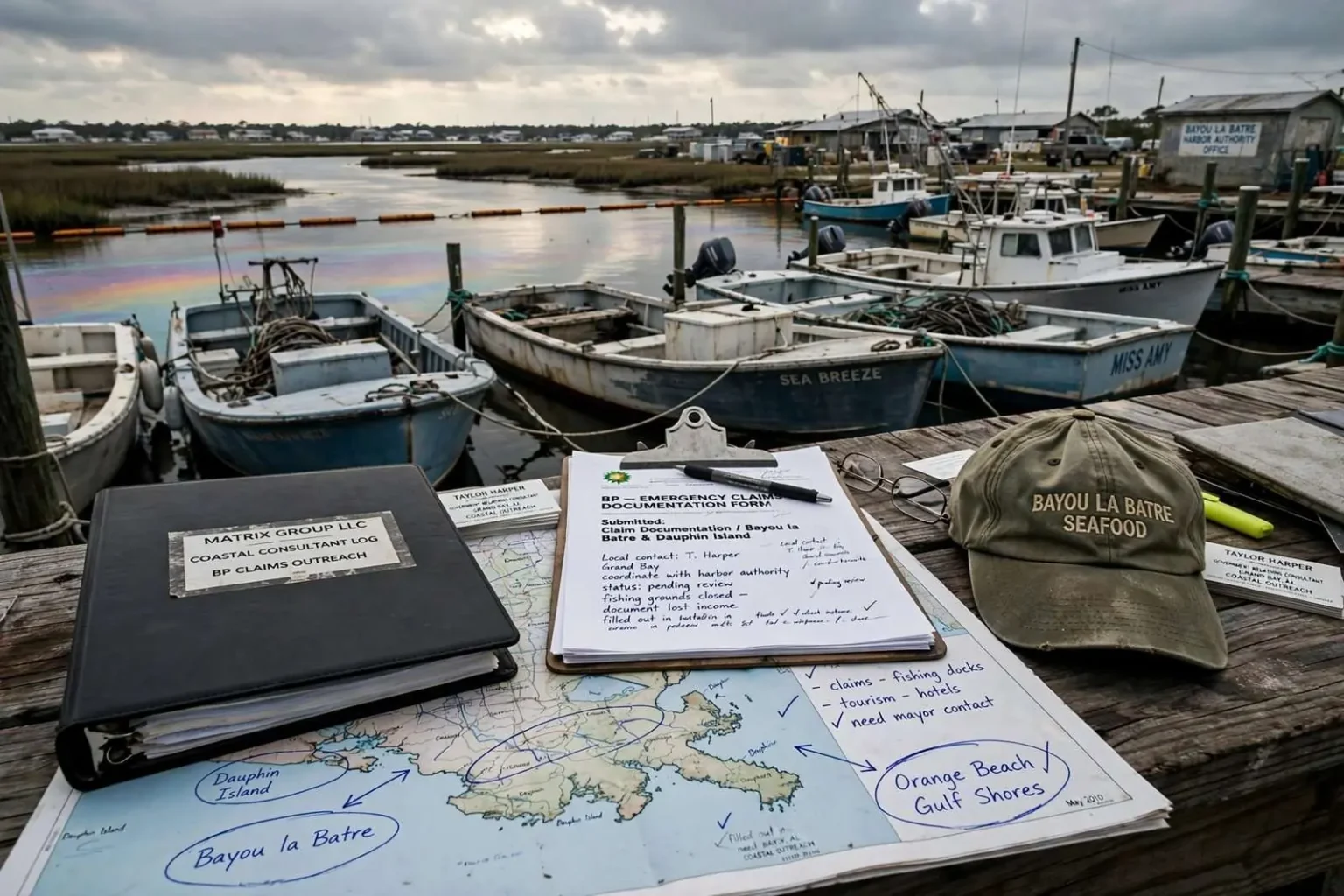
As BP grappled with the fallout from the Deepwater Horizon disaster, a state political consulting and communications firm engaged to assist the oil giant reached for hands who knew the Alabama coast, including a veteran lobbyist from Grand Bay assigned to look after Dauphin Island and Bayou la Batre.
A Chain of Subcontractors
The firm, Matrix Group LLC, had been brought in to help BP manage its dealings with various governments in the wake of the April 20 rig explosion, the resulting spill, the cleanup effort and the damage claims process. Matrix, in turn, subcontracted with several governmental relations specialists, among them Taylor Harper of Grand Bay and Martin Christie, formerly of the Business Council of Alabama.
Harper, who had lobbied the state Legislature for many years, described his assignment as less lobbying than translation, connecting elected officials with a corporation suddenly at the center of the region’s life.
“Joe Perkins retained me to look after Dauphin Island and Bayou la Batre,” Harper said, referring to the Matrix founder. “I’m not really a lobbyist in this situation. I coordinate with the parties on questions and report up the chain of command, up the BP pipeline.” Christie, meanwhile, was handling the Orange Beach and Gulf Shores area.
The division of territory tracked the different problems each community faced. Dauphin Island and Bayou La Batre — the fishing villages and barrier-island communities of south Mobile County — were grappling with closed fishing grounds, dockside business that had stopped dead, and questions about how losses would be documented and paid. Orange Beach and Gulf Shores, the tourism economies of Baldwin County, were staring at a summer season in doubt, with charter boats tied up, condominium bookings wavering and municipal budgets built on visitor revenue suddenly at risk. One consultant could not credibly serve both shores, so the assignment was split along the lines the coast itself knows.
Knowing the Ground
Harper, a former Democratic legislator who once chaired the House Ways and Means Committee, argued that local knowledge was exactly what an outside corporation lacked. To expect someone from BP corporate headquarters to arrive cold and understand a place like Dauphin Island, he said, would be asking a great deal.
“Dauphin Island in its uniqueness isn’t easy for an outsider to navigate,” Harper said. “You’ve got the Town of Dauphin Island, the Park and Beach Board, the Water and Sewer Authority and the property owners association, four entities and separate from one and another. The way it is set up lends itself to confusion if you don’t know your way around. When you go over that bridge, it’s not like going to Orange Beach.”
That patchwork of local bodies, each with its own authority, illustrated why the claims and communications process on the coast required someone able to move among them.
The point generalized across the coast. Bayou La Batre’s city government, its harbor authority relationships and its deeply rooted seafood processing families formed another network no corporate org chart anticipated; Gulf Shores and Orange Beach ran through city councils, tourism bureaus and a chamber structure that spoke for hundreds of small hospitality businesses. A claims process designed in a corporate headquarters could function perfectly well in theory and still fail in practice if it asked the wrong entity for the right signature. Harper’s job, as he described it, was to keep those mismatches from happening — to know which office actually answered for the fishing fleet, which board actually controlled the public beach, and whom to call when a mayor needed an answer before the council meeting.
His own route to that knowledge ran through decades of statehouse work. Harper represented southwest Alabama in the Legislature before moving to the lobbying side, and the Ways and Means chairmanship put him at the center of the budget decisions that shaped every coastal institution from schools to the deep-water port facilities. When he says crossing the Dauphin Island bridge is not like going to Orange Beach, it is the observation of someone who has spent a career on both sides of Mobile Bay.
Politics and the Pipeline
Matrix Group carried longstanding ties to Alabama Power Co. and to a range of political figures, mostly Democrats, and it maintained offices in Jackson, Mississippi, as well as in Alabama. But the firm was itself only one link in the arrangement. According to Perkins, Matrix was actually a subcontractor for a Washington firm working for BP.
“We are a contractor for a Washington firm that asked us to facilitate communication with local governmental entities and to provide suggestions on how to make the claims process more accessible and effective,” Perkins said.
The layered structure, from BP to a Washington firm to Matrix to local specialists like Harper and Christie, reflected the scale and sensitivity of the task. Coastal communities from Dauphin Island to Gulf Shores were fielding an avalanche of questions about cleanup, compensation and the future of the fishing and tourism economies, and the elected officials who represented them needed a reliable line to the company responsible for the spill.
The arrangement also reflected how a multinational corporation organizes a disaster response it cannot staff from within. BP’s spill operation drew on national response contractors, engineering firms and, for the governmental side, communication specialists arranged through existing Washington relationships. Each layer added reach and reduced direct accountability, and the specialists on the ground understood the tradeoff: their value lay in knowing the coast, and their effectiveness depended on the answers that moved down the pipeline arriving quickly and intact. Harper’s phrase — “up the BP pipeline” — captured both the mechanism and the anxiety that came with it.
For the communities involved, the critical test was never the org chart but the speed of answers. The spill’s damage was measured weekly: fishing seasons closed, charter trips canceled, seafood processors idled, reservations evaporating. A question about a claim that took a month to route through headquarters was a question answered too late. That is the gap the local contractors were hired to close — to compress the distance between a shrimp boat captain’s dock and the corporate desk where compensation was decided.
What It Meant for the Coast
For south Mobile County and Baldwin County residents, the practical hope was that the arrangement would make the claims process quicker and clearer. For the seasoned political operatives now working the coast on BP’s behalf, it was a reminder that in a crisis of this magnitude, local relationships had become as valuable as any technical expertise.
The Deepwater Horizon disaster reached Alabama through the same geography that defined it before the spill. April 20, 2010 — the date the rig exploded — fell at the front edge of the fishing season and the tourism season, the two economies that dominate the coast’s calendar and its cash flow. Bayou La Batre, immortalized in film but long known first as a shipbuilding and seafood town, had rebuilt after Hurricane Katrina only to face a summer of water it could not fish. Dauphin Island, at the mercy of every current in the Gulf, watched the forecasts for oil arriving with each tide. The western beaches of the Island and the Florida-line towns of Baldwin County faced the same uncertainty from the other side of Mobile Bay.
The claims process that grew out of the spill would become, over the months that followed, one of the largest compensation efforts in American history, and its early days were exactly the period when communication mattered most. Residents filing emergency claims needed to know what documentation would count; mayors needed to know what reimbursement the cleanup would carry; businesses weighing whether to lay off crews needed some signal about how losses would be handled. The men hired to know the coast — who to call at the Park and Beach Board, how the Water and Sewer Authority fit into the picture, who actually spoke for the property owners — were part of that machinery whether the machinery’s design was visible or not.
Judged on the Ground
Whether the arrangement ultimately worked as intended would be judged in Mobile County and Baldwin County, not in Houston or Washington, by the speed with which the checks arrived and the accuracy with which the process captured losses that did not appear on any spreadsheet — a season’s goodwill, a boat’s reputation, a town’s confidence. The consultants hired to translate for BP had, by their own account, one deliverable: a process that made sense when it crossed the bridge.
The episode also marked a notable turn in Alabama political culture. The state’s lobbying and governmental relations world — built for the budget season and the legislative session in Montgomery — found itself hired for disaster response, its skills repurposed from bill tracking to claim routing. Harper, a Democrat, and Christie, out of the Business Council of Alabama’s Republican orbit, working the same coast for the same client, illustrated how thoroughly the spill cut across the state’s usual political lines. The communities hurting did not care who had chaired which committee; they cared whether someone in the room could get a question answered this week instead of next month.
It also set a template that disaster communication specialists have studied since. When a national corporation confronts a regional catastrophe, the response structure it builds almost always reaches the ground through exactly the kind of chain BP assembled — national firms, regional firms, local operators — because no corporation carries its own inventory of trust in places like Grand Bay, Bayou La Batre and Dauphin Island. Trust is local, and the April 2010 arrangement was, in effect, BP renting it. How well the claims process worked on the receiving end, town by town, would determine whether the rent had been well spent — and for the communities south of the bridge, whether the summer of 2010 would be remembered as the season the pipeline finally delivered.