Mobile County Names Kegley, Mitchell to Lead Reorganized Engineering, Public Works Departments
Mobile County commissioners have promoted longtime staff engineers Bryan Kegley and Ricky Mitchell to lead the county's newly restructured engineering and public works departments, capping an 18-month reorganization effort.
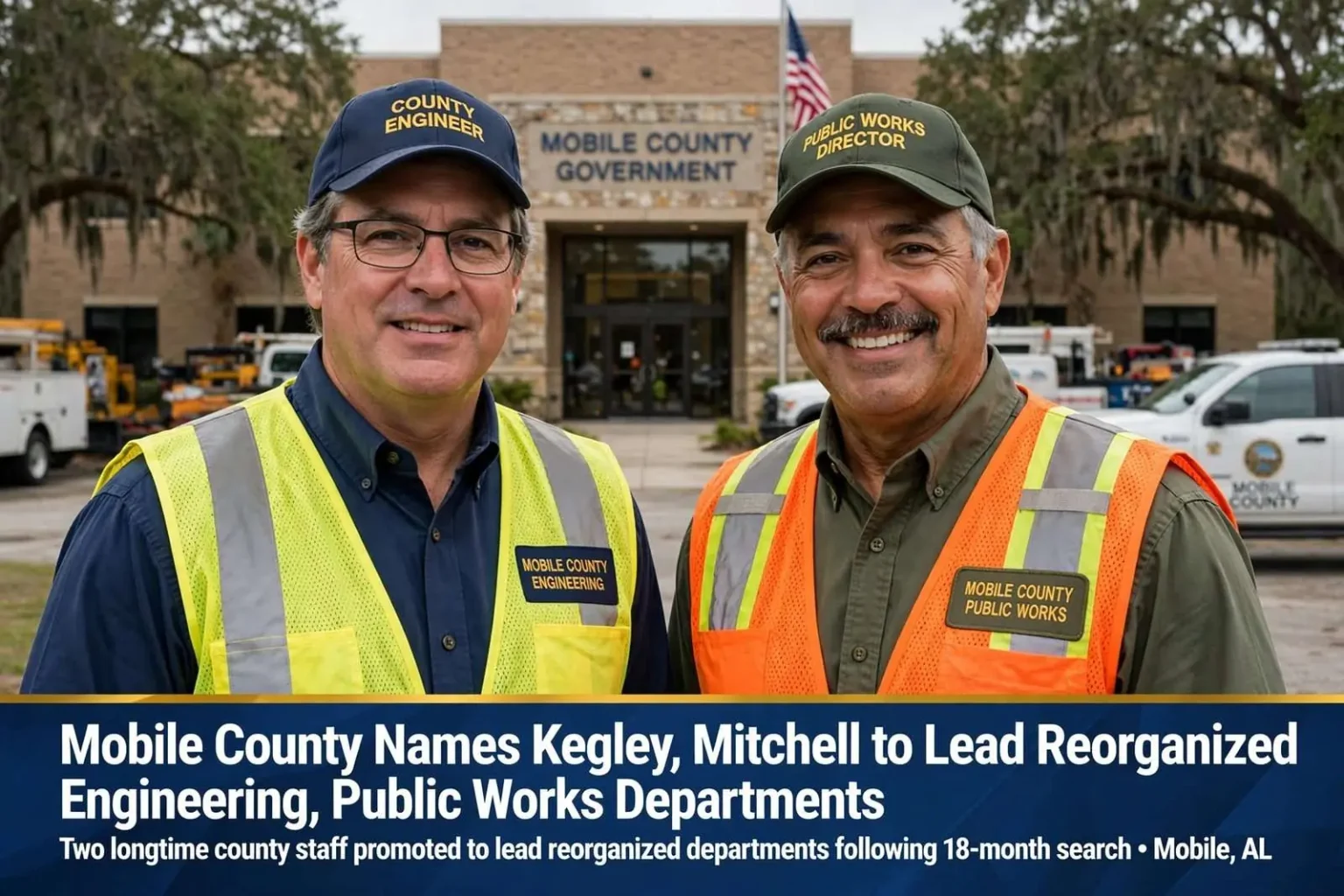
Mobile County commissioners have selected two longtime members of the county’s engineering staff to lead a newly reorganized public works structure, ending an 18-month search that followed the retirement of a department head who had served for more than four decades. During a conference meeting this week, the Mobile County Commission voted to name Bryan Kegley as county engineer and Ricky Mitchell as public works director and chief engineer of the division of public roads, filling the two most important technical posts in county government with men who came up through its own ranks.
The appointments mark the first time the roles have been filled separately since former county engineer Joe Rufer stepped down in 2016 after 42 years on the job. Rufer’s tenure spanned an era of explosive growth in the county — the subdivision boom of the western suburbs, the widening of arterial roads to carry it, and the repeated rebuilding that Gulf hurricanes demand of any coastal public works department — and his retirement left behind an office organized, staffed and accustomed to operating exactly as he had built it.
For decades, the county engineer’s office functioned as a single, wide-reaching department overseeing everything from road construction to building maintenance. The arrangement concentrated in one appointed official responsibilities that most Alabama counties spread across several: road and bridge engineering, county facilities, equipment fleets, and an assortment of service functions that had attached themselves to the department over the years like barnacles to a hull.
Why the county reorganized
That changed after the commission paid roughly $30,000 for an outside evaluation in 2017, which found that the position had accumulated too much direct control over an unusually broad range of county functions. The consultants’ finding was organizational rather than personal: no single office, however competently run, should control road design, building maintenance, information technology and a finance operation all at once, because the span of oversight makes accountability diffuse and succession nearly impossible — as the county had just discovered watching one retirement empty half its government.
Acting on the consulting firm’s recommendations, commissioners voted last summer to split many of the county engineer’s former duties between two positions: the county engineer and a newly created public works director. The design followed the pattern that most growing counties have adopted, drawing a line between the engineering discipline — roads, drainage, right-of-way, construction projects — and the operational work of keeping buildings running and equipment rolling.
The review also stripped some responsibilities, including parks and recreation and environmental services, from the department entirely, shifting them to county administration. The moves recognized that those functions are service programs rather than engineering activities, and that their placement inside a public works hierarchy had been an accident of growth rather than a deliberate design choice.
Officials said the changes were meant to eliminate functions the consultants described as duplicative or unnecessary, including redundant IT services, human resources support and a standalone finance office within the department. Large county departments that grew up before centralized administration often maintain their own versions of these functions — a payroll clerk here, a computer technician there — and each duplication represents both a cost and a seam where records and accountability can fray. Consolidating them into the county’s central offices was among the least glamorous and most durable of the consultants’ recommendations.
The reorganization unfolded over a period in which Mobile County government was professionalizing several of its operations, with commissioners increasingly willing to commission outside reviews and act on their findings. Organizational studies of this kind are common in the private sector and increasingly routine in county government, but acting on them — especially when acting means restructuring a long-tenured department’s leadership — is the step most governments avoid.
The division of duties also gives the commission something it lacked under the old structure: a second senior voice on infrastructure questions. When one official holds every public works function, the commission hears a single recommendation on every matter, and disagreements within the department rarely surface before decisions are made. Two department heads with distinct mandates — one engineering, one operational — create the natural check of parallel judgment on proposals that touch both, from facility siting to the equipment purchases that support construction projects.
The men and the mandates
Under the new arrangement, Kegley will oversee road construction and related engineering projects, while Mitchell will take charge of building maintenance and equipment services, among other duties. Each will retain additional responsibilities outside those core areas as the department settles into its new structure, a transitional acknowledgment that a department reorganized on paper still runs on people whose institutional knowledge does not respect the new lines on the org chart.
Both men rose to their new positions from within the county’s engineering department, where each had spent years on the road program and facility projects that now define their respective portfolios. Internal promotions carry their own logic in technical departments: the incoming officials arrive already fluent in the county’s engineering standards, its contract history and its maintenance backlog, sparing the commission the year-long acclimation an outside hire would have required.
The 18-month search itself illustrated the challenge counties face in filling such posts. County engineers must hold professional licensure, command construction and infrastructure expertise, and navigate the politics of a commission that answers for every pothole in a county of more than 400,000 residents — a combination of credentials and temperament that the national market for civil engineers has made progressively harder to hire at any price.
The appointments also close out the interim arrangements that carried the department through the search period. Departments in leadership transition run on deputies, and while the county’s road program continued without interruption during the 18 months between Rufer’s retirement and the new appointments, the commission had been effectively serving as the department’s acting direction-setter — a burden on three elected officials that the hire of two professionals relieves.
What the county’s road program faces
The new leadership inherits a road program shaped by the county’s particular growth pattern. Mobile County’s population has spread steadily westward and southward from the city, filling unincorporated areas whose subdivisions depend on county-maintained roads, and each year of growth converts a rural two-lane into a commuter corridor that residents expect to be widened, drained and resurfaced on schedule. Balancing new construction against the maintenance of existing pavement is the perennial arithmetic of the county engineer’s office.
Weather is the other constant. South Alabama’s hurricanes, tornadoes and flood-producing thunderstorms tax drainage systems and roadbeds across the county, and debris clearance after a major storm falls first to the public works division. The split structure puts emergency facility and fleet operations under Mitchell while storm-damaged infrastructure repair flows through Kegley’s engineering side — a division that will matter most on the day both men are working the same storm.
The commission’s conference-meeting vote reflects how Mobile County conducts much of its business: the three-member commission deliberates in conference sessions that function as its working meetings, with formal votes following at subsequent regular meetings. Personnel decisions of this significance are rarely unanimous surprises; by the time the vote came, the two appointments had been the subject of months of internal discussion among commissioners who knew exactly what the reorganization required.
A model other counties watch
Mobile County’s reorganization is being watched by other Alabama counties facing the same succession cliff. Across the state, county engineers who built their departments in the 1970s and 1980s are retiring, and commissions are discovering that a position defined by one person’s four-decade tenure cannot simply be refilled — the duties must be sorted, the extras reassigned, and the structure rebuilt around the successor rather than the predecessor.
The county’s approach — an outside evaluation, a reorganization vote, and then a patient search filled from within — offers a template of sorts: divide the empire before hiring for its pieces. The alternative, hiring one person to inherit all of it, recreates the concentration of control the consultants flagged and guarantees that the next retirement produces the same crisis.
For county residents, the reorganization will be judged by its visible outputs: roads resurfaced, bridges load-rated and repaired, county buildings maintained without surprise closures, and equipment available when crews roll out. Bureaucratic charts matter to auditors; to the public, the engineer’s office is the pothole crew and the drainage ditch, and the measure of Kegley and Mitchell’s appointments will be whether those services arrive faster, or at least no slower, under two leaders than they did under one.
What is certain is that the transition closes a chapter opened more than four decades ago. The office Joe Rufer built as a single wide-reaching department now exists as two focused ones, with its auxiliary functions dispersed to the administration that should have held them all along. Whether the design proves itself in the county’s next decade of growth is the test that no consulting report can settle — only the roads can.