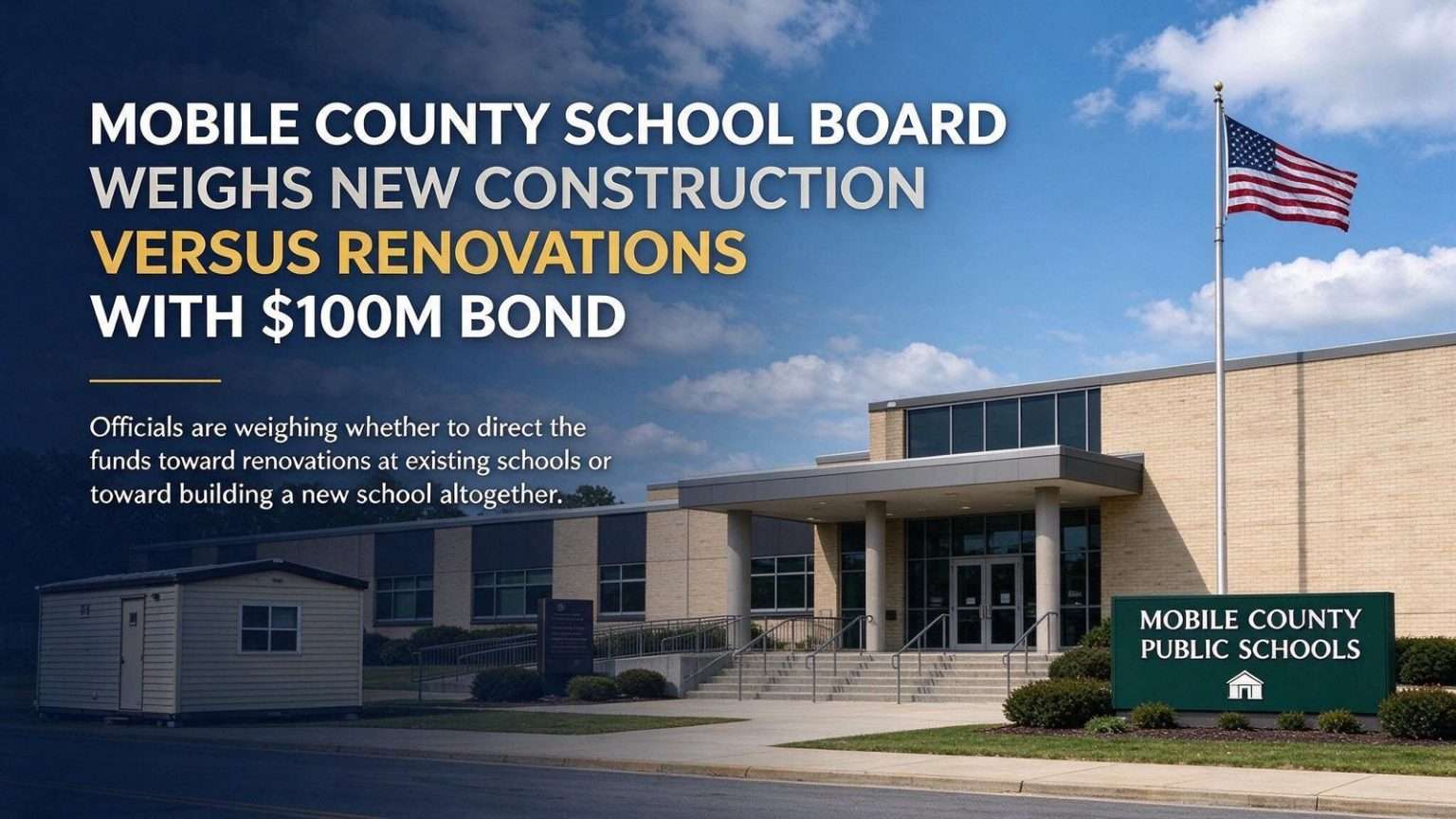
The Mobile County Board of School Commissioners has voted to issue a $100 million construction bond, but exactly how the money will be spent remains undecided. According to Rena Philips, the director of communication for the Mobile County Public School System, officials are still discussing whether to direct the funds toward renovations at existing schools or toward building a new school altogether.
The vote authorizes the borrowing but not the blueprint, leaving a list of candidate projects — and the politics of choosing among them — for the weeks ahead. Bond issues of this size typically finance a mix of new construction, major renovations, roofing, HVAC replacements and safety upgrades, and board members have historically weighed those categories against one another as needs across the district’s roughly 90 schools compete for the same dollars.
A West Mobile overcrowding problem
Superintendent Chresal Threadgill told Philips the bond may be used to build a school in West Mobile to ease overcrowding there, alongside renovation projects around the county. That tracks with a population shift toward West Mobile that board president William Foster said he has seen firsthand. “Between the two high schools there are probably 45,000 kids,” Foster said, pointing to roughly 1,500 students at each of the two middle schools serving that part of the county. A new middle or high school, he suggested, could relieve the pressure.
West Mobile’s growth has been a familiar storyline for the district. Residential development along and beyond Schillinger Road and the airport corridor has pushed enrollment upward at campuses serving that part of the county, while population in some older neighborhoods closer to the city has flattened or declined. The result is a district stretched between two kinds of need: crowded classrooms and portable buildings in the west, and aging buildings requiring renovation in communities that have been settled far longer.
Foster’s comment about the two middle schools underscored how concentrated the crowding has become. A pair of 1,500-student middle schools means thousands of adolescents cycling through campuses built for smaller populations, and the two high schools that anchor the area draw from those same feeder patterns. Mobile County’s high schools are among the largest in Alabama, and West Mobile’s are no exception — a scale that brings athletic and academic resources but also traffic, crowding and pressure on shared spaces from cafeterias to parking lots.
Where the needs are
Still, Foster noted, schools across the county have improvement needs. He said the board has already completed at least $220 million in building, construction and renovation work during his tenure, “and still, there are needs.” The comment reflected the arithmetic that governs any school construction program in a district Mobile County’s size: even a nine-figure investment, spread across a system covering more than 1,300 square miles from Citronelle to Dauphin Island, leaves a backlog behind.
The $220 million Foster cited represents years of capital work under the board’s five-year construction plans, the vehicles through which Alabama’s largest school system has historically sequenced its building priorities. Those plans have funded new campuses in fast-growing areas, wholesale renovations of older schools and a steady drip of maintenance that never makes headlines but keeps classrooms open. A new $100 million bond would layer another round of projects on top of that record.
Philips called the bond a good investment, citing favorable interest rates, but cautioned that construction dollars do not stretch as far in the current economy. Her caution pointed to a reality every school district in the region has confronted: the cost of materials and labor has risen faster than budgets, meaning a dollar of borrowing buys less building than it once did. Districts planning major construction have had to revise square footages, defer amenities or trim project lists to fit the money available.
How Alabama school bonds work
Capital outlay for Alabama public schools comes through several channels — local property taxes, state bond issues, one-cent sales tax allocations and periodic city contributions — and a county board’s own bond issue draws on its share of those revenues to repay the debt. Mobile County, as the state’s largest school district by enrollment, has used bond issues repeatedly over the decades to keep pace with growth and aging buildings, and the board’s votes on borrowing are typically followed by months of planning before ground is broken anywhere.
The sequencing matters because state law and board policy require renovation and construction decisions to be justified by enrollment, building conditions and educational adequacy. A promise to spend $100 million must be translated into specific projects, each with its own design phase, bidding process and construction schedule, and the board’s deliberations over that list are where the competing visions — a new West Mobile school versus renovations elsewhere — are ultimately reconciled.
What happens next
No timeline has been set for when the superintendent and board will settle on a slate of projects. In the meantime, the vote to issue the bond signals to the community that significant capital work is coming, even if the address of the next new school has not been announced. Parents in West Mobile watching enrollment climb will be looking for a new campus; residents of older neighborhoods will be watching for the renovation money that keeps their community schools competitive.
Threadgill’s framing — a possible new school in West Mobile plus renovations around the county — suggests the eventual plan will split the difference, as Mobile County boards have done before. The superintendent and the seven-member board face the same constraint that shaped the last $220 million in work: more need than money, and a county whose growth is concentrated in one corner while its oldest buildings stand in another.
For families, the practical effects of the bond will arrive gradually — designs, then bids, then fences around construction sites — but the decision that starts it all has been made. Mobile County Public Schools, the largest employer in the county and the school system for roughly 56,000 students, now has $100 million more in borrowing power to shape where and how its students learn.
The case for building versus renovating
The board’s debate reflects a calculation districts across Alabama are making as growth patterns shift. New construction carries immediate, visible costs but solves crowding outright and can be sited where students actually live, shortening bus rides and relieving feeder patterns for decades. Renovation costs less per project and honors the community attachment families have to established schools, but it does not add seats, and in a corridor where subdivisions keep filling in, renovated buildings can find themselves overcrowded again within a few years.
In West Mobile specifically, the question is where a new school would draw its students from. The two middle schools Foster referenced and the high schools above them in the feeder chain would each give up enrollment under a rezoning, and boundary changes of that kind are among the most sensitive decisions a board makes. Parents who chose homes for one school’s attendance zone resist reassignment, even when the new campus is an upgrade, which is why boards typically pair construction announcements with lengthy public input processes.
Renovation projects elsewhere in the county face their own arithmetic. Many of the system’s older schools were built generations ago, and bringing them up to modern standards means more than fresh paint: roofs, climate control, electrical capacity for classroom technology, ADA accessibility and secure entrances all carry price tags that add up quickly across a system of the county’s size. A bond round that funds a handful of full renovations can consume $100 million without a single new building rising.
Favorable rates, expensive market
Philips’ twin observations — that interest rates made the borrowing attractive but that construction costs were climbing — captured the trade-off timing presents. Low borrowing costs argue for issuing debt sooner rather than later, locking in principal and interest payments while rates remain favorable. High construction costs argue the opposite: every month of delay risks the project list growing more expensive, but rushing to spend can mean paying premium prices in a hot market.
Districts that have issued bonds in recent years have watched those two forces pull against each other, and Mobile County’s board will make its project decisions inside the same squeeze. The favorable rates Philips cited reduce the long-term tax burden of repayment, which matters to a county where school district debt service competes with every other claim on local revenue. What the board buys with the proceeds, and when, will determine how much of the $100 million ultimately reaches classrooms.
Until the superintendent and commissioners settle on a project list, residents can expect the question to stay in front of the board — at work sessions, in budget discussions and in the conversations board members have in their districts. The vote has been taken; the harder choices about what to build, what to fix and where remain ahead.