Two Mobile Gas Stations Robbed at Gunpoint Within an Hour of Each Other
Armed robbers hit a Schillinger Road Shell station and a University Boulevard Kangaroo store within 30 minutes, and Mobile police are seeking tips.
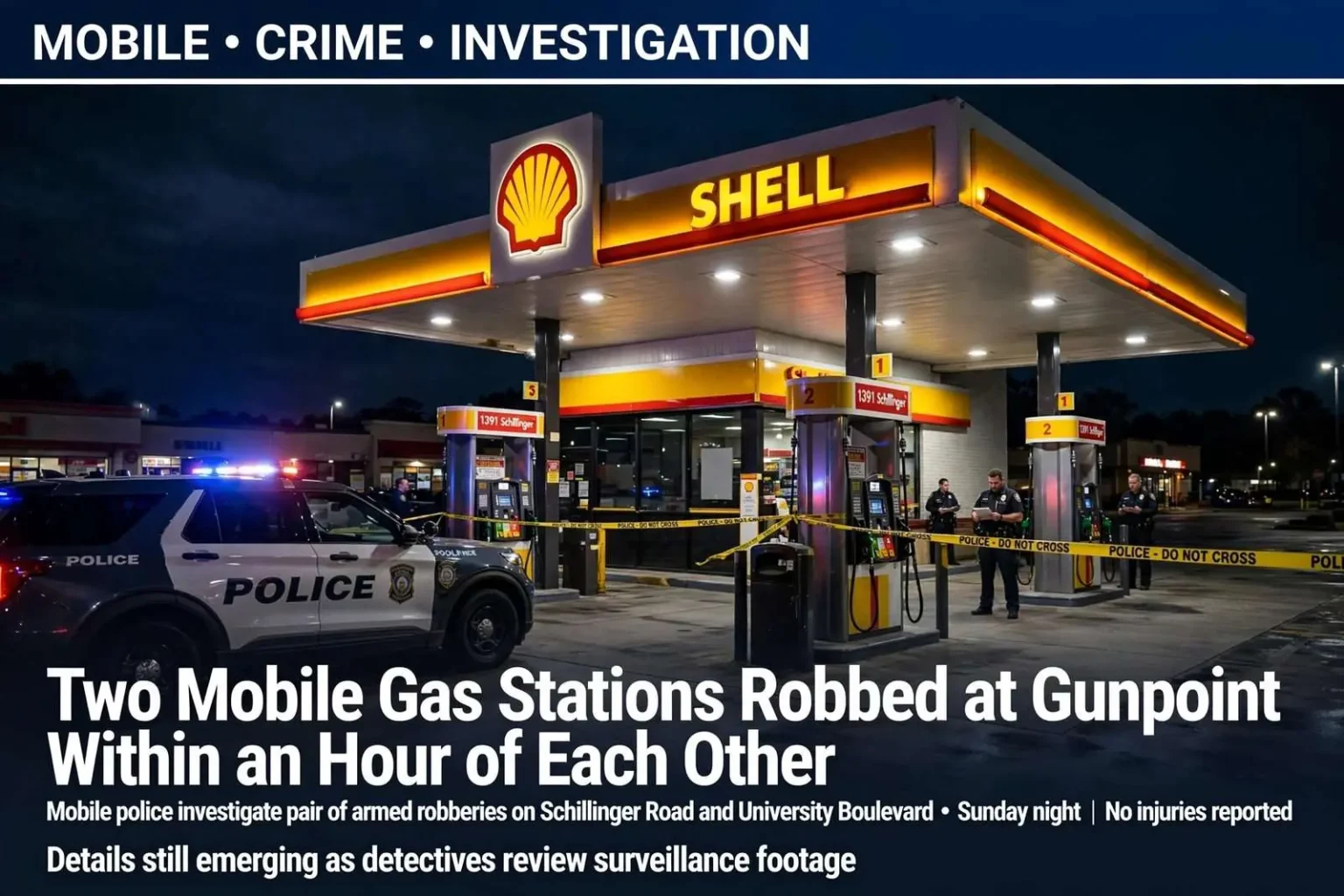
Mobile police are investigating a pair of armed robberies at gas stations that occurred within roughly 30 minutes of each other on a recent Sunday night, raising questions about whether the two holdups were connected. The quick succession of armed robberies on two of the city’s busiest west-side corridors put officers on alert and left late-night clerks across the area shaken.
The first robbery happened after 11 p.m. at the Shell station located at 1391 Schillinger Road, where an unidentified man brandishing a handgun demanded cash from the clerk on duty. The suspect fled the store on foot after collecting money from the register, according to police, disappearing into the dark stretch of neighborhoods that surround the commercial strip.
Schillinger Road runs north-south through west Mobile, lined with subdivisions, schools, and the kind of strip retail that serves the surrounding neighborhoods. The Shell station sits amid that commercial cluster, and a holdup after 11 p.m. — when the surrounding businesses are closed and foot traffic is thin — leaves a clerk alone at the register with little backup nearby.
A short time later, a second armed robbery was reported at the Kangaroo gas station at 10 N. University Boulevard. Police said a man matching a similar description, also armed with a handgun, confronted the cashier and demanded money before leaving the scene. University Boulevard is one of the main arteries of west Mobile, running between Airport Boulevard and Government Boulevard through a dense corridor of restaurants, shops, and service businesses.
Investigators have not said publicly whether they believe the same person or persons were responsible for both robberies, though the short time gap and similar methods have fueled speculation among nearby residents and business owners that the cases may be linked. Mobile police continue to review surveillance footage from both locations as part of the investigation.
Both stations operate security cameras covering their registers and fuel islands, and footage from those systems now forms the core of the investigative record. Detectives will compare the images from the two scenes — the suspect’s build, clothing, and movements — along with the timing and method of the holdups, before deciding whether to treat the cases as one series or two.
The two stations sit several miles apart, and the suspect fled both scenes on foot, so any connection between the holdups would depend on how he moved between the areas. Mapping the route a suspect could have taken, and checking for reports of a vehicle seen in both vicinities that night, is among the first tasks in determining whether one person is responsible for both.
A pattern police know well
Armed robberies at convenience stores and gas stations remain a persistent challenge for Mobile police, who regularly ask store owners to maintain working security cameras and adequate lighting around registers and parking areas. Late-night shifts are the most vulnerable window, when stores are quiet, staff is minimal, and the streets around them are nearly empty.
Late-night clerks are often instructed to comply with robbery demands rather than resist, prioritizing personal safety over store property. That guidance, drilled by corporate training programs across the convenience store industry, is built on a simple calculation: money in a register is replaceable, and confronting an armed robber dramatically raises the risk that someone is hurt. In both Sunday night robberies, the clerks complied and no injuries were reported.
Robbery prevention training also teaches clerks to observe — to note height, clothing, direction of travel, and anything distinctive — without staring or provoking the suspect. The details a clerk can give detectives in the first hours after a holdup often matter more than anything the cameras capture, and both clerks provided accounts that investigators are now checking against the footage.
Both the Schillinger Road and University Boulevard corridors see heavy traffic throughout the day and night, with numerous retail and fuel businesses operating in the area. That traffic is part of what makes the locations attractive to robbers — plenty of customers means registers are stocked — and part of what makes the crimes hard to solve, because the same volume of movement offers quick escape routes and a buffer of strangers.
Robberies at stations along these routes have prompted some owners to invest in additional security measures, including improved lighting and time-delay safes that limit the amount of cash accessible to would-be robbers. Time-delay safes, which require a waiting period before cash can be retrieved, have become standard at many chain locations, and their effect is straightforward: a robber who demands the drawer gets only the small amount of cash the clerk can reach, while the bulk of the night’s takings sits locked behind a timer.
Other measures common across the industry include high-resolution cameras at the register, panic buttons wired to alarm companies, drop safes for large bills, and visibility improvements that clear sight lines between the register and the street. Some stations also limit late-night hours for their interior stores or staff a second employee overnight, decisions that balance security costs against the risk of a holdup.
What investigators will look for
In robberies of this kind, detectives typically work from several directions at once: the surveillance footage, any physical evidence left at the scenes, witness accounts from clerks and customers, and whether similar robberies have been reported in surrounding jurisdictions. A suspect who hits two locations in half an hour often continues, so investigators in neighboring areas — Prichard, Tillman’s Corner, and the county sheriff’s office — are likely watching for matching reports.
The description of the suspect in both robberies, armed with a handgun and demanding cash directly from the clerk, will be compared against reports from any other incidents in the area that night. When a series is connected, charging decisions can consolidate multiple robberies into a single prosecution, which raises the stakes considerably for a defendant once an arrest is made.
Armed robbery is among the more serious felony charges in Alabama’s criminal code, and robbery with a deadly weapon carries the potential for a lengthy prison sentence. Prosecutors weigh the violence inherent in confronting a clerk at gunpoint even when no one is injured, and prior convictions or connected cases can extend the exposure further.
For the clerks who lived through the holdups, the aftermath is its own burden. Convenience store employees who experience armed robberies often describe lasting effects — anxiety on late shifts, wariness of customers, and in some cases decisions to leave the industry altogether. Store owners along the two corridors were checking their own cameras and lighting in the days that followed, aware that a successful robbery tends to invite imitators until someone is caught.
How to report tips
Anyone with information about either robbery is asked to contact Mobile police directly or to reach out to the Mobile County Crimestoppers tip line, which allows callers to remain anonymous. Tips can also be submitted by text message using the keyword CRIME411 sent to 274637, a system designed to make reporting easier for people who may be hesitant to call in directly.
Crimestoppers tips that lead to an arrest can also be eligible for a cash reward, an incentive local law enforcement agencies say has helped solve numerous cases across Mobile County over the years. The anonymity of the program matters in cases like these, where a tipster may know the suspect personally and hesitate to be identified as the source.
Detectives say even small details can break a robbery case open — a vehicle seen idling near the store, a description of the suspect’s clothing or gait, or chatter among people who heard about the holdups afterward. With two scenes and multiple camera systems to draw from, investigators have more material to work with than in a single-station case, but they still depend on the public to fill the gaps between what the cameras recorded.
No arrests had been announced in connection with either robbery as of the latest update from police. The investigation remains active, and police said they would release additional information — including any suspect images — as it becomes available.
After a series of commercial robberies, police typically step up visibility around late-night businesses in the affected corridors, and patrols along Schillinger Road and University Boulevard serve both as a deterrent and as a reassurance to the clerks and customers who keep those stores running through the overnight hours.
For residents of west Mobile, the episode was a reminder of the risks that come with the late shift at the neighborhood gas station, and of how quickly a Sunday night errand can turn into a crime scene. Both stations reopened and continued serving customers in the days that followed, with clerks working behind the same counters where the holdups took place, and with the city watching to see whether the same robber would strike again.