Thieves Are Stealing Mobile’s Manhole Covers, and the Charge Is Only a Misdemeanor
City officials reported a rash of stolen manhole covers and storm drainage grates being sold for scrap, leaving open holes in the roadway and few strong charges available to prosecutors.
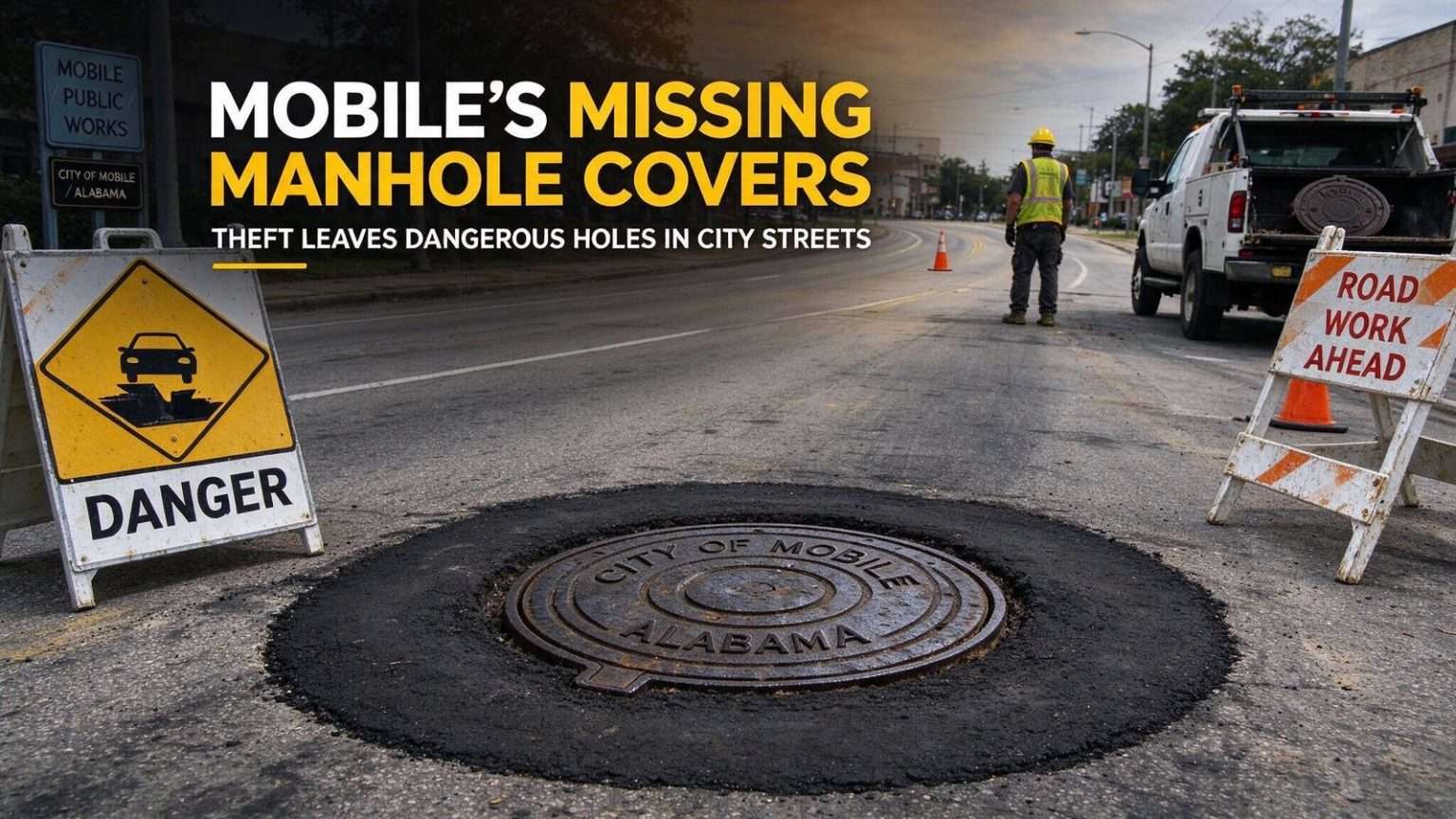
Times are tough, and the thieves have gotten bold. City officials in Mobile reported an outbreak in recent weeks of a crime that would sound absurd if it were not so dangerous: the theft of manhole covers and storm drainage grates from city streets. The problem is not confined to one neighborhood. Covers and grates have disappeared from roadways across the city, and each one that leaves the ground leaves behind something far more dangerous than the metal itself.
Scrap Metal Economics
The motive is straightforward. Cast iron has weight, and weight has value at a scrap yard. Thieves have been prying up covers and grates and selling them, according to city officials, for what amounts to a few dollars apiece. The math is lopsided in the worst possible way for the city. A stolen cover might bring a handful of dollars at a recycling scale, while a replacement casting, the labor to install it and the crew time to respond to a report of a missing cover can run the total cost of each incident into the hundreds of dollars.
The city’s cost is a great deal higher, and the timing could hardly be worse. Replacing a manhole cover or a storm grate is expensive, and the municipal budget is not in a condition to absorb an unplanned run of them. Mobile is in the middle of a fight over an $18.5 million deficit, and every dollar spent replacing stolen infrastructure is a dollar not available for services, paving or public safety. City officials have described a budget process already marked by difficult choices, and theft-driven replacement costs only deepen the squeeze.
The pattern is familiar to cities across the country. When scrap prices rise, unattended metal — copper wiring, air conditioning coils, guardrail sections and, above all, heavy cast iron — becomes a target. Manhole covers and drainage grates are particularly attractive to thieves because they sit in the open, require no tools beyond a pry bar to lift, and can be loaded into a pickup truck in seconds. Alabama legislators have tightened scrap metal reporting requirements in recent years precisely because of thefts like these, requiring dealers to document purchases and hold certain items before resale, but enforcement depends on catching the transaction, not the lift.
The Real Hazard
The greater problem is the hole left behind. A missing cover leaves an open shaft in the pavement, often invisible until a driver is on top of it. City officials warned that the absence of the covers and grates creates a serious risk to motorists, and by extension to cyclists and pedestrians who may not see the opening in low light or standing water. A standard manhole opening is wide enough to swallow a car tire entirely, and a wheel that drops into one at speed can bend suspension components, blow out a tire or cause a driver to lose control.
The danger multiplies after dark and during rain. A cast iron cover that blends into black asphalt in daylight can be completely invisible at night, and a storm drainage grate that has vanished is precisely the spot where rainwater pools, masking the opening beneath a sheet of water. For a cyclist rolling along a lane marked for bicycles, a missing grate is among the most serious hazards on the road. The Fire-Rescue Department and public works crews also rely on access to those structures — a missing cover can delay crews responding to an underground emergency or a flooded street.
The Mobile Police Department asked the public to help. Residents who see anyone who is not clearly a city or utility worker tampering with a manhole cover or drainage grate are urged to call 911. City and utility crews typically work in marked vehicles and identifiable uniforms, and legitimate work on underground structures is usually accompanied by cones or barricades. Officials emphasized that a quick report can mean the difference between a cover recovered before it reaches a scale and an open hole that sits in a roadway for days.
The Charges Available
Here the story takes a frustrating turn for prosecutors. The offenses that fit the conduct are, under Alabama law as applied to these thefts, relatively minor: theft in the third degree, if an officer witnesses the theft itself; receiving stolen property in the third degree, if an individual is found in possession of a stolen cover or grate; and receiving stolen property in the third degree, if a person knowingly pays for the stolen property — a provision that reaches the scrap buyer as well as the thief.
All three are misdemeanors, carrying a maximum penalty of not more than one year in jail. The reason lies in how Alabama grades theft by value. The state’s theft statutes escalate by the market value of the property taken, and the felony thresholds sit far above what a manhole cover fetches at a scrap yard. Only when stolen property is valued above the statutory felony amounts — or falls into special categories such as firearms or controlled substances — does the charge rise above the misdemeanor level. A cast iron cover worth a few dollars in resale simply does not reach those numbers, no matter how dangerous the consequence of taking it.
According to authorities, the thefts do not fit the categories that would allow prosecutors to charge a felony, even though a single open manhole could produce a catastrophic injury. The law measures the value of the property, not the potential cost of the hazard it leaves behind, and a $15 cover cannot support a felony theft count. That gap between the seriousness of the danger and the seriousness of the charge is what frustrates officials, who can pursue only minor counts against repeat offenders and then see them back on the street.
The receiving-stolen-property provisions are, in practice, the more useful enforcement tool. A thief caught in the act requires an officer as a witness, but a person found with a city cover in a truck bed, or a scrap dealer who pays for one without the documentation the law requires, can be charged on the transaction itself. That structure puts pressure on the resale end of the chain, where the evidence — the cover itself — is still in hand.
What the City Can Do
Municipalities dealing with similar waves have turned to a handful of practical countermeasures. Some cities have installed locking or anti-theft covers on manholes in high-theft areas, using bolt-down designs that require special keys to lift. Others have etched or branded covers with the municipality’s name so that a dealer inspection can identify stolen stock immediately. Public works departments have also moved toward regular route inspections of known problem corridors, so that a missing cover is discovered by a city crew rather than by a motorist’s tire.
None of those measures is free, and all of them draw on the same strained budget that the thefts are already taxing. Locking replacements cost more than standard castings, and Mobile’s drainage system contains thousands of grates spread across hundreds of miles of streets. Prioritizing is unavoidable: officials must weigh busy arterial roads and school zones against quiet residential blocks, and respond fastest where an open hole poses the greatest immediate danger.
The Broader Scrap Theft Problem
Mobile’s experience fits into a regional pattern that has frustrated law enforcement for years. Across Alabama, utilities have reported copper wire stripped from substations and construction sites, air conditioning condenser coils ripped from vacant buildings, and metal signs and guardrails disappearing from rural roads. Each category of theft shares the same profile with the manhole cover problem: modest resale value, easy access and a replacement cost many multiples of what the thief receives. The state responded with the Alabama Metals Theft Act, which tightened record-keeping for scrap dealers, required identity documentation from sellers and created penalties for dealers who fail to follow the rules. Those requirements give investigators a paper trail when a stolen cover turns up, but they do not prevent the initial theft from a dark street at two in the morning.
Prosecutors and police in affected cities have also pushed public awareness campaigns aimed at the scrap side of the transaction, reminding legitimate dealers that city infrastructure is marked and that paying for it carries its own criminal exposure. The receiving-stolen-property count, though a misdemeanor, applies squarely to a dealer who knowingly buys a cover stamped with a municipal name, and repeat misdemeanor convictions can add up. City officials have suggested that the most durable fix is economic: when scrap prices fall, the incentive to pry up a fifty-pound casting for pocket change falls with them. Until then, they said, the city will keep replacing covers, keep inspecting streets and keep asking residents to make the call that gets a hole flagged before someone gets hurt.
For residents, the practical advice is simple. Report a missing cover or grate rather than assuming someone else has. Treat any visible open shaft in the roadway as a hazard worth avoiding at any speed, and warn neighbors in low-light areas. And if someone without city credentials is prying at metal in the street, call 911 — because under the current law, that phone call may be the strongest tool the city has.