Mobile Marked America’s 250th Anniversary With Revolutionary War Reenactment and Time Capsule Opening
Mobile joined the nation's 250th anniversary celebrations with a living-history reenactment at Colonial Fort Conde and the opening of a time capsule buried during the city's 1976 bicentennial festivities.
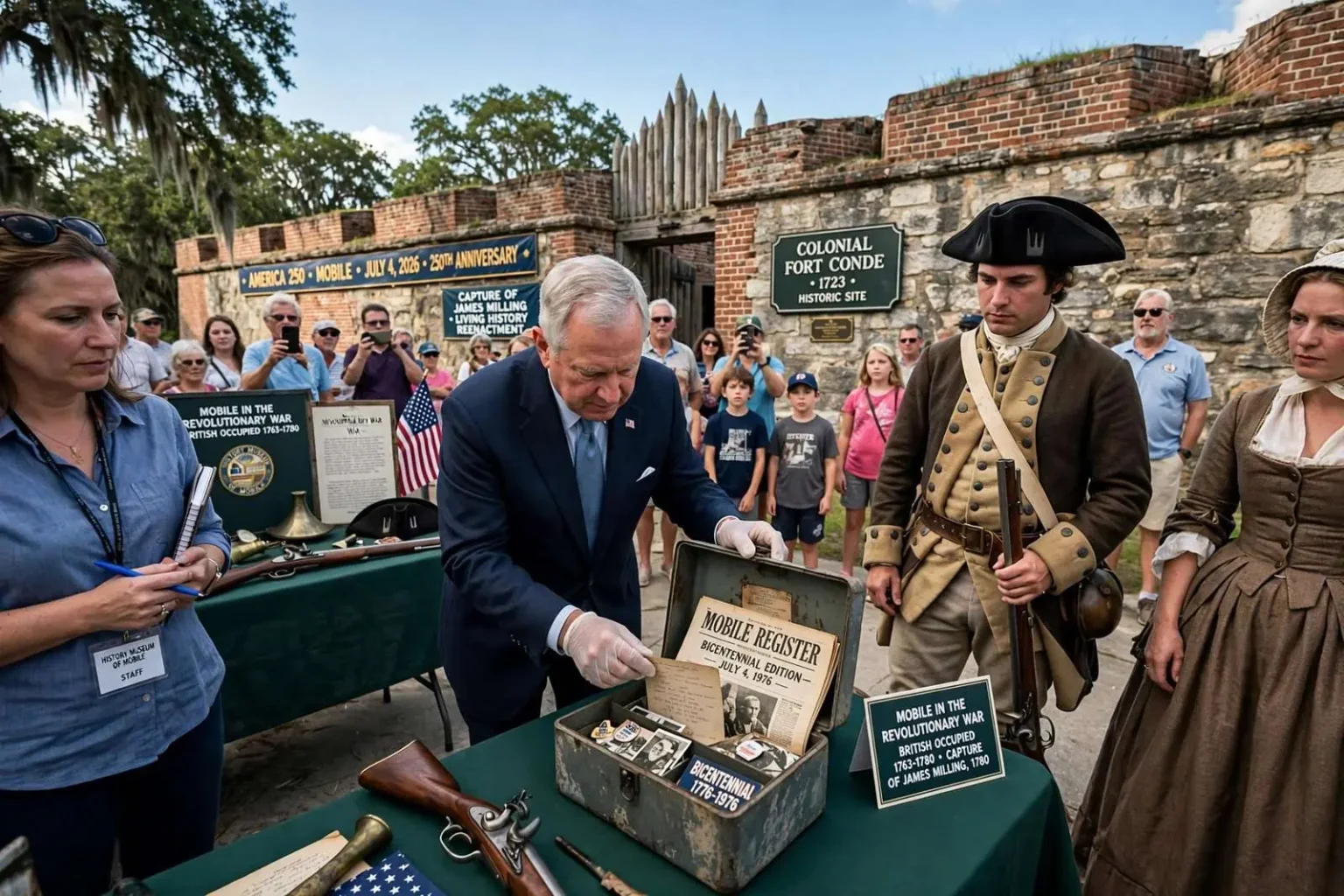
As communities across the country marked the 250th anniversary of American independence, Mobile turned to one of its own Revolutionary War-era chapters to join the celebration, hosting a living-history reenactment and the opening of a half-century-old time capsule at Colonial Fort Conde. The event, organized by the History Museum of Mobile alongside Mayor Spiro Cheriogotis’s office, tied together two commemorations in one afternoon: the nation’s 250th birthday and the 50th anniversary of Mobile’s own bicentennial celebration in 1976.
Bringing the Capture of James Milling to Life
The centerpiece of the afternoon’s programming was a reenactment of the Capture of James Milling, a Continental Navy officer whose actions helped bring the American Revolution to British-occupied Mobile — a lesser-known chapter of Revolutionary War history that unfolded far from the more widely taught battles of the northeastern colonies. Programming built around the reenactment included a full public reading of the Declaration of Independence, live musket demonstrations, and performers in period clothing, with organizers designing the event to invite audience interaction rather than simple observation.
For many attendees, the reenactment offered a rare, tangible glimpse into what life along the Gulf Coast looked like in 1776, a year usually associated in the popular imagination with events in Philadelphia and Boston rather than the Gulf of Mexico’s colonial ports. Mobile’s role during the Revolutionary era — as a contested outpost among British, Spanish, and eventually American interests — is a part of the city’s history that local institutions like the History Museum of Mobile have worked to keep visible through programming like this reenactment.
Two Anniversaries, One Afternoon
“The City of Mobile is blessed to have played a part in this country’s rich history,” Mayor Spiro Cheriogotis said in announcing the celebration. “We’re proud to celebrate that history with two wonderful events marking America’s 250th birthday. These events are unique, educational, fun, and family-friendly — telling Mobile’s story, and the country’s story, through the eyes of people who were alive 250 years ago and those of Mobilians from 50 years ago. Join us for this one-of-a-kind celebration at Colonial Fort Conde.”
That second layer of commemoration centered on a time capsule that the City of Mobile buried in 1976 as part of the nation’s bicentennial festivities. As part of the America 250 programming, Mayor Cheriogotis opened that half-century-old capsule, giving the public a chance to see items chosen nearly 50 years earlier by an earlier generation of Mobilians who wanted to leave a message — and a snapshot of their era — for the city’s future.
Why Time Capsules Still Resonate
Time capsules occupy a particular place in American civic tradition, especially around milestone anniversaries. They function as a kind of deliberate, low-technology message to the future, packed with everyday objects, newspapers, photographs, and other artifacts chosen specifically because they capture what a community valued or found notable at a particular moment. Opening one 50 years later offers a rare, unfiltered comparison between how a city saw itself at one anniversary and how it sees itself at the next — in this case, bridging Mobile’s bicentennial-era community with the one marking America’s semiquincentennial in 2026.
Fort Conde itself has long served as a natural setting for this kind of programming. Originally built by French colonists in the early 18th century and later held by British and Spanish forces before coming under American control, the fort’s layered colonial history makes it one of the few sites in the country where Revolutionary-era, French colonial, and early American history intersect within the same physical footprint. That layered past is part of why the History Museum of Mobile has used the site repeatedly for living-history events aimed at making the city’s colonial and revolutionary-era history feel tangible to modern audiences, rather than confined to textbooks.
Part of a National Commemoration
Mobile’s Fort Conde programming fit into a much larger wave of America 250 events taking place in cities and towns nationwide throughout the anniversary year, as communities large and small found their own ways to mark two and a half centuries of American independence. For a city like Mobile, with a documented Revolutionary War-era history that predates the United States itself, the anniversary offered an opportunity to place local history in a national spotlight and to draw connections between the city’s colonial past, its mid-1970s bicentennial commemoration, and its present-day identity.
Museum officials and city leaders have continued to emphasize the value of hands-on historical programming, particularly for younger residents who may have limited exposure to Mobile’s role in events that unfolded well before the city’s more widely known 19th- and 20th-century history. Events like the Fort Conde reenactment and time capsule opening are intended to make that early chapter of the city’s history feel immediate rather than abstract, using costumed performers, live demonstrations, and physical artifacts rather than lectures alone.
The History Museum of Mobile has indicated it will continue to build America 250-related programming throughout the broader anniversary period, with Fort Conde expected to remain a central venue for events connecting the city’s colonial and revolutionary past to its ongoing civic life.
Mobile’s Place in Revolutionary War History
Long before it became part of the United States, the area around present-day Mobile changed hands repeatedly among French, British, and Spanish colonial powers, a layered history that makes Fort Conde one of the few sites in the country where visitors can trace French colonial founding, British occupation, Spanish control, and eventual American statehood within a single physical location. During the Revolutionary War era specifically, British-occupied Mobile represented a frontier outpost far removed from the fighting in the northern colonies, making stories like the Capture of James Milling a genuinely lesser-known thread of Revolutionary history that most American students never encounter in a standard classroom curriculum.
That relative obscurity is part of why living-history programming carries particular value for institutions like the History Museum of Mobile: it offers a chance to correct a common misconception that Revolutionary War history took place exclusively along the Eastern Seaboard, when in fact contests for control of Gulf Coast port cities like Mobile and Pensacola were very much part of the broader global conflict between Britain, Spain, France, and the emerging United States during that period.
\n
America250: A Multi-Year National Commemoration
\n
Mobile’s Fort Conde programming is one small piece of America250, the official national commemoration of the 250th anniversary of the signing of the Declaration of Independence, coordinated in part through a congressionally chartered commission established to encourage commemorative events, educational programming, and community projects across the country. Unlike a single-day celebration, the America250 commemoration has unfolded across an extended multi-year period, with individual states, cities, and cultural institutions organizing their own local programming under the shared national banner.
\n
That structure has allowed communities with their own distinct colonial or Revolutionary-era histories, including Mobile, to design commemorative programming that reflects local historical significance rather than a one-size-fits-all national script. For a city whose own founding predates the Revolutionary War and whose Revolutionary-era history involves colonial powers other than Britain and the original thirteen colonies, that flexibility has allowed the History Museum of Mobile to build programming, like the Fort Conde reenactment, that speaks specifically to Mobile’s own layered past.
Fort Conde’s Own Bicentennial Story
The choice of Fort Conde as the venue for both the reenactment and the time capsule opening carries a symmetry that organizers leaned into throughout the event. The fort visitors tour today is itself largely a product of the 1976 bicentennial era: much of the current structure is a partial reconstruction, built to roughly two-thirds scale on part of the original French footprint, that the city undertook as its own contribution to the nation’s 200th birthday celebrations. That means the time capsule Mayor Cheriogotis opened was sealed the same year the reconstructed fort itself was completed and dedicated, making Fort Conde not just a convenient backdrop for the 250th anniversary programming but a genuine artifact of the city’s bicentennial commemoration in its own right. Few historic sites can claim that kind of layered timing, where the building hosting an anniversary event is itself the physical product of the anniversary that came half a century before it. City officials and museum staff have periodically pointed to that overlap as one of the reasons Fort Conde continues to serve as Mobile’s default setting for major civic commemorations, functioning simultaneously as a stage for colonial and Revolutionary-era history and as a monument to how the city chose to remember that history in 1976.
Living History as an Educational Tool
Reenactment-based programming like Mobile’s Capture of James Milling event belongs to a broader tradition of experiential history education that institutions from Colonial Williamsburg in Virginia to smaller regional museums have used for decades to make distant historical periods feel immediate to modern audiences. Rather than presenting history purely through static exhibits, text panels, or lectures, living-history programming relies on costumed interpreters, period-accurate demonstrations of tools and weaponry, and structured audience interaction to give visitors — particularly children and families — a multisensory entry point into eras that can otherwise feel abstract or remote. Musket demonstrations, in particular, are a staple of Revolutionary War-era living history because they convey something textbooks struggle to capture: the noise, smoke, and slow reload process that defined 18th-century combat, details that help visitors understand tactical decisions and daily military life in a way written descriptions alone rarely achieve. Museum educators generally view this kind of programming as complementary to, rather than a replacement for, traditional exhibits and archival collections, using reenactments to draw visitors in and generate interest that can then be deepened through a museum’s permanent galleries, research materials, and educational programs aimed at school groups throughout the year.
Heritage Tourism’s Role in Mobile’s Identity
Programming like the Fort Conde reenactment also fits into Mobile’s broader positioning as a heritage tourism destination, a role the city has cultivated alongside its identity as a working Gulf Coast port. Mobile markets its layered colonial history — French founding, British and Spanish control, and eventual American statehood — as a genuine point of differentiation among Southern tourism destinations, most of which trace their notable history to the 19th century rather than the colonial and Revolutionary periods. Heritage tourism of this kind typically depends on a combination of preserved or reconstructed physical sites, active museum and interpretive programming, and periodic special events, like anniversary commemorations, that give visitors and residents alike a reason to return to sites they may have already toured once. For local cultural institutions, national milestone anniversaries such as America’s 250th represent a particularly valuable opportunity, since they generate heightened public interest and media attention that a routine weekend historic site visit typically would not, allowing institutions like the History Museum of Mobile to draw larger audiences to programming built around collections and historical narratives they maintain year-round.