Mobile Musicians Band Together for Beatles Benefit Honoring Janet Pope at Alabama Music Box
Local musicians covered the Beatles at downtown Mobile's Alabama Music Box to raise money for Janet Pope, a local mother battling cancer.
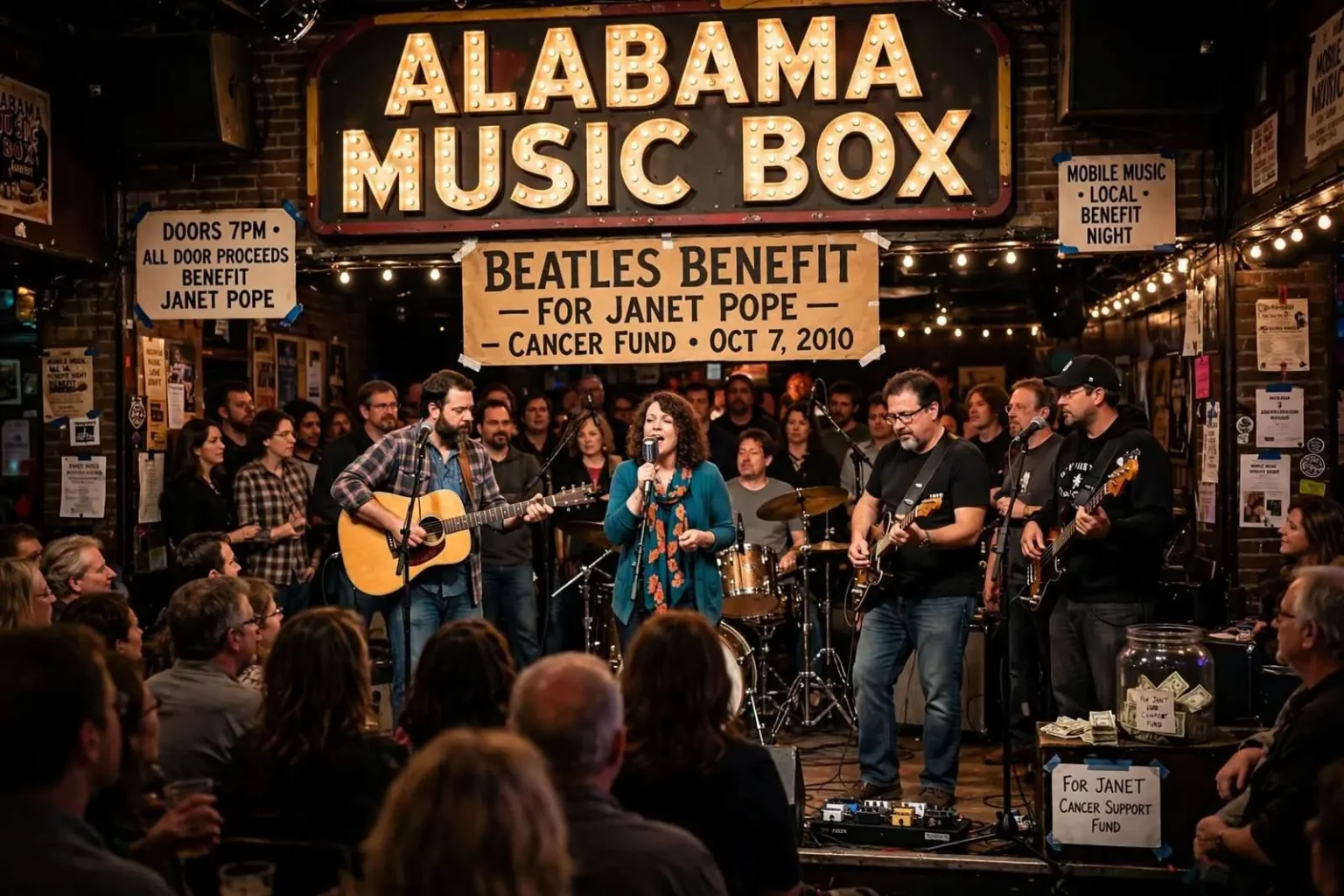
Downtown Mobile’s Alabama Music Box turned into an all-Beatles songbook on October 7, 2010, as local musicians gathered for a benefit show supporting Janet Pope, a local mother battling cancer. Acts from across the Mobile music scene took turns working through the Fab Four’s catalog, with door proceeds going toward Pope’s fight. The venue on Dauphin Street, a staple of the downtown entertainment district, provided the setting for a night when the city’s club circuit set aside its usual mix of originals and covers to play a single songbook — one of the most familiar in popular music — for the benefit of one of their own.
Benefits of this kind run on the willingness of performers to give up a paying Friday and learn material outside their normal sets, and the October 7 lineup showed how deep that willingness runs in Mobile. The artists who took the stage spanned genres and generations of the city’s music scene, from veteran club performers to younger acts still building their followings. Each brought a handful of Beatles songs, and the relay format meant the audience heard the evening’s catalog filtered through a dozen different styles — folk arrangements, rock treatments, duo harmonies — rather than one band’s single take on the material.
Choosing the Beatles catalog for a benefit is a practical decision as much as a sentimental one. Because the songs are universally known, acts that had never shared a stage could coordinate a set with minimal rehearsal, and the audience could sing along with every number. Door proceeds — the money taken at the entrance over the course of the night — formed the core of the evening’s fundraising, making turnout itself the measure of the show’s success. For a local family facing the costs that come with cancer treatment, a packed room on a Thursday night in downtown Mobile translated directly into support.
The Lineup
The bill stretched across the Mobile scene’s map. Andy and Kevin of Fat Man Squeeze brought the long-running act’s dual songcraft to the Beatles material, and singer Heather Heart added her voice to the night’s roster. Robbie Morgan and Luke Andrianopoulos performed, alongside Tony T., each taking a turn with selections from the catalog. The duo Under the Tree, featuring Ashelea Penquite and Katelyn Merrill, contributed paired harmonies suited to the Lennon-McCartney songbook, and the band Green Lights appeared as well, along with The Blackjacks rounding out the list of full acts on the bill.
The evening closed with a sprawling Beatles tribute outfit assembled specifically for the show, pulling players from across the local scene into one band: Chris Murman, David Manning, Duane Knight, Jonah Star, Greg Yates and Aaron O’Brien. Putting that many musicians into a single lineup is a hallmark of benefit shows, where the goal is to give as many scene members a role as possible while building toward a finale that feels like the whole community on stage at once. Special guest Dana Lee joined the tribute outfit for the set, giving the closing block of the night its headline moment.
For the musicians themselves, the show doubled as a reunion. Members of bands that normally play separate venues and separate circuits found themselves sharing a green room and, eventually, a stage. That crossover is part of what benefits do for a local scene — they remind audiences that the acts they follow in isolation are part of one community, and they remind the musicians that the network they have built can be pointed at something more urgent than a Saturday-night billing.
A Community That Shows Up
Nights like this one have become a familiar show of force for Mobile’s close-knit music community, which has repeatedly rallied around members and neighbors facing medical bills. Across the Gulf Coast, where club-level musicians rarely carry the kind of insurance that cushions a medical crisis, benefit shows are the scene’s informal safety net — organized quickly, staffed by volunteers, and promoted through the same word-of-mouth channels that fill the clubs on weekends. Mobile’s circuit has a long history of them, and the turnout for the Alabama Music Box show continued a pattern familiar to anyone who has watched the city’s musicians respond to a family in need.
The Alabama Music Box itself has been a recurring home for such events. As a downtown venue on Dauphin Street, it sits at the center of the strip where Mobile’s live music audiences already congregate, which makes it the natural choice when organizers need a room that regulars know how to find. Its stage and layout accommodate the kind of rotating multi-act bill the Pope benefit required, with load-in and changeovers timed tightly enough to keep the music nearly continuous from the first act to the last.
The structure of the night also reflected the realities of fundraising at the club level. Rather than selling tickets in advance, the show relied on the door — every attendee’s cover charge flowing directly to the cause — supplemented by whatever the venue and performers could encourage over the bar. That model keeps overhead at zero and sends a clear message: the more people who come, the more the family receives. It also gives the beneficiary’s story a human presence in the room, as friends and family members mix with the crowd alongside the musicians donating their time.
One Night, One Songbook
The Beatles catalog proved to be the right common language for the occasion. Spanning moods from heartbreak to exuberance, the Lennon-McCartney songbook let the night’s performers move between tender acoustic numbers and full-band rock without ever losing the audience, and it gave the tribute finale material that every player on stage already knew by heart. Few bodies of work could absorb the range of styles represented on the bill — from Fat Man Squeeze’s veterans to the young duo Under the Tree — while still sounding like a single, coherent evening of music.
For Janet Pope and her family, the evening’s value extended well beyond the money raised at the door. A packed room of neighbors and musicians is a statement of standing in the community, and for a family absorbing the strain of long-term illness, that support matters in ways that are hard to price. The musicians who organized and played the show offered their labor the only way a music scene knows how: by playing.
For one October evening on Dauphin Street at least, every number was a Lennon-McCartney classic — and every one of them was for a good cause. The show joined the long line of benefit nights that have become part of Mobile music culture, and it left the Alabama Music Box’s audience with a reminder that the scene they support on ordinary weekends is capable of organizing something bigger when one of its own needs it. The October 7 show stands as one more entry in the city’s quietly maintained tradition of musicians taking care of their community, one packed house at a time.
The mechanics of mounting a benefit show in a matter of weeks say a great deal about how the Mobile scene operates. There is no promoter’s office coordinating these events and no payroll covering them; typically a handful of musicians and venue staff divide the work — booking the acts, printing the flyers, spreading the word through social media and word of mouth, and arranging the changeovers so a dozen acts can share one stage in a single night. Performers volunteer their sets, sound engineers donate their hours behind the board, and the venue opens its doors on a night it might otherwise sit dark. Every element of the evening is a donation, which is why the door take matters so much: nearly all of it flows to the family the show exists to help.
The multi-act format carries its own challenges. Twelve performers and ensembles on one bill means back-to-back changeovers, shared backline equipment, and set lengths short enough to keep the evening moving. That the October 7 show held together at all is a credit to the coordination of the musicians involved, many of whom have played enough shared bills in Mobile’s clubs to run a smooth handoff almost by habit. The closing tribute band, drawing six players plus a special guest from across the evening’s roster, turned that familiarity into the night’s centerpiece, assembling in real time a band that had no other reason to exist than this show.
Dauphin Street as a Gathering Place
The choice of Dauphin Street for the benefit placed the event at the heart of Mobile’s nightlife geography. The downtown corridor has spent years rebuilding itself as the city’s entertainment district, with clubs, bars, and music rooms within a few blocks of one another, and a strong draw at one venue tends to lift the whole street’s foot traffic for the night. On October 7, that gravity worked for the benefit: music fans who came downtown for the evening found their usual night out repurposed, their cover charge redirected from a standard show to a neighbor’s medical fight.
It also meant the audience for the benefit extended beyond the regular club crowd. Benefit shows draw the extended network of a family under strain — coworkers, church friends, neighbors, and relatives who may not set foot in a music venue on a typical weekend but will come out when the cause is personal. Mixing that crowd with the scene’s regulars is part of what gives these nights their energy, and part of why local musicians keep organizing them. The room on October 7 held both audiences at once, united by a songbook everyone knew.
As the night wound down, the accounting was straightforward: a stack of performances donated, a venue given over to the cause, and door proceeds collected for Janet Pope’s fight against cancer. In the economy of a local music scene, that is what mutual aid looks like — no committees, no campaigns, just a phone tree of musicians agreeing on a date and a songbook. Mobile’s circuit has performed this ritual many times before and, on the evidence of the Alabama Music Box turnout, will perform it again whenever the need arises.