Mobile Panhandling Sign Campaign Asks Public to Give to Homeless Groups, Not Cash
The City of Mobile has begun posting signs, starting in Bienville Square, that urge people not to give cash to panhandlers and instead donate to the United Way of Southwest Alabama through a QR code.
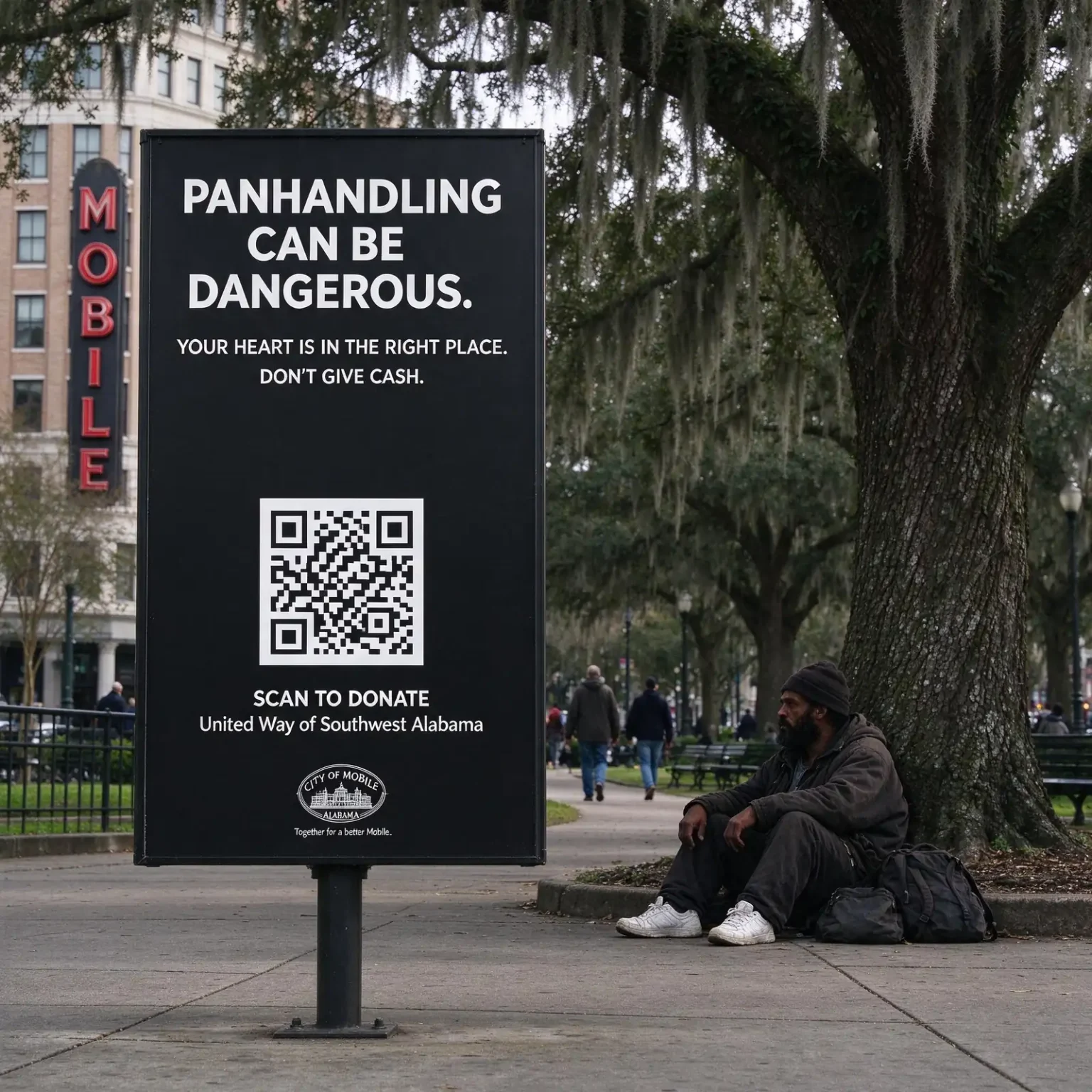
MOBILE, Ala. — The City of Mobile has launched a Mobile panhandling sign campaign that asks residents and visitors to stop handing cash to people asking for money on the street and instead give to nonprofit organizations that work with people experiencing homelessness. The first sign went up Wednesday, Oct. 28, in Bienville Square in the heart of downtown, and city officials say more will follow in places where panhandling is common.
The signs carry a short, direct message: “Panhandling can be dangerous. Your heart is in the right place. Don’t give cash.” Below the text, a QR code sends anyone who scans it to the donation portal of the United Way of Southwest Alabama, where people can give money that will be used to fund services for people who are homeless.
The reverse side of each sign is aimed at a different audience. Under the heading “Unhoused? Get help,” it lists contacts for local resources and includes a second QR code that connects people without stable housing to services that may be able to help them.
Why the city launched the Mobile panhandling sign campaign
In a news release announcing the initiative, the city said that cash handed directly to someone on a street corner does not provide the kind of coordinated support needed to address the complicated problems behind homelessness. Officials went further, saying that giving cash can actually prolong the very circumstances that keep people on the streets instead of helping connect them with resources that could move them forward.
“These coordinated efforts focus on addressing the underlying challenges that contribute to homelessness and the need for greater stability,” the release said.
The city said the signs are meant to “reinforce a simple but important message: By working together and directing assistance through organizations equipped to help, our community can make a more meaningful impact.”
Dr. Kendell Young, the homeless outreach coordinator for the City of Mobile Department of Public Safety, said he understands why people reach for their wallets when they see someone in need.
“My team and I travel across the city frequently, meeting with unhoused individuals, doing our best to put a name with each face we encounter,” Young said in the release. “I understand giving cash comes from a place of compassion, and we all want to help, but donating money to these organizations directly and connecting these individuals with these resources can really help amplify our efforts to ensure they’re on the right track to overcome the challenges they’re facing.”
‘Instant relief’ versus lasting help
Speaking in Bienville Square, Young said a handout may solve a problem for a few hours but does little to change a person’s situation.
“The reality is it provides instant relief, but that’s really not going to solve the problem of an individual that’s unhoused,” Young said. “You may get them a meal today, but if they go to a shelter, they can get a meal, three meals for that day.”
Young said people who are homeless often face deeper challenges, including mental illness and addiction, and that money directed to service providers can help pay for the kind of care that addresses those needs.
“We don’t want anybody out panhandling. We want these individuals helped. We want these individuals connected to the services,” Young said. “And I think when you get innovative and think of ways, different ways that you could potentially change the outcome, that is what this is all about. It’s trying to help our unhoused population in a different way.”
Outreach team works the streets daily
The signs are one piece of a broader effort run through the Department of Public Safety’s Homeless Outreach Team. According to the city, the team works alongside community partners to help people experiencing homelessness find housing or shelter, obtain identification and reach other resources that support stability, well-being and, ultimately, self-sufficiency.
Identification is a practical hurdle that is easy to overlook. Without a state ID or other documents, people can have trouble applying for jobs, renting an apartment, opening a bank account or enrolling in benefit programs, which is why outreach programs in many cities treat replacing lost or stolen documents as an early step.
Young acknowledged that not everyone living on the street owns a smartphone that can scan the “Get help” QR code on the back of the signs. For those people, he said, the outreach team goes to them.
“For those individuals that don’t have electronic devices,” Young said, “we ride the streets daily, engaging those individuals, trying to connect them to various services as we talk with them.”
Residents react to the new signs
Reactions from people passing through downtown Mobile were mixed.
Glen Higdon said he often sees people panhandling and feels for them, but he has chosen not to give them cash.
“I see them a lot,” Higdon said. “I do feel guilty. I don’t give to them because I feel like it could be just enabling. But, you know, it’s just a sad situation.”
After looking at the sign, Higdon scanned the QR code and made a donation to the United Way.
Not everyone was persuaded. One woman who stopped by the sign said she does give money directly to people who ask for it and questioned the idea of telling the public not to.
“It’s nice that the city is trying to help the homeless, but I mean, why not just give the homeless the money directly if you have it on spot?” she said. She added that while organizations can help, “you can’t tell people whether to not give money to the homeless, because how else are they supposed to get their money.”
What the numbers show
The most recent federal point-in-time count found 497 people experiencing homelessness in Mobile and Baldwin counties, down from 675 in 2024.
Point-in-time counts are required by the U.S. Department of Housing and Urban Development for communities that receive federal homelessness funding. Volunteers and service providers fan out on a single night, usually in the last 10 days of January, to count people staying in shelters and transitional housing as well as those sleeping outside, in cars or in other places not meant for people to live.
Because the count captures only one night, it is a snapshot rather than a full tally of everyone who lacks stable housing over the course of a year. People who are doubled up with friends or relatives, or who move in and out of motels, may not be counted at all. Even so, the counts are widely used to track trends over time and to help direct federal dollars.
Panhandling is legal and protected speech
The new campaign does not change any law. Panhandling is not illegal in Mobile and is considered protected speech, which means the city’s approach relies on persuasion rather than enforcement.
Across the country, courts have struck down a number of local ordinances that broadly banned or restricted asking for money in public, finding that they violated the First Amendment. Many of those rulings followed the U.S. Supreme Court’s 2015 decision in Reed v. Town of Gilbert, which tightened the standard for laws that regulate speech based on its content. As a result, many cities have turned to public education campaigns like Mobile’s instead of trying to prohibit panhandling outright.
Mobile is not the first city to try this approach. Houston, Texas, and Savannah, Georgia, are among the cities that have posted similar signs encouraging people to give to service organizations instead of to individuals.
About Bienville Square
The city chose a high-profile spot for its first sign. Bienville Square, bounded by Dauphin, St. Francis, St. Joseph and Conception streets, is one of downtown Mobile’s best-known gathering places, with its large live oaks, cast-iron fountain and steady foot traffic from office workers, tourists and visitors to nearby restaurants and shops. The park takes its name from Jean-Baptiste Le Moyne, Sieur de Bienville, the French colonial leader who founded Mobile in 1702.
Because the square draws so many people, it is also a place where people asking for money are often seen, which made it a logical starting point for a campaign meant to reach the public where giving decisions are made.
How residents can help
City officials are asking the public to “be a part of the solution.” They encourage residents to take an active role by making informed choices about how they give, supporting local service providers and helping connect people experiencing homelessness with the resources they need to pursue stability.
- Give through the signs: Scan the QR code on the front of any campaign sign to reach the United Way of Southwest Alabama’s donation portal.
- Find help: People who are unhoused can scan the QR code on the back of the sign, marked “Unhoused? Get help,” to be connected with local services.
- Where to look: The first sign stands in Bienville Square in downtown Mobile. More signs are planned for locations around the city where panhandling occurs.
- Outreach: The Mobile Department of Public Safety’s Homeless Outreach Team works the streets daily to connect people with shelter, housing, identification and other services.
What comes next
Young said the sign in Bienville Square is only the beginning and that similar signs will eventually be posted throughout the city. The city has not said how many signs it plans to install or a timeline for completing the rollout.
For the outreach team, the goal remains the same with or without the signs: to meet people where they are, learn their names and stories, and steer them toward help that lasts longer than a single meal or a few dollars. The city is betting that if more of the community’s generosity flows through organizations built to deliver that help, more people will be able to make the move from the street to stable housing.
Related coverage from South AL News
- Mobile Council Authorizes $200,000 Federal Grant Bid to Expand Homeless Outreach Team
- Social Security Now Accepts Mobile's Homeless ID Card as Supporting ID
- South Alabama Students Build Homeless Housing App to Match Mobile's Unhoused With Open Rooms
- United Way of Southwest Alabama to Kick Off 2026 Campaign at Mobile Breakfast