

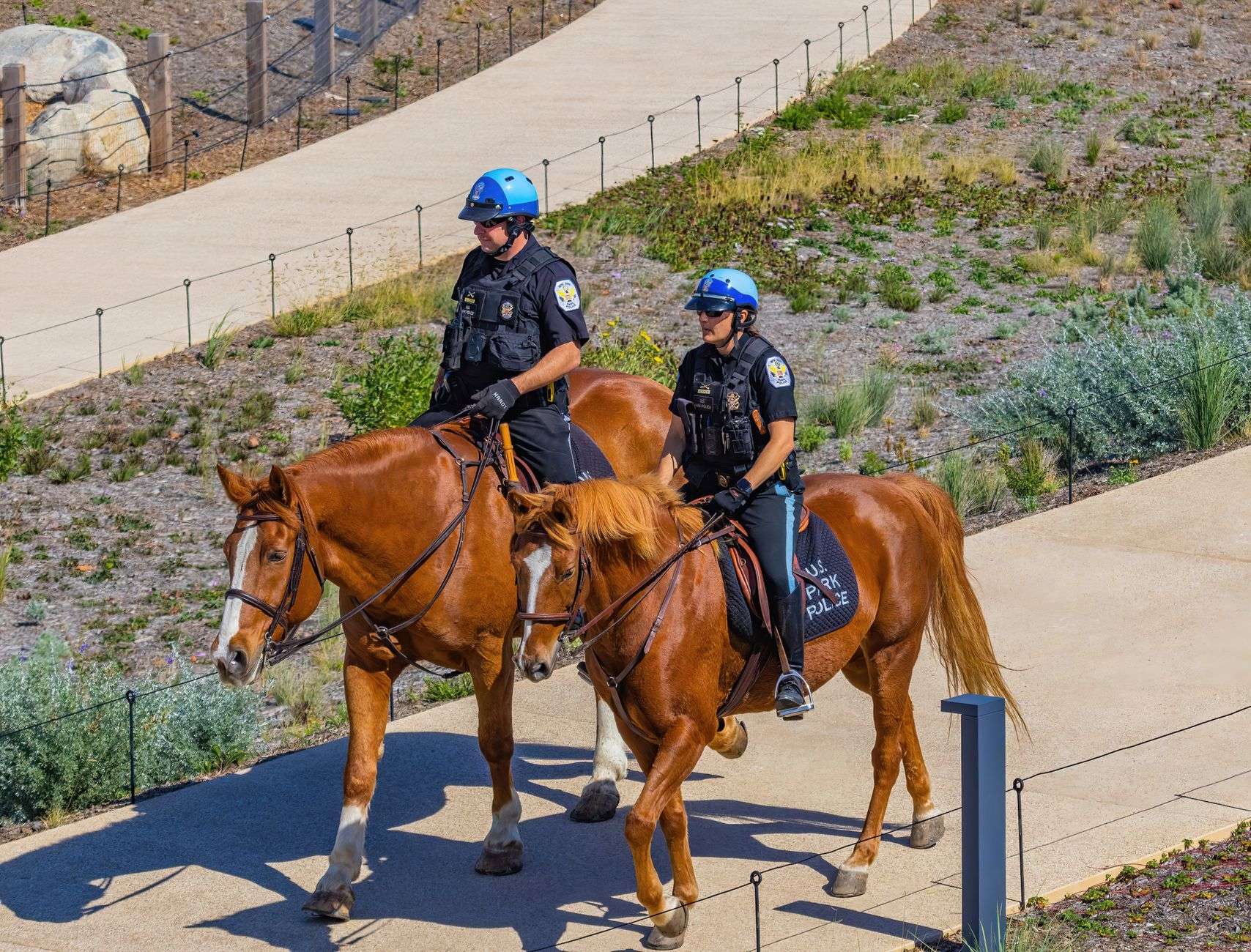
MOBILE, Ala. — Five Mobile police officers and their horses are spending this week in Oxford, Mississippi, helping local law enforcement manage what is expected to be one of the loudest college football environments of the season.
The occasion is Lane Kiffin’s return to Ole Miss as head coach of the LSU Tigers — a game that had Oxford building up its police presence well before kickoff.
Oxford’s roughly 150-person department is being supplemented Thursday through Saturday by mounted units from Mobile and New Orleans, an Oxford Police Department spokesperson said.
For Mobile, this is neither unusual nor expensive. It is one half of a long-running trade.
A Fifteen-Year Exchange
Mobile’s mounted unit regularly assists other departments, and those departments return the favor when Mobile needs them — which, in the Port City, means Mardi Gras.
“In turn, we utilize Oxford PD and other agencies during large-scale events like Mardi Gras,” said Blake Brown, public affairs manager for Mobile’s Department of Public Safety.
“This training is important because it allows other agencies to better prepare their officers for the sights and sounds along parade routes when riding a horse or maneuvering tight routes on a motorcycle.”
Brown said the partnership with Oxford goes back more than 15 years, and that the cost to Mobile this week is essentially a fuel bill.
“The only expense for the Mobile Police Department will be for fuel to and from Oxford this week,” Brown said. “We’ve been partnering with the Oxford Police Department for more than 15 years. These partnerships are beneficial and allow our officers to work in other areas, bringing back additional knowledge and skills that could be utilized right here at home.”
That last clause is the part worth sitting with. The arrangement is described as training, not merely as staffing, and the training runs in both directions.
Why Departments Still Use Horses
Mounted police can look like a ceremonial holdover until you watch one work a dense crowd, at which point the logic becomes obvious.
A mounted officer sits roughly ten feet off the ground. That elevation produces two effects at once. The officer can see across a crowd that a foot patrol cannot see through — spotting a fight, a fall or a medical emergency several rows deep. And the officer is visible from a distance, which is what allows a crowd to self-organize around a moving line rather than having to be pushed into one.
The commonly cited rule of thumb in crowd management is that a single mounted officer can do the work of a substantial number of officers on foot when the task is moving or holding a crowd. The reason is not force. It is presence and sightlines. People yield space to a horse instinctively, without a confrontation having to occur.
Horses also go places vehicles cannot. A patrol car is useless in a packed pedestrian area; a horse moves through it at walking pace.
The Training Problem the Exchange Solves
The difficulty with mounted policing is that the horse has to be conditioned to environments that run against every instinct a horse has.
Horses are prey animals. Their default response to sudden noise, close crowds, flashing lights, brass bands and airborne objects is to move away from all of it, quickly. A police horse working a parade route or a stadium crowd has to do the opposite — stand in the middle of the noise and stay steady.
That conditioning cannot be fully manufactured in an arena. It requires exposure to the real thing, repeatedly, under supervision, which is exactly what Brown described: officers and horses getting practice with “the sights and sounds along parade routes.”
Mobile has an advantage here that few American cities can match. Mardi Gras in Mobile runs for weeks and produces dozens of parades with marching bands, throws, floats and crowds packed against barricades — an unusually demanding and unusually repeatable training environment. Departments that want their horses seasoned in that setting come to Mobile. Mobile, in turn, gets help staffing a season that would otherwise strain its own roster.
A college football Saturday in Oxford is a different stressor with overlapping features: tailgating crowds on the Grove, heavy pedestrian flow into and out of a stadium, alcohol, and noise. Working it is training for Mardi Gras. Mardi Gras is training for it.
Why Mobile Is the One Lending Horses
It is worth asking why a department in coastal Alabama is the one with capability to spare in September.
The answer is Mobile’s calendar. The city’s Mardi Gras season is one of the longest and most parade-dense civic events in the country, and Mobile’s claim to the oldest organized Carnival celebration in the United States is not a marketing line — it is the basis for a public safety operation that has been refined over generations.
Policing dozens of parades over several weeks, with hundreds of thousands of cumulative attendees pressed against barricades along fixed routes, requires a specific set of skills: managing a moving crowd, holding a line without escalating, working alongside marching bands and float traffic, and doing it for hours at a stretch. A department that does this every winter accumulates institutional knowledge that most agencies simply have no occasion to build.
That expertise is exportable. When Oxford needs help with a stadium crowd, or another city needs help with a festival, Mobile has both the equipment and the practiced personnel. The reciprocity is what makes it sustainable: Mobile cannot staff its own Carnival season entirely in-house either, so the favors it does in September are effectively deposits against February.
Two Cities, Two Mounted Units
The presence of both Mobile and New Orleans in Oxford this week is itself a small illustration of how this network operates.
The two cities share a Carnival tradition and a history of cooperating on the public safety side of it. Both maintain mounted capability in part because both spend weeks each year policing parade routes. Sending units to the same event in Mississippi means their officers train together in a third jurisdiction, under conditions neither controls, which is more useful than either could arrange at home.
For Oxford, the benefit is simpler: two experienced mounted units arrive already knowing how to work a crowd, requiring no local training investment and no permanent line item.
What a Football Saturday Demands
Game-day crowd management in a college town is a distinct problem from a parade.
A parade has a fixed route, a known direction of travel and a defined start and end. A football Saturday is diffuse: tailgating spread across a campus for most of a day, a compression period as tens of thousands of people funnel toward a stadium, three hours inside, and then a sudden simultaneous release in every direction at once.
The hours before and after kickoff are where mounted officers do their most useful work, because those are the periods when the crowd is dispersed across open ground and moving. An officer on horseback covers considerably more territory than one on foot, sees over the crowd, and can reach a developing problem through pedestrian congestion that would stop a vehicle.
Multiply that by a game carrying more than the usual attention, and the case for borrowing capability from two other states becomes straightforward arithmetic.
Mutual Aid, Without the Paperwork Problem
Arrangements like this one fall under the general heading of mutual aid — agreements that let agencies lend personnel and specialized resources across jurisdictional and state lines for planned events and emergencies.
Specialized units are where mutual aid earns its keep. Most departments cannot justify maintaining a mounted unit, a bomb squad or a marine division for the handful of days a year they would use one. Sharing them across a network of departments is how mid-sized agencies get access to capabilities that would otherwise be out of reach.
The economics on display in Oxford this week illustrate the point. Mobile is fielding five mounted officers in another state for three days and paying for fuel. The value it receives is not a reimbursement check. It is help during Mardi Gras and a set of officers and horses who have worked an unfamiliar high-intensity crowd and come home better at it.
What Oxford Is Preparing For
The staffing buildup reflects a specific expectation about this particular game.
Kiffin coached Ole Miss before taking the LSU job, and his return to Oxford in an opposing team’s colors is the kind of storyline that fills a town well beyond a normal home weekend. Oxford is a small city that already absorbs enormous crowds on football Saturdays; a game carrying this much additional attention stretches a 150-person department further than usual.
Bringing in mounted units from Mobile and New Orleans is a straightforward response — add visible, mobile crowd-management capability in the pedestrian areas where it does the most good, and keep the local officers available for everything else.
For Mobile, the officers head home after Saturday. The horses will be back on parade routes soon enough.