
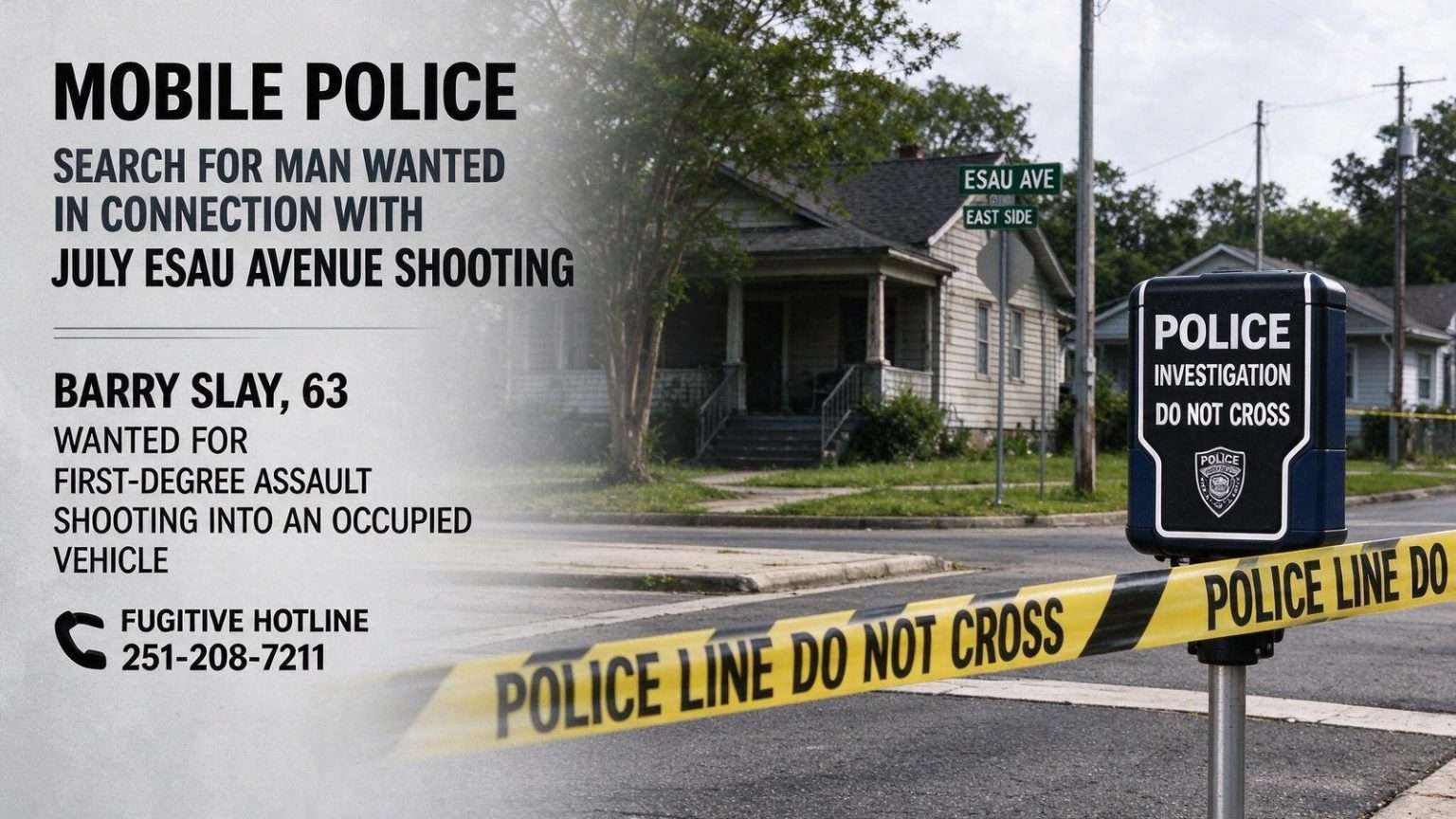
Mobile police are asking for the public’s help locating a man wanted in connection with a shooting late last month that stemmed from an argument on the city’s east side.
Investigators are searching for Barry Slay, 63, who is wanted in the July 27 shooting on Esau Avenue. Police said the shooting followed an argument between those involved. Slay faces charges of first-degree assault and shooting into an occupied vehicle.
The case unfolded on a residential street on Mobile’s east side, where police responded to the July 27 shooting and opened an investigation into the circumstances surrounding it. Investigators say the violence grew out of an argument between the parties involved, a dynamic that appears repeatedly in violent crime statistics: disputes that escalate, weapons that turn disagreements into felonies, and neighborhood blocks left to cope with the aftermath. Police have not released additional details about the nature of the argument that preceded the shooting or the extent of any injuries involved, citing the ongoing investigation.
The search for Slay has now moved into its fugitive phase, with the department’s investigators working to locate him and the public asked to help. Authorities emphasize that locating a wanted suspect safely depends heavily on tips from residents — people who recognize a name or face, notice someone staying with a relative, or spot a vehicle tied to a case.
The Charges and What They Carry
First-degree assault is a Class B felony under Alabama law, typically involving an act that causes serious physical injury to another person through the use of a deadly weapon or dangerous instrument. In practical terms, the charge is reserved for the most serious assault cases short of attempted murder — incidents where a victim suffered grave injury, or where the manner of the attack itself demonstrated extreme indifference to human life. Class B felonies in Alabama carry significant prison terms upon conviction, placing the offense among the most serious on the state’s criminal code below Class A crimes.
Shooting into an occupied vehicle is also treated as a serious felony offense in Alabama, reflecting the danger such conduct poses not only to the intended target but to bystanders and other motorists. The law recognizes that a bullet fired into a car endangers everyone in and around it: passengers who may have nothing to do with a dispute, drivers on surrounding streets, and residents of nearby homes. Because the act combines firepower with the unpredictability of a moving or occupied vehicle, legislators have treated it as a crime whose consequences can extend far beyond whoever the shooter aimed at.
Together, the two charges indicate the seriousness with which prosecutors view the Esau Avenue case. Charging decisions of this kind typically follow a review of evidence gathered in the immediate aftermath of a shooting — witness accounts, physical evidence, and the statements of those involved — and they set the legal stakes for any eventual arrest and prosecution.
How the Public Can Help
Mobile police are asking anyone with information about Slay’s whereabouts to come forward. Tips can be submitted to the Mobile Police Department’s Fugitive Hotline at 251-208-7211. Callers may remain anonymous.
The anonymity option matters. Many of the tips that resolve fugitive cases come from people who know the suspect personally — relatives, acquaintances, neighbors — and who would hesitate to attach their names to a police report involving someone from their own circle. Anonymous tip lines lower that barrier, allowing information to reach investigators without exposing callers to social friction or retaliation. Departments across the country credit such lines with closing thousands of cases, and Mobile’s fugitive unit treats the hotline as a primary investigative tool.
Residents with information can also expect the process to be straightforward: a call to the hotline, a description of what they know, and a pass-along to the investigators working the case. Police advise the public not to approach or confront a wanted suspect directly — locating and apprehending an armed-felony suspect is work for trained officers, and civilian intervention risks turning a tip into a tragedy.
The Investigation Continues
Esau Avenue is located in Mobile, and police continue to investigate the circumstances surrounding the shooting as the search for Slay continues. That dual track — active investigation and active manhunt — is standard in cases like this one. Investigators keep working the original incident: re-interviewing witnesses, following up on forensic results, and building the case file that will matter if and when an arrest is made. Meanwhile, the fugitive side of the house works locations, associates, and tips to find the suspect.
For the neighborhood where the shooting occurred, the unresolved case keeps a wound open. Residential streets recover slowly from gunfire; residents remember where it happened, and the visible absence of an arrest can feed a sense that the justice system has moved on. Departments counter that perception with periodic public appeals like this one, which serve both an operational purpose and a reassuring one — telling the neighborhood that the case remains active and that the person police believe responsible has not been forgotten.
The July 27 shooting also joins the broader public conversation about dispute-related violence in American cities. Police officials consistently note that arguments — over money, relationships, respect, parking, anything — remain the leading precipitant of serious violence, which is why conflict de-escalation programs and community intervention efforts have drawn investment in cities across the country. Mobile has participated in that trend through community policing initiatives and violence-prevention partnerships aimed at interrupting exactly the kind of escalation police describe in this case.
Understanding the Legal Process Ahead
Should Slay be located and arrested, the case would move through the standard sequence that felony prosecutions follow in Mobile County. An arrest on outstanding warrants leads to booking and an initial appearance, where the charges are formally presented and bond is addressed. From there, the case proceeds to a preliminary hearing or grand jury review, where a district judge or grand jury determines whether probable cause supports advancing the charges to trial in Circuit Court.
The presumption of innocence applies fully throughout. An arrest warrant and criminal charges are allegations, not findings of guilt, and the prosecution would bear the burden of proving every element of both charges beyond a reasonable doubt. The severity of the charges, however, shapes the stakes: a Class B felony conviction in Alabama can bring a prison sentence measured in years, and convictions on multiple felony counts frequently run consecutively.
Victims and witnesses in cases like this one are supported by the county’s victim services apparatus, which keeps those affected informed of court dates and connects them with resources. Witness cooperation often proves decisive in argument-related shootings, where the people closest to the dispute are the ones who saw what happened — and where the decision to testify can be a difficult one.
The Broader Role of Public Appeals
Public appeals like the department’s announcement about Slay are a fixture of modern policing, and their design has evolved alongside media habits. A fugitive notice today travels farther and faster than its predecessors: picked up by local news outlets, shared across social platforms, and seen by thousands of residents within hours of release. Departments structure these appeals to give the public exactly what investigators need — a name, an age, the charges, and the number to call — while withholding details that could compromise the prosecution.
The Mobile Police Department’s use of its fugitive hotline reflects that division of labor. The public contributes sightings and information; sworn investigators evaluate, corroborate, and act. Every tip, even one that seems minor — a sighting weeks ago, a phone number, a relative’s address — becomes one more data point in the search. Cases have been closed on the strength of a single call months after an appeal first aired.
Until Slay is located, the department’s message to the public remains the same: if you know where he is, call the Fugitive Hotline at 251-208-7211, and let investigators handle the rest. The Esau Avenue case, for now, stands as an open file — a July argument that ended in gunfire, two serious felony charges, and a 63-year-old man whose whereabouts Mobile police are asking the city’s help to find.
Residents who live near Esau Avenue and the surrounding east side blocks will be watching for that resolution. Neighborhoods affected by unsolved violent crime tend to organize informally — church groups, block associations, family networks — and those structures are often where tips originate before they ever reach a phone line. The department’s appeal is, in part, an invitation to those networks: the people best positioned to help find Slay are the ones who know him, and the anonymous hotline exists precisely so that knowing him does not have to stand in the way of helping.


