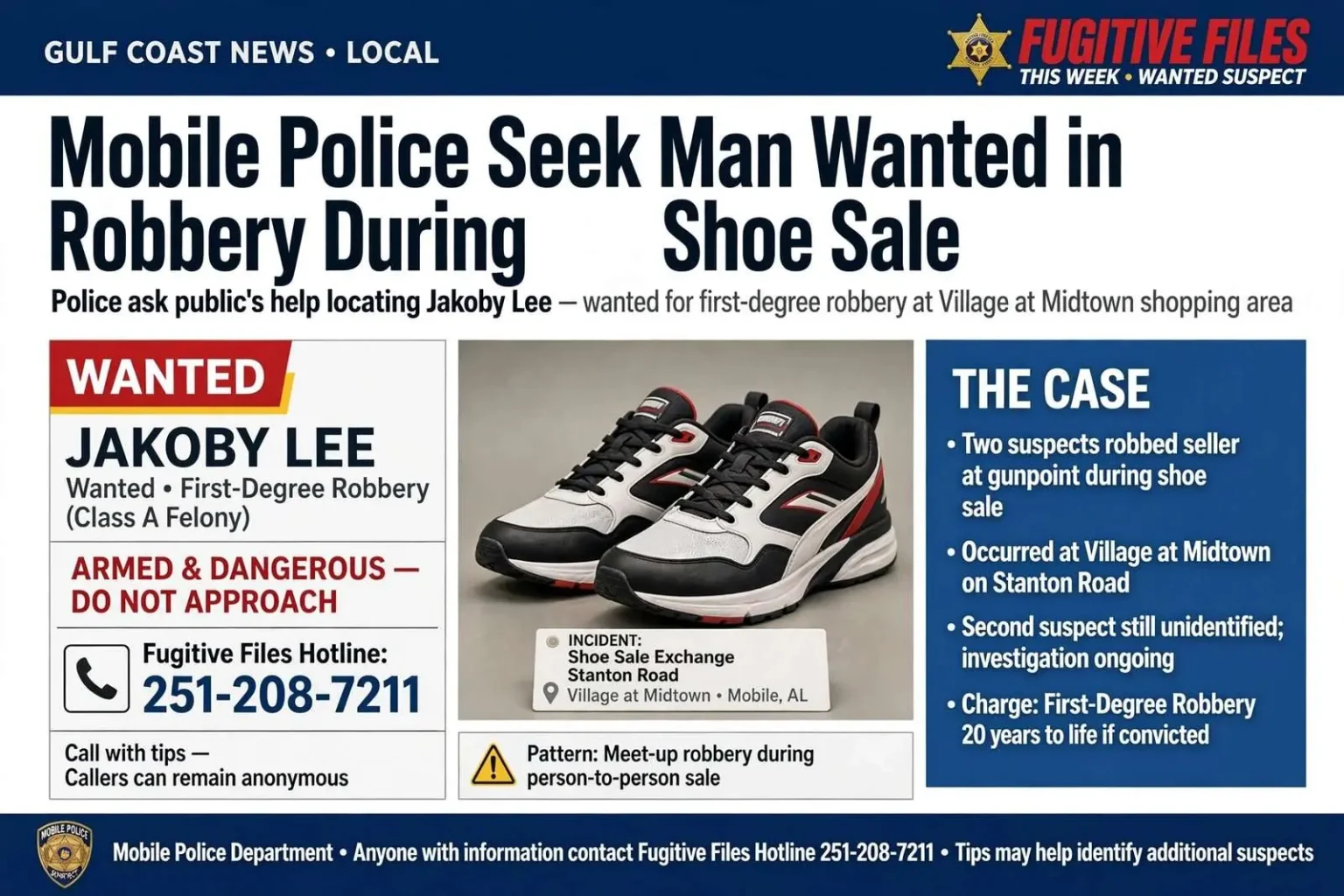
Mobile police are asking for the public’s help finding a man wanted in connection with an armed robbery, featuring him on this week’s edition of Fugitive Files. The long-running program pairs the department with local media to put wanted suspects’ faces in front of thousands of viewers, a format that has generated tips in cases across the city for years.
Investigators are looking for Jakoby Lee, who is wanted on a charge of first-degree robbery. Under Alabama law, first-degree robbery is a Class A felony — the most serious robbery classification — and it applies when a perpetrator is armed with a deadly weapon or causes serious physical injury during the offense. A conviction can carry a sentence of twenty years to life in prison.
According to police, a man had arranged to sell a pair of shoes when two people robbed him at gunpoint during the exchange. What was set up as a routine transaction between a seller and a buyer turned into a holdup the moment the seller produced the merchandise, a pattern detectives say they have seen repeat itself across Mobile in recent years as person-to-person sales moved from storefronts to phones and social media.
The robbery took place on Stanton Road at the Village at Midtown, a shopping and residential area in Mobile. The Midtown location — a mixed commercial district that draws steady foot and vehicle traffic throughout the day — is the kind of setting criminals sometimes choose precisely because it looks safe: buyers and sellers expect the public visibility of a shopping area to protect them, and robbers know their victims will show up carrying cash and merchandise.
Police say the investigation remains active and that additional arrests are possible as detectives continue working to identify everyone involved in the robbery. The reference to two suspects in the robbery itself, and the open question of whether others assisted before or after the fact, means the case is not closed with the identification of a single fugitive.
Anyone with information on Lee’s whereabouts is asked to call the Fugitive Files Hotline at 251-208-7211. Tipsters’ information goes to investigators working the case directly, and the hotline operates as a standing channel for the public to report wanted suspects without wading through general police dispatch lines.
How Fugitive Files Works
Fugitive Files has been a fixture of Mobile-area crime fighting for years, presenting a rotating lineup of suspects wanted on outstanding warrants. Each edition pairs photographs and charges with a direct hotline number, converting thousands of casual viewers into a distributed network of potential tipsters.
The format works because visibility is a fugitive’s enemy. A suspect who can move around town unrecognized is dangerous; a suspect whose face has been broadcast across the Gulf Coast has to change routines, avoid familiar places and depend on friends willing to take on legal risk by harboring them. Departments across the country have adopted similar programs precisely because tips generated by media exposure account for a meaningful share of fugitive captures.
Tips can help investigators track down Lee and determine whether other suspects connected to the case are still at large. Even partial information — a vehicle description, a neighborhood where the suspect was seen, a nickname connecting him to an associate — can advance a case, and investigators can follow up on hotline tips without revealing who called.
Mobile police routinely remind the public not to approach wanted suspects directly. Fugitives facing serious felony charges have little to lose by fleeing or fighting, and the department’s standing guidance is to observe, remember details and call — a division of labor that keeps civilians safe and leaves apprehension to trained officers.
First-Degree Robbery Under Alabama Law
The charge Lee faces reflects the elements investigators believe the case contains. Alabama’s robbery statute escalates by degrees: third-degree robbery covers force or threats in the course of a theft; second-degree adds serious injury or an accomplice; first-degree — the top tier — attaches when the robber is armed with a deadly weapon or inflicts serious physical injury.
Committing a theft with a gun, as police describe here, places the offense squarely in the first-degree category regardless of whether the weapon was fired or whether the victim was physically harmed. The classification matters for victims and prosecutors alike: it signals how seriously the justice system treats the moment a property dispute becomes an armed confrontation.
For the victim, the aftermath of an armed robbery typically involves more than the loss of merchandise. Detectives work with victims to document the incident, recover any evidence from the scene and prepare identification procedures, and victims of violent felonies are connected to support services through the district attorney’s office and state victim assistance programs.
Meet-Up Sales Have Become a Policing Problem
Robberies tied to online or in-person sales of personal items have become a recurring concern for local law enforcement, who routinely urge residents arranging such transactions to meet in well-lit, public locations, ideally in view of security cameras, and to consider using a police department’s designated safe-exchange zone when available.
The rise of social media marketplaces and classified apps made person-to-person sales effortless — and created a new crime pattern to match. Sellers advertise sneakers, phones, game systems or jewelry, agree to meet a “buyer,” and are met instead by someone with a weapon who takes both the merchandise and any cash on hand. Because the parties are strangers who connected online, robbers count on anonymity to shield them.
Sneakers sit near the top of the risk list. Limited-release shoes routinely resell for hundreds of dollars, creating a cash-heavy, portable, untraceable commodity that draws both genuine collectors and criminals. Police departments nationwide have logged robbery patterns built almost entirely around shoe deals, and the Mobile case fits the profile: a valuable pair, a meet-up, and a gun at the moment of exchange.
Safe-exchange zones answer that risk directly. The Mobile Police Department, like departments across the country, designates spots near its headquarters — typically in the parking lot, under camera coverage, close to the station itself — where buyers and sellers can complete transactions. Robbers know the zones are monitored, and legitimate buyers can propose one without insulting a seller; a counterpart who refuses a police-station meeting is itself a warning sign.
Detectives offer a consistent checklist for anyone arranging a sale: trade in daylight, bring someone along, meet at the designated zone rather than a random parking lot, keep personal information out of the conversation, and trust instincts — if the buyer changes the location at the last minute or asks the seller to come somewhere secluded, cancel the deal.
What Happens Next in the Case
With the warrant issued and the case featured on Fugitive Files, the next steps belong to investigators and the public. Tips to the hotline are screened and worked, and when officers locate Lee, the first-degree robbery charge moves to the court system — an initial appearance before a magistrate, bond proceedings and eventual presentation of the evidence to a grand jury.
The open question of additional arrests keeps pressure on the investigation. Detectives will work the second suspect’s identity through evidence gathered at the scene, witness descriptions and any digital trail left by the transaction itself — messages arranging the sale, phone numbers and accounts used to set it up. Digital records have become central to meet-up robbery cases, since the entire transaction is planned on a platform that preserves it.
Investigators also encourage victims in similar cases to report them even when the merchandise is recovered or the loss seems minor. Pattern crimes are solved by aggregation: when several holdups around shoe or phone sales are reported across the city, detectives can connect descriptions, locations and methods, and a serial robbery crew becomes visible in a way isolated reports never reveal.
For Midtown residents, the case is a reminder that the Village at Midtown’s busy commercial setting is a double-edged sword. The area’s shops and residential blocks make it a natural meeting point — which is exactly why anyone arranging a sale there should stay in the most visible, camera-covered parts of the property, in daylight, with company.
Anyone with information about Jakoby Lee’s location, or about anyone else involved in the Stanton Road robbery, is asked to call the Fugitive Files Hotline at 251-208-7211. Callers can remain anonymous, and the department emphasizes that even small details — where a suspect spends time, what vehicle he drives, who he runs with — can be the piece that closes the case.
Until an arrest is made, the featured photograph does the work that warrants alone cannot: it turns every viewer into a set of eyes. The department’s message to the public is the same one that closes every edition of the program — these cases get solved when the community takes part, and one phone call is often all it takes.