Consultant Report Flagged Deferred Maintenance at Mobile-Owned Buildings
A 2018 consultant review found that 40% of Mobile-owned properties were rated poor or worse, highlighting years of deferred maintenance.
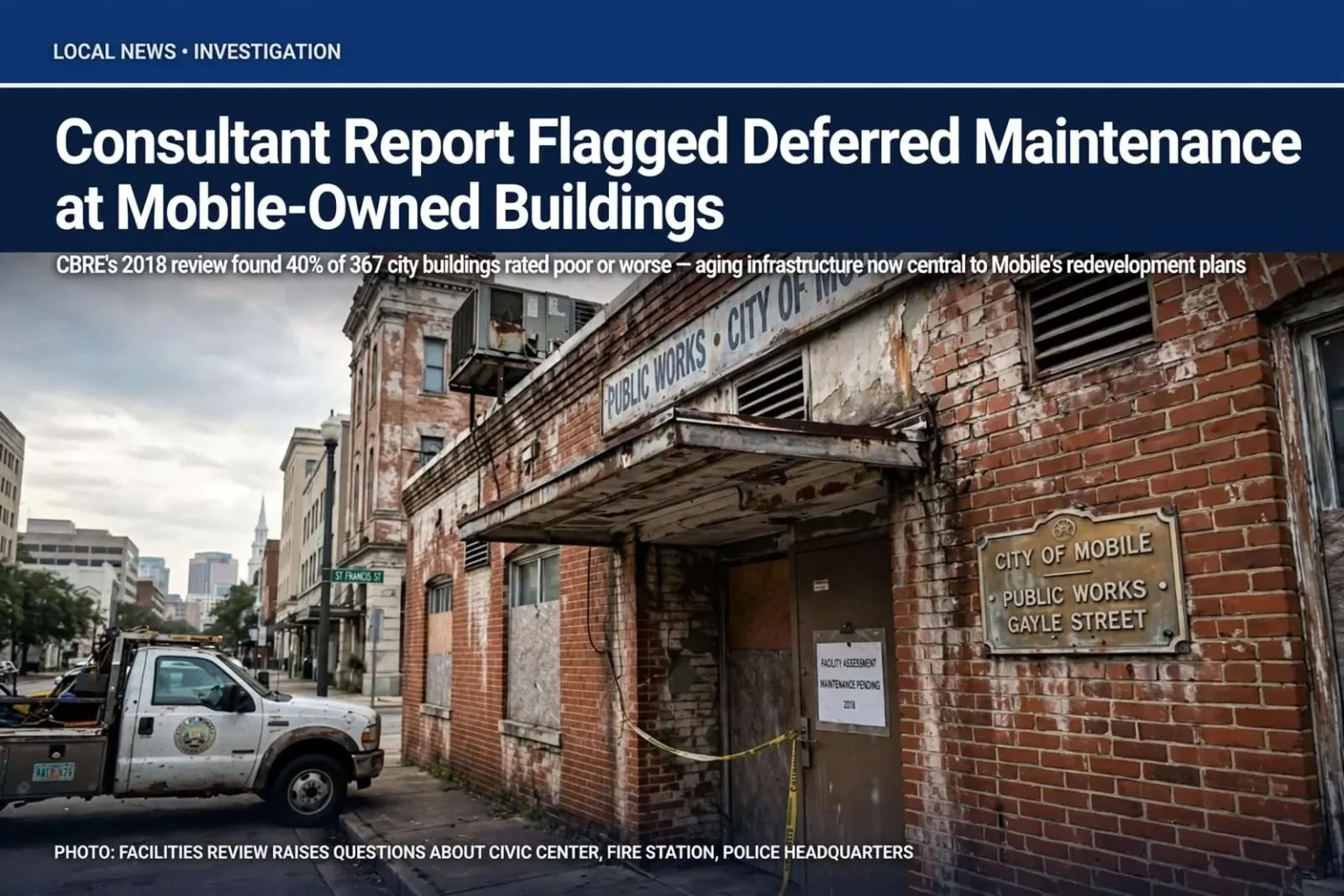
A consultant’s 2018 review of city-owned buildings found that a substantial share of Mobile’s property portfolio needed attention, placing deferred maintenance and future redevelopment decisions at the center of the city’s long-term planning. The findings described a municipal estate that had aged faster than the budgets set aside to care for it, and they framed choices that city leaders would face for years afterward.
The review was prepared by CBRE, the international commercial real estate services firm, for the city. It examined 367 municipal buildings, from neighborhood fire stations and community centers to major downtown facilities, and compared the value of those assets with the cost of maintenance and improvements that had been postponed over time. That comparison is the core of any deferred maintenance analysis: every year a roof, chiller or parking deck goes unaddressed, the eventual repair grows more expensive relative to what the building is worth.
The headline finding was stark. Forty percent of the properties in the review were rated poor or worse, meaning the condition of those buildings had fallen below the standard expected for facilities serving the public. For a city of Mobile’s size, the rating covered a wide cross-section of everyday government: places where residents pay bills, attend meetings, receive services and, in the case of fire and police stations, rely on responses that start from those very buildings.
Facilities Identified as Obsolete
Several prominent municipal facilities were described as functionally obsolete, including the downtown main fire station on St. Francis Street, the Public Works building on Gayle Street and Mobile Police Headquarters. Functional obsolescence is a specific judgment: it means a building’s layout, systems or design can no longer support the work done inside it, regardless of how well the structure has been kept up. A fire station built for smaller apparatus and smaller crews can struggle to house modern equipment; a police headquarters designed decades ago cannot easily accommodate today’s technology and security needs.
The findings illustrated how aging infrastructure could affect both the cost of operations and the quality of public services. Older buildings typically cost more to heat, cool and maintain, and repairs on failing systems tend to arrive as emergencies rather than planned projects. For employees working in those buildings and residents visiting them, the effects show up as cramped quarters, outdated wiring and spaces that never quite fit the departments assigned to them.
City engineering and development officials said the report documented a problem that had accumulated over many years. Deferred maintenance is rarely the result of a single budget cycle. It builds when annual repair budgets fall short of actual needs, when bond funds are directed to new construction instead of existing buildings, and when hard decisions are postponed because the consequence, a worsening building, is not immediately visible to the public.
The review ranked buildings and infrastructure in categories ranging from good and fair condition to poor condition and extensive backlog, providing the city with a framework for prioritizing work. That structure matters as much as the ratings themselves. Before such a review, a city faces hundreds of buildings with no common standard for deciding which repairs come first. Afterward, leaders can sort the portfolio by severity and cost, sequencing projects from the most urgent to the routine.
The Future of the Civic Center
The Mobile Civic Center stood out as the largest aging property discussed in connection with the review. The downtown complex, which has hosted generations of concerts, sporting events, graduations and civic gatherings since opening in the 1960s, carries the maintenance burdens of a facility designed for a different era of entertainment and exhibition. City officials anticipated accepting proposals later that year addressing the facility’s future, linking the maintenance findings to broader questions about redevelopment of the site.
The Civic Center question was never simply about repairs. A facility of that scale presents three basic paths: invest heavily in renovation, replace it with a modern venue, or redevelop the property for another use altogether. Each path carries different costs and different consequences for downtown Mobile, where the Civic Center’s event traffic supports restaurants, hotels and parking operations nearby. The 2018 review put those choices in context by documenting just how far the building had slipped.
The report did not solve the funding challenge by itself, but it gave city leaders an inventory of the assets requiring attention. That distinction matters in municipal finance. A consultant’s assessment does not appropriate money, and it does not repair a single roof. What it does is convert an amorphous problem, aging buildings generally, into a documented list with price tags attached, which is the starting point for bond issues, budget amendments and capital plans.
With hundreds of buildings in the municipal portfolio, the findings pointed to the scale of planning needed to balance repairs, replacements and potential redevelopment projects. A city cannot address 367 buildings at once, and it cannot simply walk away from facilities that house essential services. The realistic approach is a rolling capital program that retires or replaces the worst properties first while keeping the rest of the portfolio functional, and the CBRE review provided the baseline data for building one.
What Deferred Maintenance Means for Residents
For residents, the 2018 analysis provided a snapshot of the condition of facilities used by city departments and the financial pressures involved in maintaining them. Every rating in the report traced back to a building people actually use: the fire station whose crews answer calls downtown, the public works yard whose crews maintain streets and drainage, the headquarters where police reports are filed and records requested.
The three functionally obsolete facilities named in the review each illustrate a different side of the problem. The main fire station on St. Francis Street operates in the densest part of downtown, where land is valuable and expansion is difficult. The Public Works building on Gayle Street houses the operations behind street repair, solid waste and other services residents notice first when they slip. Police Headquarters concentrates critical functions in a structure whose limitations affect recruitment, training technology and day-to-day operations for hundreds of officers and civilian staff.
Deferred maintenance reviews like the one CBRE prepared are common tools for American cities, and their findings tend to follow a familiar arc. Ratings create attention, attention creates a capital plan, and a capital plan eventually produces either repaired buildings or replacements. The pace depends on funding. Cities typically pair operating budget increases with bond referendums or lease-purchase financing for the largest projects, and the size of a documented backlog often shapes how much borrowing a council will support.
Mobile’s review arrived during a period when the city was already weighing major downtown investments, and the Civic Center question became the most visible test of how those decisions would be made. The proposals city officials expected to accept later that year represented the first formal step toward answering whether the complex would be renovated, replaced or redeveloped, and the maintenance data gave everyone evaluating those proposals a common set of facts about the existing condition.
The report’s categories also created a way to measure progress over time. A city that re-rates its buildings every few years can show whether the backlog is growing or shrinking, whether investments made after the 2018 review moved properties from poor to fair, and whether new facilities reduced the operational costs that aging buildings impose. Without that follow-up, a single snapshot ages quickly and the same decisions resurface a decade later.
For the city departments housed in the buildings rated poor or worse, the review validated what staff had long reported: leaking roofs, failing HVAC systems and cramped quarters are not anecdotes but patterns spread across the portfolio. Turning that documentation into funding became the task facing the council and the administration, and the 2018 study served as the reference point in every budget discussion that followed about the city’s physical plant.
Long-Term Stakes for the City
The broader lesson from the review is that municipal buildings are assets that depreciate like any others, and the cost of neglect compounds quietly until it competes with every other claim on the budget. Mobile’s 367-building inventory, with forty percent rated poor or worse, gave the city a clear-eyed accounting of that liability, and the decisions that followed, from fire stations to the Civic Center, grew directly out of the framework the consultant’s report put on the table.
Reading the Report’s Numbers
A forty percent poor-or-worse rating across 367 buildings means more than 140 properties fell below standard in a single assessment. Municipal facility assessments usually grade on a scale that weighs structural condition, mechanical systems, code compliance and suitability for current use, and the lowest tiers of those scales describe buildings where repair costs approach or exceed the value of the asset itself. When a portfolio reaches that concentration, the question shifts from which buildings to fix to which buildings the city can afford to keep at all.
The St. Francis Street fire station’s location underscores the difficulty of those choices. Fire station placement is driven by response-time coverage, and the downtown station protects the city’s highest-density concentration of offices, hotels, residences and event venues. Closing or relocating such a station changes response maps that have been in place for decades, which is why obsolescence findings for public safety facilities tend to trigger careful study rather than quick action.
Police headquarters raises a different set of considerations. Modern law enforcement operations depend on evidence storage, communications infrastructure, holding facilities and technology systems that older buildings were never designed to carry. Renovating a headquarters to meet those demands can cost nearly as much as building new, and the review’s obsolescence rating signaled that Mobile’s facility had crossed the line where incremental repairs no longer keep pace with operational needs.
The Public Works building on Gayle Street represents the least visible but most operationally demanding category. Public works functions, fleet maintenance, materials storage and crew staging, require heavy-duty structures with large doors, floor loads and yard space. When those facilities age, the degradation often affects equipment as much as people, as trucks and machinery work around buildings never sized for modern vehicles and equipment.
What the CBRE review ultimately delivered was a shared vocabulary for those decisions. Council members, department heads and residents could all point to the same ratings when debating priorities, and the range of categories from good condition to extensive backlog gave the city a way to describe its portfolio honestly rather than letting every building dispute become a contest of anecdotes. That documentation, more than any single number in the report, is what allowed the deferred maintenance conversation in Mobile to move from complaint to planning.