

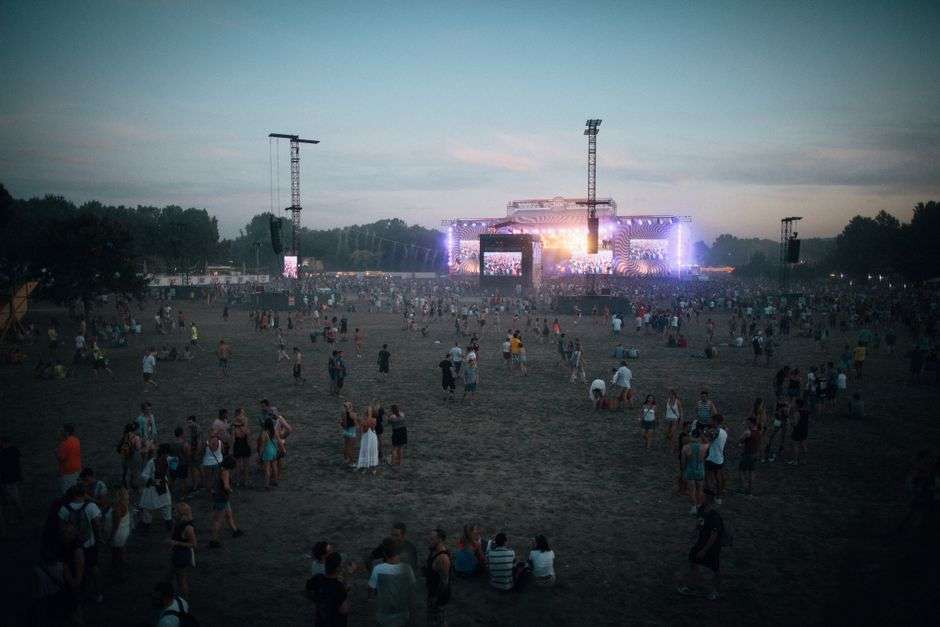
While many of America’s biggest music festivals have struggled — canceled lineups in California, half-empty stadium shows — one of the healthiest live-music experiments in the country is happening on a golf-course driving range in Miramar Beach, Florida, where a few thousand fans watch from roped-off “coves” stocked with folding chairs, served by staff, a short golf-cart ride from the condos they rented for the week. It is called Moon Crush, it is not a festival — its founder will insist on that — and it has quietly become one of the most successful music-event models on the Gulf Coast.
The Man Who Put Rock Bands on Cruise Ships
Moon Crush is the creation of Andy Levine, whose title at parent company Topeka Live is Chief Promise Maker. A Nashville native who attended the University of Florida and played acoustic guitar — “not very well,” he says, “but since I booked the band, they let me play” — Levine dropped out of college to manage Sister Hazel, the Gainesville rock band, for a decade. In 2001 he chartered an entire cruise ship for the band’s fans, the Sixth Man Cruise, and stumbled into a business: 1,500 people paid $99 deposits at $1,000 per person, and the music-cruise industry was born. After 24 music cruises generating roughly $10 million a year, he sold the company — Sixthman — to Norwegian Cruise Line, went back to the University of Florida at 35 to finish a business management degree, and watched his old professor read the essay about his own company and concede, “I guess I’m going to have to give you an A.”
A Vacation, Not a Festival
The pandemic gave Levine the catalyst for his second act. His family’s spring-break trip to Miramar Beach was scrapped in 2020; instead they rented a house, then bought one, and on morning bike rides past the Seascape Resort golf course he had the idea that would become Moon Crush. In April 2021 — as far as anyone knows, the first multi-day destination music event staged after COVID shut everything down — about 2,000 fans gathered on the resort’s golf course for a week of music from Jason Isbell & the 400 Unit, Sheryl Crow, NEEDTOBREATHE and others, watching from socially distanced coves and ordering food and merchandise by app.
The event was billed — deliberately — as a “music vacation,” not a festival. “‘Festival’ has come to mean a bunch of stages, bands all day, thousands of people in a field,” Levine explains. Moon Crush runs one stage, no more than three or four acts a night, and no lineup conflicts. Guests stay in rental homes and condos around the resort — more than 300 properties were secured for the first event — and walk or golf-cart to the show. When the pandemic ended and other festivals dropped their protocols, the coves stayed: guests told him not to change a thing. Today the coves, with their chairs, servers and app-delivered food, are the signature amenity.
Curated by the Artists Themselves
What distinguishes Moon Crush from ordinary festivals is the curation model. Headliners don’t just play; they design a weekend, inviting the artists they want to share it with. Brandi Carlile has curated her “Mothership Weekend” over Mother’s Day, bringing in Bonnie Raitt, Nickel Creek and Sara Bareilles — and holding court at a “Brandioke” singalong on the beach. Lyle Lovett curated “Cowboy Moon,” a three-day event that brought Jason Isbell, Molly Tuttle, The Mavericks, Little Feat, Nikki Lane and Paul Thorn to Miramar Beach alongside Lovett and his Large Band. Luke Combs headlined “Bootleggers Bonfire,” a sellout that drew attendees from 40 states and 13 countries.
The artists play deep-cut sets — songs their festival slots rarely allow — with no two sets alike, and they share in the economics of the event rather than simply collecting a fee. “We are all in this together and share in all the components,” Levine says, “expenses and profits of a Moon Crush concert series.” Smaller venues put artists closer to their fans, and the artists, he says, have embraced the trade.
Why the Model Works Now
The timing has proved fortunate. As some legacy festivals have folded under ticket-sales pressure, Moon Crush has kept growing — the venue now holds just under 5,000 fans, several themed weekends run each year, and the brand has expanded with events like Brandi Carlile’s Mothership Weekend. Topeka hires more than 100 local workers for each event, and the company’s “In-Time, In-Tune, In-Color” mantra — punctual shows, guest-listening, Gulf Coast hospitality — has produced the kind of loyalty festivals dream about: attendees return year after year, and the 2027 Pink Moon weekend with Nathaniel Rateliff, Jason Isbell, the Avett Brothers and Brandi Carlile has already sold out its top accommodations.
For Gulf Coast music fans, the practical takeaway is that one of the country’s most innovative concert experiences is a two-hour drive east. Days are for the beach, fishing or golf; nights are for the kind of intimate, single-stage shows that big festivals can’t deliver. As Levine puts it: “It’s about flip flops, not sandals. It’s not about how shiny things are. It’s like, who are you with?” By that measure, Moon Crush has built exactly what it promised — a vacation where the music is the excuse and the community is the point.
The venue, the coves, and a 120-day rebuild
The show ground itself has its own origin story. When the Seascape resort trimmed nine holes from its original 27-hole golf course to make room for new development, Levine worked out an agreement to build a concert venue just steps from the condos and the beach — close enough that guests walk or take a golf cart from their rental to the stage. The layout is deliberate: beach vacation by day, live music as the sun goes down.
As soon as the final weekend of last season wrapped, Levine went to work rebuilding the place. Local crews reoriented the stage, rebuilt the restroom area, and added concessions with an outdoor bar, food vendors, and lounge space between sets — all in a 120-day window. The result is a sound stage and seating bowl of roughly 6,000 fans with clear sightlines and large screens flanking the stage. The first weekend in the renovated venue sold out completely. ‘It’s the hardest thing I’ve ever done in my life,’ Levine said of the sprint. ‘We only had 120 days to complete the project, but we got it done.’
How a weekend actually runs
A Moon Crush weekend is built around the headliner, who performs twice — two completely different sets, with the closing set typically built around deep cuts rather than the radio hits. The most recent weekend was the Sound Wave theme headlined by Joe Bonamassa, the guitar prodigy widely ranked among the best blues-rock players of his era, with sets from Grace Potter, Gov’t Mule, Larkin Poe, and JJ Grey & Mofro filling out the bill. Shows wrap before 10 p.m., leaving the beach house porch for the after-hours.
Day passes are available for fans who do not want the full weekend package, and pit passes put standing-room ticket holders directly in front of the stage. Roughly 80 percent of the crowd travels in from out of town, many attending several themed weekends a year, and first-time VIP guests go home with a branded cooler that staff will keep stocked with ice and drinks on request. Up next is the Sun, Sand & Soul weekend curated by the Tedeschi Trucks Band, bringing Jason Isbell and the 400 Unit, Molly Tuttle, Taj Mahal & the Phantom Blues, Drive-By Truckers, Honey Hounds, Elles Bailey, and Jamie Wyatt to the shore. ‘The bands have skin in the game,’ Levine says. ‘If we do well, they do well, too. They enjoy beach vacations as much as the next guy, so they get to bring their families, and I just think when you are happy, you perform better.’