

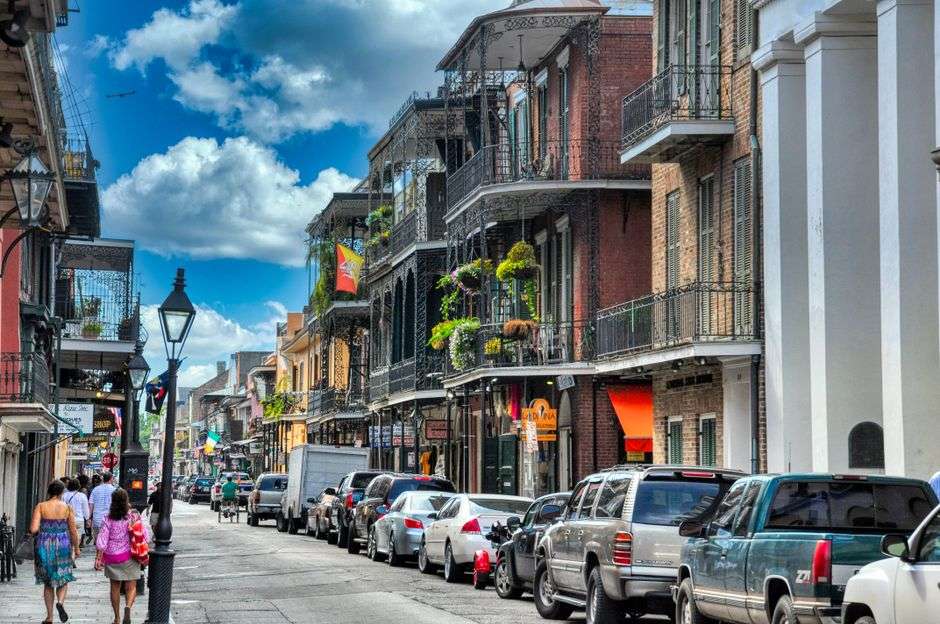
Every summer has one weekend that redeems the rest of it. For our family, a few summers back, it arrived in New Orleans — a Father’s Day gift from my three sons that turned into a two-night run of grilled oysters, ghost stories of old bars, and the best concert any of us had ever seen.
The plan was simple: dinner and Jackson Browne at the Saenger Theatre. My sons, Zeb, Bryan, and Matthew, handled every detail. Linda and I just had to show up, which, after a summer of triple-digit heat, felt like a gift in itself.
We left Fairhope on a Friday afternoon with the temperature hovering around 100 degrees, the dogs riding along to their favorite destination — my son’s house in New Orleans, where he has lived for more than a decade. It was our first trip back in almost three years. The pandemic had severed the habit of easy crossings to the Big Easy, the way it severed so many habits, and it had taken a nudge from my sons to rebuild it.
An old condo on St. Charles Avenue
We gathered that first evening at a getaway condo my cousin and his wife keep next to the Columns Hotel on St. Charles Avenue, a place that has quietly anchored family visits to New Orleans for years. There is something about the avenue — the streetcar rattling past, the oaks, the Victorian houses — that resets a Gulf Coast brain after a hot week. We were glad to be together again, in the city that has always been our nearest big city, even though it belongs to another state.
Dinner that night was a short walk away, at Superior Seafood and Oyster Bar at the corner of St. Charles and Napoleon. On a sultry July evening the place was bustling, which surprised us; late summer is usually the slow season in New Orleans, when everyone squeezes in a last beach trip or flees to somewhere cooler. We started with grilled oysters — the only correct way to begin anything in that city — and three of us settled into seafood pastas while one contrarian ordered a seafood salad. Good wine, good conversation, and we walked home happy.
The corner itself is a lesson in how New Orleans organizes its appetites. St. Charles and Napoleon sits at the hinge of the Garden District and Uptown, close enough to the streetcar line that dinner can roll itself home, and the restaurants there have long catered to a mixed crowd of neighbors, students, and visitors staying at the small hotels along the avenue. Superior, an airy spot with a raw bar and a serious oyster program, leans Gulf Coast in both menu and volume of laughter per square foot.
We had earned the appetite, frankly. The drive over from Fairhope in 100-degree heat is not a long one by interstate standards, but it crosses a state line, a lake, and a psychological distance: Alabama’s quiet beach towns and Louisiana’s loudest city sit three hours apart and feel like different planets. Crossing it after three years away made the first glass of wine taste like a homecoming.
On the way back I made a small pilgrimage. Fat Harry’s, the bar on St. Charles that has served generations of Tulane students and young strivers, got my head stuck in the door for a minute. I spent more days and nights there than I can count — or, honestly, remember — back when I lived in New Orleans. The neon looked the same. That is the thing about that city: the places stay put and wait for you.
Magazine Street and the girl named Brei
Saturday began late, the way New Orleans Saturdays should. We eased over to the Columns Hotel for a meal that straddled breakfast and lunch — the hotel’s broad front porch, its lush landscaping, its cheerfully eccentric interior are exactly what fits a city where the eclectic and the eccentric shake hands. Afterward we said our goodbyes to Doug and Ginger and wandered down Magazine Street, ostensibly to shop for new prescription eyewear.
It turned into one of those small encounters that make travel worthwhile. At Warby Parker, a sales associate named Brei — B-r-e-i, and yes, she explains immediately, her mother just didn’t know what brie cheese was — told us about her Instagram page, Sweet Honey and Brei, where nearly 14,000 followers get her book reviews and handbag opinions. We compared notes on unusual names; she gets the puzzled look at the spelling, and I get asked, always, what Zeb is short for. Twelve thousand miles of conversation in ten minutes.
Pêche and a storm rolling in
Then it was time for the main event’s opening act. My sons picked us up for a 6 p.m. reservation at Pêche Seafood Grill, the restaurant that helped prove Gulf seafood could be the whole show — its kitchen earned a James Beard Award in 2014, and the room still hums with that confidence. We started with hand-crafted cocktails, a dozen wild oysters from Louisiana Area 3, and gumbo. Then came the centerpiece: grilled whole red snapper with salsa verde, flanked by grilled shishito peppers, grilled zucchini with capers and feta, and the best field peas with bacon and onion I have ever put in my mouth.
I have eaten a lot of meals in New Orleans. That one belongs near the top.
As a prelude to the concert, the sky did its part — a proper storm rolled in just as we left the restaurant, which would have made a fitting opening number had Browne chosen “Before the Deluge.” We made the walk to the Saenger somewhat drenched, traffic snarled by the downpour, and reached our seats, wine in hand, just as Jackson Browne stepped onstage alone.
Almost three hours with Jackson Browne
What followed was, without exaggeration, the best concert I have ever attended. Browne was 74 that summer, and neither his voice nor his enthusiasm had missed a beat. I have loved his music since high school and had seen him twice before in Birmingham, but never with his full band. The sound was full and rich, his banter between songs was easy and funny, and he worked through the familiar songs with new material threaded in, alternating between guitar and grand piano for nearly three hours.
The crowd did what New Orleans crowds do: shouted out requests all night. Browne took it with grace. “I appreciate all your suggestions,” he said with a laugh, “but I’m better at playing my songs.” Somewhere in there, a certain Southern rock anthem went unplayed, and the world was better for it. He did set the guitar down once to honor a request at the piano, and by the end of the night he had the room entirely. Linda agreed with my verdict. So did my sons, who live for live music and do not hand out superlatives cheaply.
The venue deserves its share of the credit. The Saenger Theatre opened on Canal Street in 1927 as one of the grand movie palaces of its age, flooded badly when Katrina’s levees failed in 2005, and reopened in 2013 after a painstaking restoration. Its starlit ceiling and ornate interior make it a spectacular place to hear anyone, and its story — closed, drowned, restored — is very much a New Orleans story.
Browne, meanwhile, has earned the right to hold a room like that. A Rock and Roll Hall of Fame inductee since 2004, he wrote or co-wrote some of the most durable songs in American popular music — “Take It Easy,” which he started and Glenn Frey finished into an Eagles classic, and “Running on Empty,” an album literally recorded on the road. Watching him run through his catalog in a restored 1927 theater was the kind of night that reminds you why people drive a hundred miles for music.
Coffee in the Marigny, then home
The weekend wound down the next morning over coffee and pastries at Ayu Bakehouse on Frenchmen Street in the Marigny, where we caught up with close friends before collecting the dogs and pointing the car back toward Fairhope. The bakery has become a fixture of the neighborhood’s morning scene, and the walk back through the Marigny — shotgun houses, porch chairs, the smell of last night’s music still hanging around — is as good a closing argument as any city could make. My son Bryan and his wife caught Browne the following night at the Alabama Theatre in Birmingham — another beautifully restored venue, a 1927 movie palace that anchors the city’s theater district — and reported back with an enthusiastic two-thumbs-up verdict.
By then I had rekindled something the pandemic had let go dark: the easy love for New Orleans that anyone who grew up on the Gulf Coast carries. The restaurants, the music, the eccentrics, the storms that roll in mid-dinner and don’t dare stop the evening — it was all still there, exactly as remembered, and better than remembered.
It won’t be three years before we go back. Probably not even three months. Some weekends you take for the food, some for the music. The good ones, like that one, soothe the soul with both.