Navarre Fishing Pier Draws Crowds Despite Oil Fears on the Gulf
The rebuilt Navarre Fishing Pier, the longest on the Gulf, keeps drawing anglers from Gulf Shores to Okaloosa despite lingering oil and tarballs.
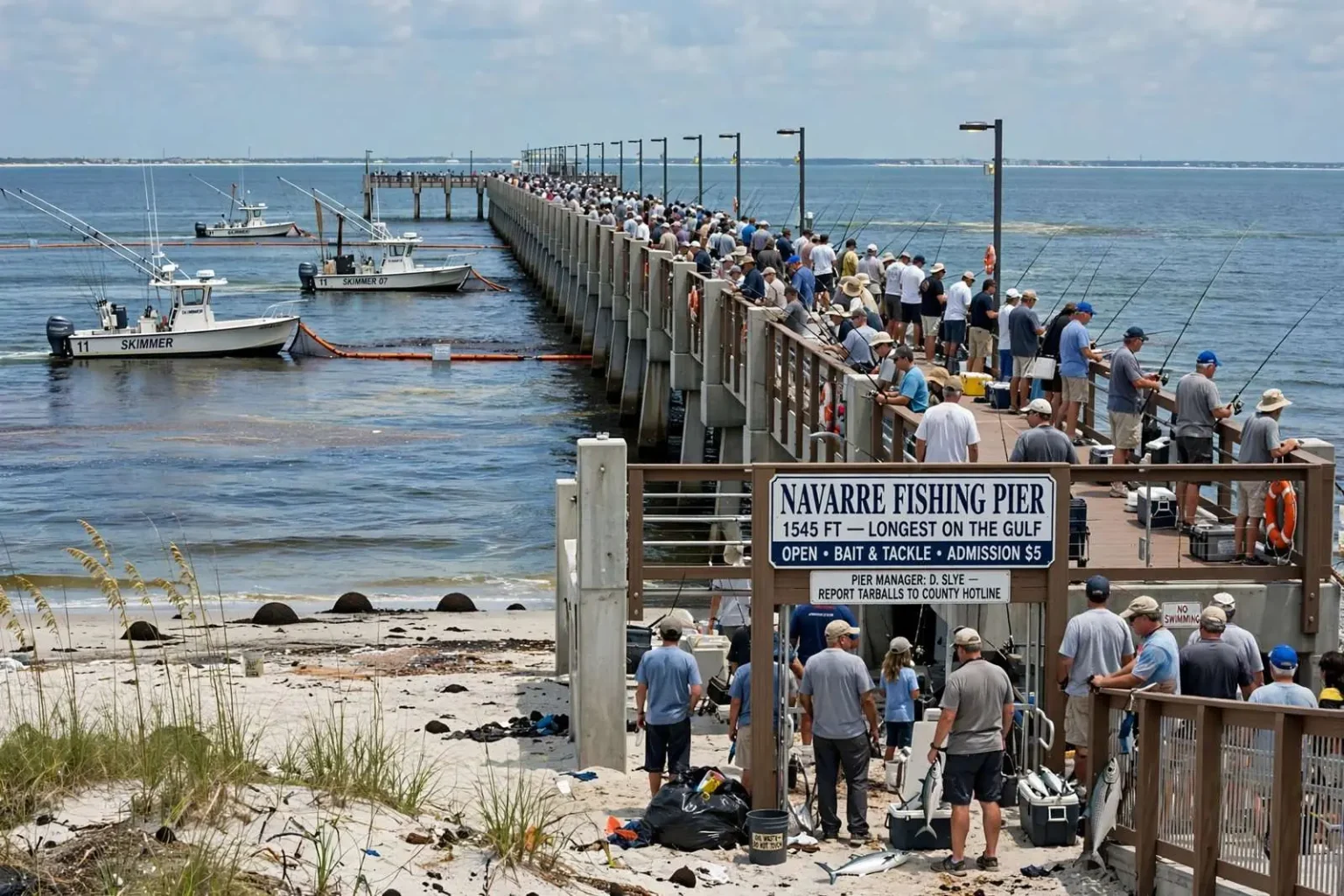
Five years after Hurricane Ivan destroyed it, the Navarre Fishing Pier is open for business again — and despite oil creeping through the Gulf, anglers are showing up.
The rebuilt pier stretches 1,545 feet, making it the longest fishing pier on the Gulf of Mexico. Pier manager Dorothy Slye said business has remained strong even as tarballs have begun washing ashore.
“There were some tarballs the other day,” Slye said. “My husband brought them in and I told him to throw it away.”
Part of the pier’s draw, Slye believes, is that the waters off Navarre remain open to harvesting while other stretches of the coast face closures. “Our pier is still open for harvesting and so folks from Gulf Shores, Pensacola, and Okaloosa are coming here to fish,” she said.
Longtime anglers say conditions have actually improved in recent days. Wiley Keyser, who has fished at Navarre since 1960, said he smelled heavy oil the day before but found the water cleaner on his return — and noticed the skimmer boats had moved out of view.
Slye said the uncertainty is the hardest part. “This beach has always been a big part of our life, to see these things and not know how it’s gonna affect us. It’s like doom hanging over your head,” she said.
The pier remains open for both fishing and swimming, and Santa Rosa County officials reported 11 skimmers working off the Navarre coast as cleanup crews continue to intercept oil before it reaches the beach.
The moment captured in these summer weeks — a rebuilt pier drawing crowds while tarballs wash ashore — compresses the strange dual history of the Navarre Beach Fishing Pier: a structure that has been destroyed, rebuilt, and threatened in cycles, while remaining the anchor of a community’s identity. Ivan’s destruction in 2004 left Navarre without the pier that had defined its beachfront for decades, and the years that followed were a lesson in how much a piece of infrastructure can mean to a small coastal town. The rebuilt pier’s 1,545 feet — the longest on the Gulf — was as much a statement of intent as a fishing platform: that Navarre Beach would come back, and come back bigger.
The Structural Appeal for Anglers
The pier’s draw for anglers is structural as much as scenic. Piers put fishermen over deeper water without a boat, and long piers reach the depth and distance where the Gulf’s more prized inshore species run — Spanish and king mackerel, pompano, redfish, flounder, and the seasonal migrations that pass within casting distance of the rails. Serious pier anglers fish the structure itself, working the pilings for sheepshead and trout, while families fish the shallower reaches with tackle no more elaborate than bait and bottom rigs. That range of users — from tournament anglers with pedigreed gear to visitors who have never baited a hook — is what fills a pier on a summer morning, and what kept the rebuilt Navarre pier busy from the day its gates opened.
The BP oil spill, which put tarballs on Navarre’s sand that summer, hung over the entire Gulf coast’s recreational economy in ways no closure alone could capture. The Deepwater Horizon disaster, which began with the rig explosion in April 2010, had by summer sent oil drifting toward the northern Gulf coastline, and the response — skimmer fleets, boom lines, beach-cleaning crews — became part of the daily landscape from Louisiana to the Florida Panhandle. For fishing communities, the fear operated on two clocks: the immediate question of whether waters would close to harvesting, and the longer question, impossible to answer, of what the spill would do to the fish populations, the marshes, and the food chain that Gulf fishing depends on. Slye’s “doom hanging over your head” described precisely that suspended state — the economy continuing while everyone waited to learn what the water would decide.
Fishery closures during the spill followed a patchwork logic that anglers along the coast tracked daily. Federal authorities closed and reopened waters based on ongoing sampling, with zones shifting as the oil’s drift changed and as testing cleared areas that had been tainted. A pier whose waters remained open, as Navarre’s did through those weeks, became a magnet — the destination for anglers from closed stretches of coast in Alabama and elsewhere in Florida who still wanted to fish legal waters. That inversion — a disaster driving crowds to one spot because it was the last one open — is part of what pier managers and coastal businesses mean when they describe the summer’s trade as strange: good business for the worst of reasons.
The skimmer fleet working off Navarre was the visible edge of a response that grew into one of the largest in American history. Skimmers — vessels that collect surface oil as it drifts — were deployed by the hundreds across the Gulf, coordinated by the unified command managing the spill response, with their positions adjusted daily to the forecasts of where oil would make landfall. For coastal residents, the boats’ presence offshore became a kind of weather report, their arrival signaling that oil was near and their absence suggesting the threat had eased, at least for the moment. Keyser’s observation — the oil smell one day, cleaner water and no skimmers the next — tracked exactly the way residents on the coast learned to read the spill’s rhythms.
A Long History of Storms and Rebuilds
The pier’s own history gave the summer’s anxiety a longer frame. Hurricanes have repeatedly damaged or destroyed the structure — Ivan in 2004 most catastrophically, but Opal and other storms before it left their marks — and each rebuilding cycle brought the question of whether the pier would be rebuilt at all. Its post-Ivan reconstruction, completed five years later, was designed with the lessons of past storms in mind: modern materials and construction meant to give the next hurricane less to destroy. For the residents who had waited through those five years, the pier reopening just in time to face an oil crisis rather than a hurricane had the feel of the coast’s particular luck — a decade in which every season seemed to bring a new test.
For the families who fished the pier that summer, the economics were inseparable from the emotion. Navarre Beach’s visitor economy is built on the same simple appeal Slye described — a quiet stretch of coast where the beach and the fishing have always been “a big part of our life.” The spill threatened the image that draws tourists, even where the water stayed clean; a single photograph of tarballs on white sand travels further than any reassurance. Local officials and businesses spent that summer trying to hold two truths at once: that the beach was open and the fish were biting, and that no one could promise what the rest of the season would bring.
What the pier offered, in the end, was continuity — the simple act of fishing continuing through the uncertainty as it had through hurricanes. Anglers who had fished Navarre since the 1960s stood on the same rails where they had caught their first mackerel, on a structure that had been destroyed and rebuilt, over water that was being tested daily, in a summer that nobody on the coast would forget. The crowds that came — from Gulf Shores, Pensacola, Okaloosa, and points beyond — came to fish, and in doing so made their own statement about the coast’s resilience: that the pier was open, the water was open, and life on the Gulf goes on, one line at a time, whatever the water brings.
Engineering a 1,545-Foot Pier
The engineering behind a Gulf pier of this length is its own story. A structure reaching 1,545 feet into the Gulf must withstand currents, salt corrosion, vessel strikes, and — every decade or so — a hurricane’s direct assault. Modern pier construction typically pairs concrete piles and composite or treated decking designed for decades of marine exposure, with railings, lighting, and cleaning stations positioned along the length. The Navarre pier’s rebuild came in at a cost measured in millions, funded through a combination of local tourist-development dollars and state investment — a sum that itself testifies to what the structure means to the community’s economy. Pier operations run on the modest economics of admission fees, tackle rentals, and bait sales, and the manager’s role, as Dorothy Slye’s years in the position reflect, blends retail, hospitality, and a working knowledge of the fish that move through local waters month by month.
The pier’s reopening timeline — five years after Ivan — also tracked the broader recovery of Navarre Beach itself. The barrier island community rebuilt its infrastructure in the years after the storm: the beach itself was renourished, condominiums and homes were reconstructed to newer code, and the bridge and utilities that serve the island were upgraded. Each season of delay had tested the patience of anglers who had made the pier a daily habit, some of whom drove past the gap where the pier had stood to fish the surf or the bridge ramps instead. When the new pier finally opened, the crowds that arrived were in part a homecoming — the return of a routine that stretches back through the old pier’s decades to the original structure generations before.
Ecologists watching the spill’s approach to the Panhandle that summer focused on the same resources pier anglers cherish. The nearshore waters and passes that concentrate gamefish are fed by the estuary systems behind the barrier islands — Santa Rosa Sound among them — where juvenile fish spend their early lives in seagrass and marsh. Oil reaching those nurseries, rather than open water, was the scenario scientists feared most, because the effects would persist in the food web for years after the surface cleared. The tarballs that reached Navarre’s beach, weathered and patchy as they were, belonged to the surface phase of the spill; the deeper uncertainty — what was happening below and in the bays — was the question no skimmer fleet could answer, and the one that would occupy biologists and fishermen alike for the decade that followed.
Legal Claims and the Spill’s Long Reach
The legal and economic aftermath of the spill eventually reached every coastal business of the kind Slye ran. The compensation process administered under the Oil Pollution Act — claims for lost revenue, diminished bookings, and closed seasons — became a fixture of Gulf Coast life in the years after 2010, with businesses documenting summer by summer what the spill had cost them. Pier operations occupied a particular place in that ledger: open waters and steady crowds told one story, but the perception of a tainted coast told another, and claims turned on exactly the uncertainty Slye described. The settlements that ultimately flowed to the Gulf states funded, among other things, the restoration projects and tourism campaigns intended to repair the spill’s economic damage — a full-circle outcome for a disaster whose tarballs had once been carried off the beach by hand.
For anglers returning to the pier in the years since, the summer of the tarballs has settled into local history — one more chapter in a structure that has outlasted hurricanes and an oil spill within a single decade. The pier continues to draw the migration seasons that made it famous, and its status as the longest fishing pier on the Gulf keeps it on the itinerary of visiting anglers from across the Southeast. The people who manage it, and the regulars who fish its rails at dawn, carry the institutional memory of what the place has survived — the storms, the rebuilding, the summer the oil came — and the practical optimism that defines coastal fishing: the fish will come back through, the pier will be here, and the only thing to do is keep a line in the water.