Off-Bottom Oyster Farms Report a Strong Season Even as Wild Reefs Suffer
Caged off-bottom oyster farms near Dauphin Island had a strong season while freshwater from the Bonnet Carre Spillway hurt Alabama's wild reefs.
Alabama’s oyster harvest told two very different stories this season, and the difference came down to how the shellfish were grown. Wild, on-bottom reef harvesting had a difficult year. A prolonged opening of the Bonnet Carré Spillway in Louisiana pushed large volumes of fresh water into the Mississippi Sound earlier in the year, and that sustained drop in salinity killed off much of the oyster stock sitting on traditional reefs. Reef harvesters, who depend on oysters staying put where they grow, had no way to move their crop out of harm’s way.
The Bonnet Carré Spillway, located upriver of New Orleans, is the Mississippi River’s relief valve, opened when spring floods on the river threaten the levees of southeast Louisiana. When its bays are opened, river water — fresh, sediment-heavy and nutrient-rich — pours into Lake Pontchartrain and then finds its way east into the Mississippi Sound, the brackish estuary that shelters oyster reefs on both the Louisiana and Mississippi sides and influences the waters along coastal Alabama.
Oysters live within a narrow band of water chemistry. They tolerate a range of salinity, but sustained exposure to fresh water kills them, and the mortality accelerates the longer the low-salinity conditions last. A flood-driven opening of the spillway that stretches for weeks can therefore function like a slow-motion disaster for a reef-bound oyster population, which cannot move to saltier water farther from the river’s influence.
Cages Give Farmers Something Reefs Cannot: Mobility
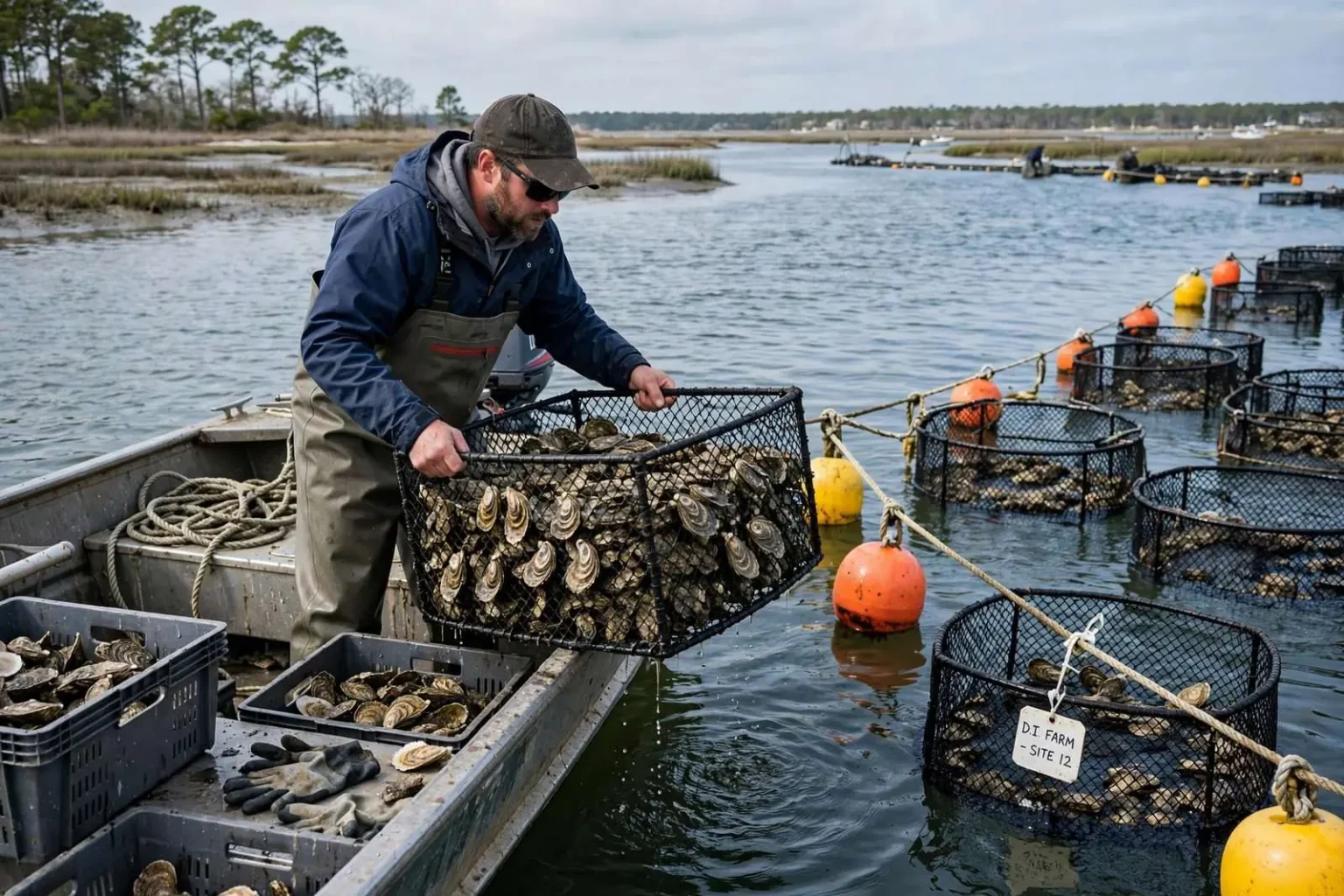
Off-bottom oyster farming, by contrast, came through the same conditions in good shape. In that method, oysters are raised in floating or suspended cages rather than on the sea floor, which lets growers relocate their stock when water conditions turn against them, and adjust depth to find better salinity.
That mobility is the decisive difference. A farmer who sees fresh water approaching can winch cages onto a barge, tow them miles to saltier water and redeploy them, then move them back when conditions normalize. Depth adjustment offers a subtler tool: salinity in an estuary is layered and variable, and even moving gear from the surface to deeper water, or shifting a farm’s footprint within a leased area, can keep oysters on the right side of the salinity line.
Operators on Dauphin Island who supply that caged equipment and produce oyster seed described the season as a good one for their side of the industry. The flexibility built into the gear is the central reason: when fresh water arrives, a farm on cages can be moved, while a reef cannot.
Dauphin Island has become a center of Alabama’s off-bottom oyster sector, home to gear suppliers, hatcheries and the growers who lease state water bottoms for their farms. Oyster seed — the tiny, hatchery-spawned oysters that farmers buy to grow out in their cages — is the foundation of the whole enterprise, and local seed producers give Alabama farmers a supply chain that does not depend on shipments from out of state.
How off-bottom farming works
Off-bottom aquaculture borrows techniques refined in Chesapeake Bay and New England and adapted to Gulf waters. Farmers begin with seed oysters, place them in mesh cages, bags or baskets that float at the surface or hang in the water column, and tend them through a grow-out period that includes routine handling — tumbling, sorting and cleaning — that shapes the oyster’s shell and conditions the meat.
The finished product is aimed squarely at the half-shell market: a consistent, deep-cupped, well-conditioned oyster with a brand name attached. That is a different business from the traditional reef fishery, where tonging and dredging bring up wild oysters sold largely to shucking houses and wholesale markets. The two sectors share a species and a body of water but operate on different economics, timelines and customer bases.
A Growing Piece of the Coastal Economy
Off-bottom aquaculture has expanded steadily along coastal Alabama over the past decade, marketed largely to restaurants and raw bars that want a consistent, branded half-shell product year round. This season’s split results underline why some growers have shifted toward the caged approach, and why freshwater events upstream continue to be one of the biggest variables facing the traditional oyster fishery in Mobile County waters.
The restaurant trade along the Gulf Coast has embraced the farm-raised product, and Alabama oyster farms now supply raw bars not just locally but across the region. A branded oyster — named for the farm that grows it — commands a premium price and builds customer loyalty the way a vineyard’s label does for wine, giving small coastal businesses a product with identity and year-round reliability.
The industry’s growth has also drawn attention from state agencies and lawmakers, who have weighed how to expand leasing opportunities, streamline permitting and support hatchery capacity in response to the wild fishery’s long decline. Public oyster reefs in Mobile County waters have faced a series of setbacks over the years — hurricanes, drought, harvesting pressure and the recurring freshwater intrusions — and state management of those reefs has had to balance commercial harvest against the need for broodstock to seed future generations.
What freshwater events mean for the fishery
The Bonnet Carré’s openings are not hypothetical threats; in recent years the spillway has been activated during major flood seasons, and each prolonged opening sends a plume of fresh water eastward through the Sound. Fisheries managers in Louisiana and Mississippi have documented widespread reef mortality in the wake of the longest openings, and the effects reach into Alabama waters through the connected estuarine system.
For reef harvesters, the options during a freshwater event are grim: watch the crop die in place, or attempt harvest and relocation on a scale and timeline that most independent operations cannot manage. Oysters on a reef belong to a public resource governed by state seasons and rules, while the oysters in a farmer’s cages are private property under lease — a legal distinction that makes the farmer’s mobility practical in a way the tonger’s never can be.
That structural difference is now a central fact of the Gulf oyster economy. As long as river floods, hurricanes and drought keep stressing the wild reefs, the caged sector’s built-in insurance — the ability to move — will keep separating the fortunes of the two industries, and this season’s divergent outcomes on the Alabama coast are the latest evidence of it.
Looking ahead for both sectors
State officials and industry members continue to discuss rebuilding the wild reef stock, including shell planting programs that return cured oyster shell or alternative substrate to the reefs to give wild larvae a place to attach. Those efforts take years to bear fruit and remain vulnerable to the same freshwater and storm events that have repeatedly set the fishery back.
The farmed sector’s trajectory, meanwhile, points toward continued growth. Gear suppliers on Dauphin Island report steady demand, hatchery capacity has expanded to feed the farms, and the half-shell market’s appetite for branded Gulf oysters has proven durable. Entrepreneurs considering entry into the business face real hurdles — lease applications, permitting, capital for gear and boats, and years of hands-on husbandry — but the season’s results suggest the model works even in a year when the traditional fishery struggles.
For consumers, the practical takeaway is that Alabama oysters remain on the menu, sourced increasingly from the state’s growing number of farms. And for the coastal communities where both industries operate, the season’s split outcome is a reminder that the future of the region’s signature shellfish may rest as much on cages floating above the reefs as on the reefs themselves.
Oysters and the Alabama coast’s identity
Oysters are woven into the culture of coastal Alabama as deeply as any food on the Gulf Coast. The oyster houses of Mobile, the raw bars of Dauphin Island and the seafood joints along the causeway all trace their menus to the same estuarine waters, and debates over reef management, water quality and leasing policy routinely draw crowds at public meetings in Bayou La Batre and across Mobile County.
The industry’s two branches employ different kinds of coastal workers. The wild fishery is built on independent tongers and dredge boat operators, many working family traditions that go back generations, concentrated in communities like Bayou La Batre. The farmed sector skews toward newer entrants — small businesses started by watermen, retirees and transplants drawn to the coast — and its jobs run from hatchery technicians and gear fabricators to the shuckers and servers who move the finished oysters onto plates.
Water quality remains the shared foundation for both. Oysters filter large volumes of water as they feed, which makes them sensitive barometers of estuarine health, and it also makes them valuable: healthy oyster populations improve the water around them. That dual role — crop and ecosystem engineer — is why restoration projects and aquaculture expansions are often discussed together as complementary rather than competing paths for the coast.
Lessons from this season
This season’s divergence offers a case study in resilience that other Gulf states have watched closely. Mississippi and Louisiana operate their own off-bottom sectors, and the recurring freshwater intrusions have accelerated interest in caged production across the region as a hedge against events no reef can survive.
For Alabama’s reef harvesters, the hope remains that shell planting and careful season management can rebuild public reefs to the point that a bad year does not mean no year. Restoration projects funded through natural resource damage settlements following the 2010 Deepwater Horizon spill have already directed money toward oyster habitat in the region, and each generation of planted shell that successfully recruits wild oysters strengthens the base the fishery depends on.
The contrast between the two harvests will likely keep widening the conversation about how coastal Alabama balances tradition and adaptation. The tongers’ work is part of the coast’s history; the farmers’ cages are part of its future; and this season showed that both futures depend on the same fragile, shifting mix of fresh and salt water that defines the northern Gulf of Mexico.
Consumers, restaurants and wholesalers watching the market should expect both products to remain available, with the farmed half-shell sector continuing its steady growth and the wild fishery working to recover the stock that this year’s freshwater intrusion took from the reefs.