Olivia Rodrigo’s Surprise Gift Helped an Alabama Student Reach Graduation
A University of Alabama graduate says Olivia Rodrigo quietly paid the $5,000 left on her final semester bill after seeing a TikTok about her struggle to finish college as a first-generation student.
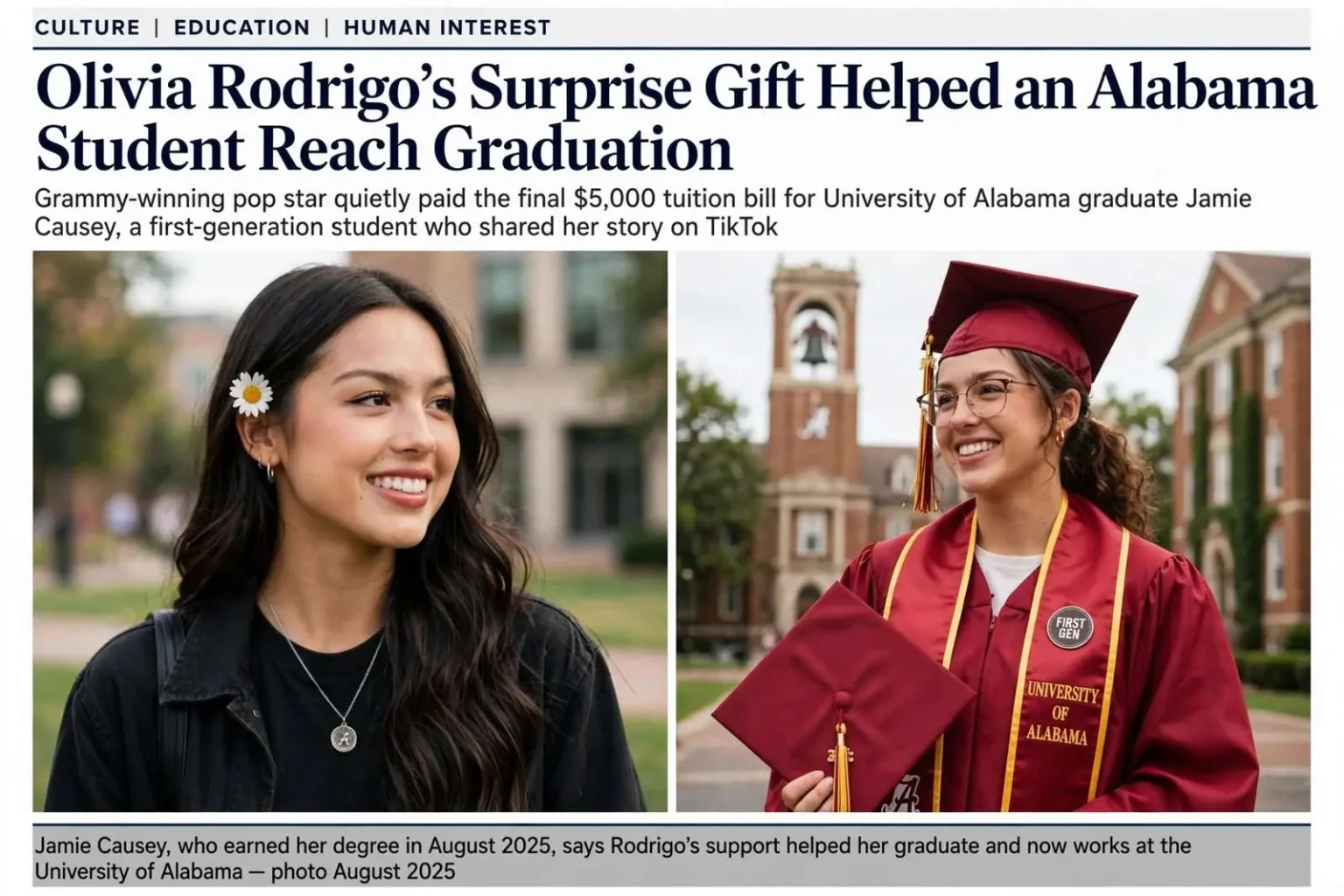
A University of Alabama graduate says a message from Grammy-winning singer Olivia Rodrigo changed the trajectory of her life, after the pop star quietly covered the final $5,000 tuition bill standing between her and a diploma.
Jamie Causey, who earned her degree from the University of Alabama in August 2025, recently opened up on TikTok about the gift more than a year after it happened. Causey said she had kept the story private, not wanting the moment to turn into a public spectacle, but ultimately decided to share it as a way of publicly thanking Rodrigo.
Causey said she changed his life for the better and he cannot thank her enough.
The decision to go public a year later says something about how the story sat with her. A gift that arrives from a celebrity carries a strange weight: the gratitude feels disproportionate to any private expression, and the temptation to tell everyone collides with the instinct to protect something that mattered. Causey’s choice to finally share it — framed not as her own story but as a thank-you — followed more than a year of the episode quietly shaping her working life at the university she graduated from.
A viral post about a common struggle
The gift traces back to April 2025, when Causey posted a TikTok describing a problem familiar to many college students: she had run out of ways to pay for her final semester. As a first-generation college student, Causey said her scholarships and grants had been exhausted with only two classes left before graduation.
Causey said if you have a bump in the road you have to figure it out somehow.
The situation Causey described is the financial no-man’s-land that catches thousands of first-generation students each year. Federal aid packages, state grants and institutional scholarships are built to cover a standard four-year arc, but most students no longer finish in four — and the semesters beyond the packaged ones are the hardest to fund. Two remaining classes can stand between a student and a degree that unlocks an entire career, with no loan avenue small enough and no scholarship category designed for the gap. Universities have begun building completion grants around precisely this problem, but the students most affected are frequently the least aware those resources exist.
Causey said she wasn’t looking for a handout or expecting anyone to step in financially. She said she simply wanted to be candid about the real cost of finishing a degree and to help other students in similar situations feel less alone.
Causey said she recorded a message saying she is first-generation, not expecting anyone to pay or feel bad, but just to show the reality of college.
That framing — testimony rather than appeal — has become one of the distinctive genres of student life on TikTok, where young people narrate the unglamorous mechanics of paying for school. The platform’s economy of candor means a single honest video can reach more struggling students than any campus office’s outreach, which is exactly what Causey said she was aiming for.
Olivia Rodrigo was watching
Unbeknownst to Causey, Rodrigo had been following her content for some time, after coming across a post celebrating Causey’s 21st birthday.
Causey said Olivia Rodrigo saw her 21st birthday post, wished her happy birthday, and kept up with her.
After watching Causey’s video about her financial struggles, Rodrigo reached out directly with an offer to help her get to graduation.
Causey said Rodrigo told her she is a source of positivity and light and offered to help her graduate, which blew her away.
The directness of the contact — a personal message rather than a public gesture — fit the way Rodrigo has handled her platform’s scale. The three-time Grammy winner built her following on an unusually direct relationship with her audience, answering fans and weaving their stories into her public life, and her philanthropic work has centered on supporting young people through education and health causes. A one-on-one tuition payment sits in that tradition: not a branded donation, but the kind of help a person gives another person.
Causey admitted her first instinct was skepticism — she wondered whether the message could be a scam. The wariness is itself a sign of the times. Impersonation schemes targeting young fans of major pop stars are common enough that a message claiming to be from a Grammy-winning artist is, on its face, more likely to be fake than real. Causey’s skepticism, and Rodrigo’s team’s understanding of it, shaped how the transaction unfolded.
But Rodrigo’s team followed up soon after and made good on the offer, sending $5,000 toward Causey’s outstanding semester bill.
Causey said Rodrigo’s team reached out, and Rodrigo followed up to ensure it happened. It paid her semester bill, allowing her to graduate, and Rodrigo owed her nothing.
The follow-up detail — the star checking back to confirm the bill was actually paid — is the part of the story Causey seems to treasure most. Anyone who has received help knows the difference between a gesture and an act: a gesture announces itself, an act verifies its own completion. The $5,000 cleared a bill; the follow-up made it a completed rescue.
More than a tuition payment
Causey said the gesture meant far more than covering a bill. It kept her on track to finish her degree on schedule and, she said, shaped the career she has today.
She said without Olivia’s help, she might not have continued creating content, would not have graduated on time, and would not have her current career.
Causey now works at the University of Alabama and says she hopes to pass along the same kindness she received, even in small ways.
Causey said she wants to give back to others, whether through a smile, a message, buying coffee, or doing everything she can.
The pay-it-forward arc — a first-generation student helped at the finish line, now working on the campus that nearly lost her — is the part of the story with the widest implications. Students who come within a semester of a degree but never cross it do not show up in graduation statistics, but they carry student debt without the earning power a credential provides, and universities lose the alumni, employees and advocates those graduates would have become. Causey’s story is a single case with a famous benefactor; the pattern it illustrates is an ordinary one happening without them.
The timing of the reveal — more than a year after the graduation it enabled — also traces the arc of a private gift becoming a public lesson. Causey graduated in August 2025, spent the following year building the career the degree made possible, and only then decided the story belonged to the public. Her stated reason was gratitude; the effect is that other first-generation students scrolling the platform where she first described her predicament will now see how it resolved.
The University of Alabama’s scale makes the story locally resonant as well. With tens of thousands of students on its Tuscaloosa campus, the university enrolls a growing share of first-generation students — many of them Alabama residents financing school through a patchwork of state programs, Pell Grants and merit awards that rarely stretch to a fifth semester. Campus administrators have made first-generation completion a stated priority, and stories like Causey’s circulate widely in that community precisely because the predicament is so recognizable: not a failure of ambition or effort, but a $5,000 gap at the very end of a finished journey.
The lesson is not that celebrity generosity solves college affordability. A viral video that catches one star’s attention is not a financial aid policy, and most students with a two-class gap will never get the message Causey did. What the story offers instead is proof of the smallest possible intervention: one semester, one bill, one yes at the exact moment a student was deciding whether to stop.
Causey said she is stepping back from TikTok going forward to focus on her career and the next chapter of her life, closing the book on a story that started with one honest video about the cost of college.
That exit note gives the story its shape. A student posted her reality, a pop star watching from afar decided to change it, and the student — now a university employee — chose to end her run on the platform with a thank-you rather than a complaint. The bump in the road she described turned out to be navigable, and her final message amounts to instructions for the next person who hits one: figure it out somehow, say the hard part out loud, and when help arrives, pass it on.
Related coverage from South AL News
- Bay Minette, Fairhope Students Among 100 Statewide Winners of Alfa Foundation Scholarships
- Alabama College Application Campaign Week Lets Seniors Apply Free to 60-Plus Colleges Through Oct. 9
- Mobile's Anna McElroy Passes on Riley Green, Picks Kelly Clarkson on 'The Voice'
- Liquid Gold on De La Mare: How a Former Nurse Made The Happy Olive Fairhope's Gift Stop