One Tank Trip: Why Ocean Springs Makes an Easy Gulf Coast Day Trip
Ocean Springs makes an easy Gulf Coast day trip with the Walter Anderson Museum of Art, historic downtown shops and local favorites like Tatonut.
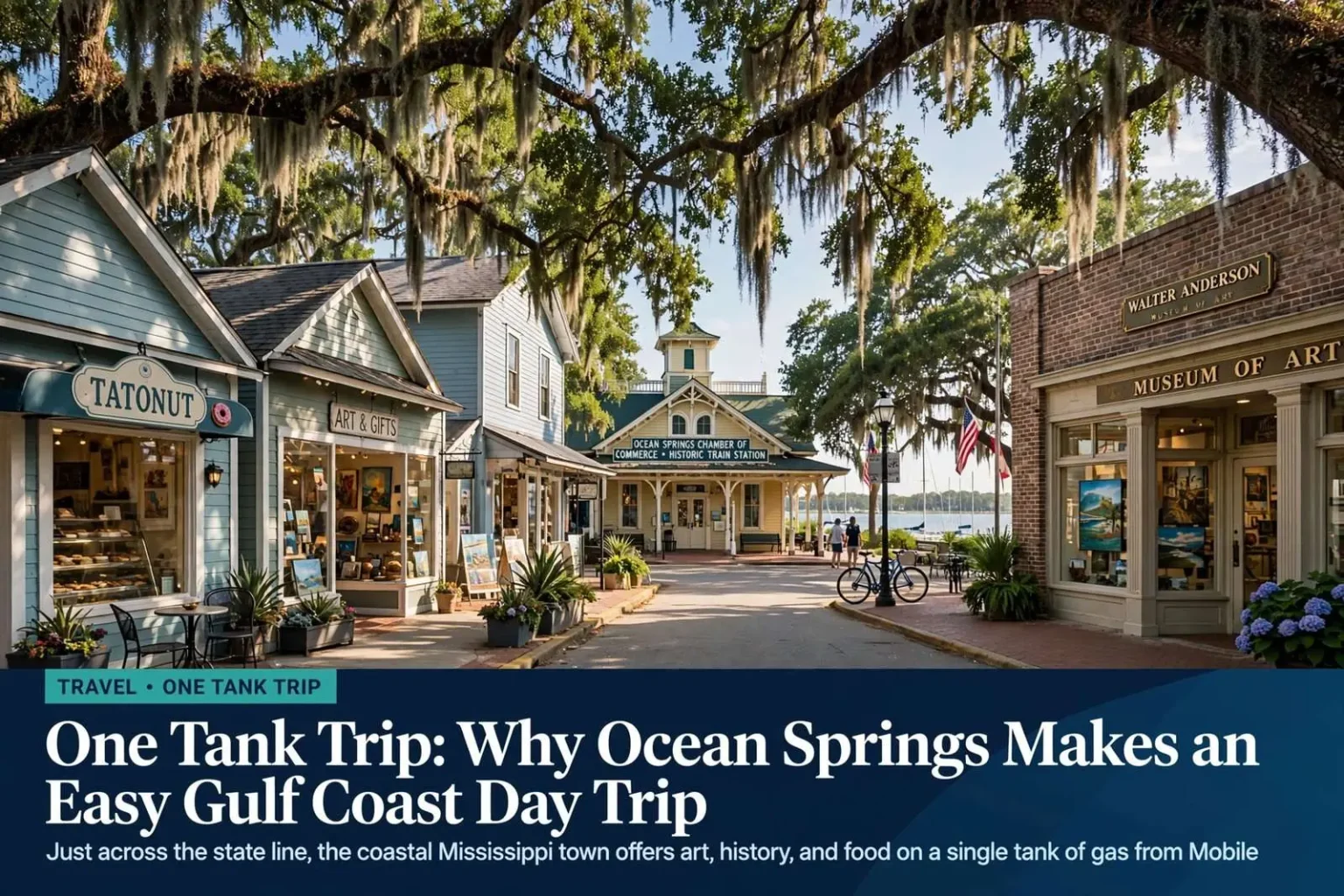
Just across the state line, the coastal town of Ocean Springs, Mississippi packs a surprising amount of art, history and food into a destination close enough for a single tank of gas from the Mobile area. The heart of any visit is the walkable downtown, where blocks of cottage-style storefronts hold locally owned restaurants and independent shops. The town’s creative reputation centers on the Walter Anderson Museum of Art, which celebrates the work of the famed Gulf Coast artist who made Ocean Springs his home. Nearby, the Ocean Springs Chamber of Commerce operates out of the community’s historic train station, a good first stop for visitors mapping out their time in town. Locals will point hungry travelers toward Tatonut, a bakery and eatery so beloved that it is routinely described as a must-visit stop for anyone passing through. With its quiet residential streets, live oaks and easy access to the water, Ocean Springs has managed to hold onto its small-town coastal character even as it has grown into one of the Mississippi Gulf Coast’s most-visited destinations. For Mobile and Baldwin County residents looking for a low-effort getaway, it remains one of the region’s most rewarding short drives.
Ocean Springs sits on the eastern shore of the Mississippi Gulf Coast, a straightforward drive south and east from Mobile across the state line. For households in Mobile and Baldwin counties, that proximity is the whole point of a “one tank trip”: a full day of exploring without the planning or expense of a longer vacation. The town’s compact layout means most of what visitors want — dining, shopping, the museum, the waterfront — is reachable on foot once they park downtown, which keeps the day relaxed and unhurried.
The Walter Anderson Museum of Art is the cultural anchor. It honors Walter Anderson, the Gulf Coast artist whose watercolors, block prints and murals captured the plants, animals and spirit of the region, and who is closely identified with Ocean Springs. The museum gives visitors a focused introduction to his work and to the broader artistic identity of the town he helped define. For travelers from Alabama’s coast, where Anderson’s influence is also felt, the museum is a natural extension of a shared Gulf Coast creative heritage.
Dining is the other major draw, and Tatonut has become something of a landmark. The bakery and eatery is famous among regulars for its doughnuts and casual fare, and its reputation has spread well beyond Mississippi — enough that locals routinely steer first-time visitors straight to it. Around it, downtown Ocean Springs is studded with independently owned restaurants and cafés that favor local character over national chains, making the town a dependable choice for a food-centered day trip. Pairing a Tatonut stop with a museum visit and a stroll past the cottage storefronts is the classic Ocean Springs itinerary.
The town’s history adds another layer. Ocean Springs has long traded on its identity as an arts colony and resort community, and its Chamber of Commerce’s location in the historic train station is a small reminder of that past — a practical welcome center housed in a building with its own story. Visitors mapping out a day can start there for maps and event information before walking the surrounding blocks. The live oaks that shade the residential streets and the easy access to the water give the town a slower, coastal feel that distinguishes it from busier Gulf resort hubs.
For Mobile and Baldwin County residents, Ocean Springs works as a contrast to their own beaches and downtowns. It offers a different state’s take on Gulf Coast living — Mississippi’s version of the art-and-food small town — within an easy drive. That makes it ideal for a spontaneous outing: leave in the morning, browse the shops, tour the museum, eat well, and be home before dark, all on a single tank of gas. The beaches of the Mississippi Gulf Coast are also nearby for those who want sand and surf added to the day.
The practical appeal is hard to overstate for families and couples alike. There is no admission required to walk the downtown, window-shop the independent stores, or simply enjoy the oak-shaded streets, and the major paid stop — the museum — is modest in cost. Parking downtown is manageable, the distance from Mobile is short, and the pace is forgiving. For south Alabama residents who have done their own local beaches and boards plenty of times, Ocean Springs is the kind of close, low-effort change of scene that refreshes without complicating the calendar.
As one of the Mississippi Gulf Coast’s most-visited destinations, Ocean Springs has managed a difficult balance: absorbing tourist interest while preserving the small-town coastal character that made it worth visiting in the first place. That balance is exactly why it endures as a day-trip favorite for the Mobile area. Whether the goal is art, history, food or just a quiet walk under the live oaks, the town delivers it within a single tank of gas — and sends travelers home with a fuller sense of the wider Gulf Coast they share. For a quick getaway that feels far away without actually being far, Ocean Springs remains one of the easiest, most rewarding trips a south Alabama resident can make.
Travelers mapping an Ocean Springs day from Mobile should plan the logistics as loosely as the town invites them to. The drive is short enough that an early departure and a late-afternoon return leaves hours to wander, and because downtown is compact, there is little wasted time shuttling between stops. Pairing the trip with a midweek or off-season day avoids the heaviest coastal traffic and makes parking and restaurant seating easier. Those who want to extend the theme can string Ocean Springs together with neighboring Mississippi Gulf Coast towns, but for a true one-tank trip the town alone rewards a full day. Mobile and Baldwin County visitors who make the crossing regularly know the rhythm by now: cross the state line, slow down, and let a walkable Mississippi coast town remind them how varied the Gulf’s shores really are.
The artist at the center of the town’s identity led one of the more remarkable lives in American art. Walter Inglis Anderson, born in New Orleans in 1903 and trained at the Pennsylvania Academy of the Fine Arts, settled in Ocean Springs with his family, where he ran Shearwater Pottery — founded by his brother Peter — and painted the coastal world around him with an intensity that has become legendary. His block prints of Gulf birds, crabs, marsh grasses, and scenes from local history decorated a generation of Coast homes, and his large-scale murals, including the ocean-cycle work painted for the Ocean Springs community center, are counted among the region’s artistic treasures. He spent stretches of his later life living and drawing alone on Horn Island, one of the barrier islands offshore, producing watercolor journals of its wildlife that are now studied as masterworks of American nature painting. The museum on Washington Avenue preserves and exhibits this legacy, and for many visitors it is the first time they encounter an artist whose work, once seen, changes how the Gulf landscape itself looks.
The town’s roots run deeper than its arts reputation. Ocean Springs traces its founding to 1699, when French explorers under Pierre Le Moyne d’Iberville established Fort Maurepas near the site — the first permanent European settlement in what would become the Mississippi Territory and a claimant to the title of oldest settlement on the Gulf Coast. That colonial history is commemorated in local sites and names, and it gives the community a historical identity that predates by more than two centuries the casinos and condominiums that define other stretches of the Mississippi coast. The railroad that arrived in the nineteenth century turned the town into a resort destination for New Orleans and Mobile families escaping summer heat, a pattern visible today in the Victorian and cottage architecture that gives downtown its distinctive texture.
Hurricane Katrina in 2005 tested that inheritance severely — Ocean Springs sits directly on the surge path that devastated the Mississippi coast — and the town’s recovery became part of the broader Gulf Coast rebuilding story. The downtown’s antebellum-era and mid-century structures largely survived or were restored, and the arts community that anchors the town’s identity reassembled quickly, a resilience that residents often cite when explaining why Ocean Springs feels less like a rebuilt resort strip and more like a place that simply continued. Travelers from Alabama who visited before 2005 and return today will find the same walkable core, the same oak canopy, and the same emphasis on locally owned business that defined the town before the storm.
The culinary scene beyond Tatonut rewards a bit of wandering. Downtown’s restaurants range from white-tablecloth dining in restored cottages to taquerias, oyster bars, and coffee roasters, many occupying buildings that have housed cafes and shops for generations. The town’s proximity to working waterfronts — the seafood heritage of neighboring communities along the Back Bay — keeps Gulf fish, shrimp, and oysters on menus at prices and freshness that inland travelers associate with special occasions. Annual events, including arts-and-crafts festivals that draw regional crowds each fall, add to the calendar for visitors flexible about timing; the chamber’s staff at the train station can point travelers to whatever is on during their visit.
For the Alabama day-tripper, the practical economics are part of the appeal. The round-trip drive from Mobile or the Eastern Shore consumes only a few dollars of fuel, there is no toll on the standard routing, and a day spent on foot in a walkable downtown costs little beyond meals and the museum ticket. Compared with a beach day at home — parking fees, gear, crowds — an Ocean Springs day trades sun for shade, sand for sidewalk, and the same Gulf scenery viewed from a different state’s porch. It is the kind of trip that can become a family ritual precisely because it asks so little: no reservations strategy, no itinerary stress, no long return drive with tired children in the back seat.
The town also rewards repeat visits in a way single-destination getaways do not. First-timers typically cover the museum, Tatonut, and a pass through the main retail blocks. Regulars learn the side streets — the pottery at Shearwater, the quiet front porches of the historic districts, the waterfront parks on the Back Bay, the small galleries that rotate shows monthly. That depth is the quiet argument for keeping Ocean Springs on the short list of Gulf Coast day trips: a town small enough to feel familiar after one visit, and layered enough that the tenth visit still offers something the first one missed.
More Stops Worth Adding to the Itinerary
Returning visitors who have already made the classic museum-and-Tatonut loop have plenty of new ground to cover. On Washington Avenue, Maison de Lu Restaurant and Bar is a favorite lunch stop, with a porch that catches the first cool days of fall and a menu that rewards the wait for a table. The street itself remains the best walking tour in town, lined with art galleries, gift shops, coffee houses, and bars with names as colorful as their clientele, from the Village Idiot to Knuckleheads and the Office Bar & Lounge.
Cross the Shearwater Bridge over the back harbor to reach the homeplace where Walter Anderson and his brother Peter operated Shearwater Pottery, founded in 1918 on land their parents purchased the same year. Visitors can still see original figurines and pottery alongside reproductions made by later generations of the Anderson family, who rebuilt the business after Hurricane Katrina damaged the original property and destroyed many early works. It is a working studio as much as a shop, set among the marshes and shrimp boats of the Inner Harbor.
Back downtown at the old train depot, Realizations is a small shop run by Anderson’s descendants dedicated to making his art accessible, with an extensive selection of hand silk-screened prints and textiles drawn from his block-print designs. Local artists hand-paint each watercolor print, so no two are alike.
Travelers with extra time can add the Davis Bayou Area of Gulf Islands National Seashore, part of the barrier island chain that stretches between the coasts of Mississippi and Florida, or simply take the scenic route home along U.S. Highway 90, where reminders of past hurricanes line a road that runs between the sound and the shore.