Fire Heavily Damages Island Dunes Condominiums in Orange Beach
A predawn fire tore through the Island Dunes condominiums on Perdido Beach Boulevard in Orange Beach, leaving 21 of the complex's 36 units uninhabitable.
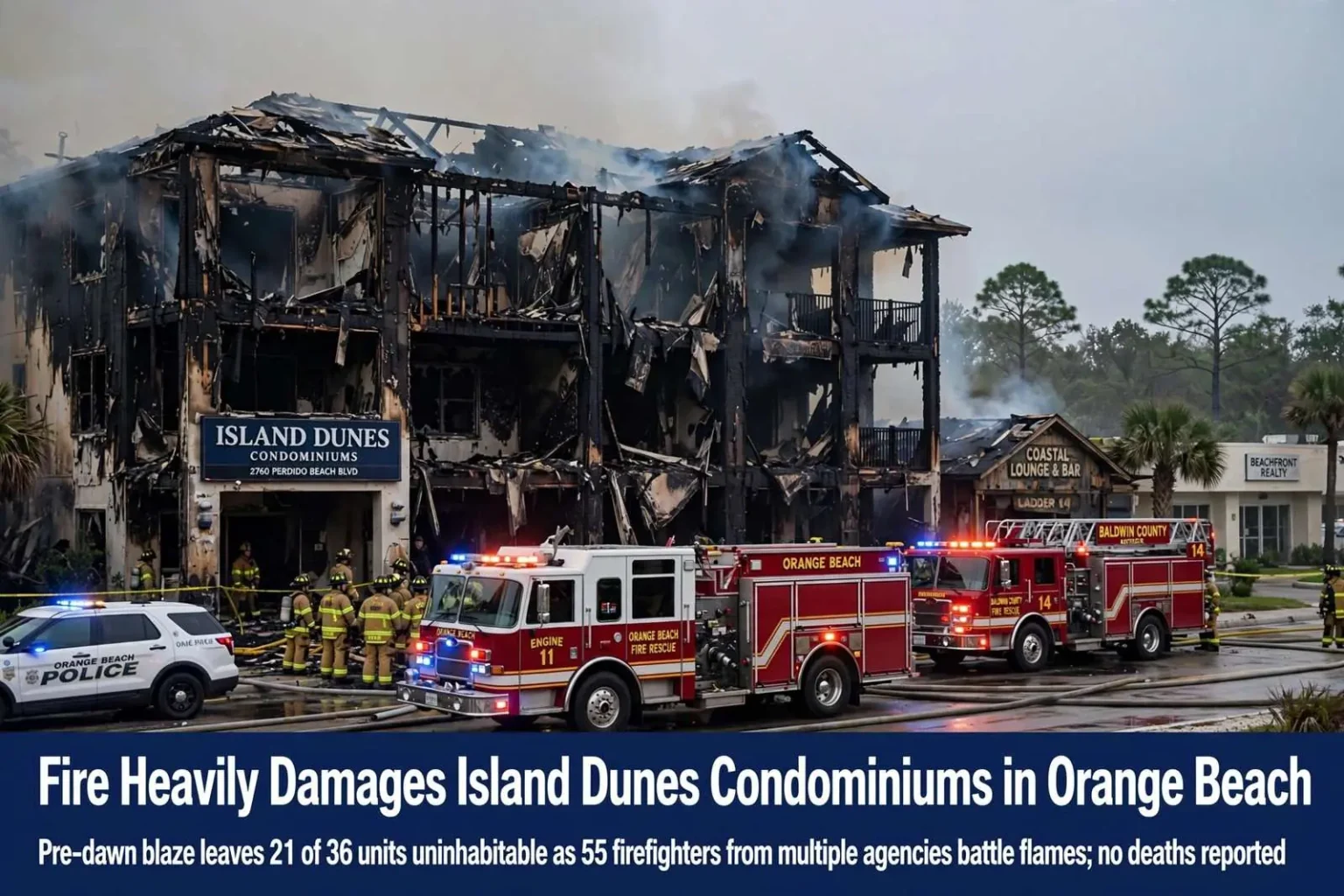
A massive fire broke out before dawn at the Island Dunes condominium complex on Perdido Beach Boulevard in Orange Beach, causing extensive damage and leaving more than half the building’s units uninhabitable. The blaze ignited around 3 a.m. and quickly grew, prompting a large-scale response from Orange Beach firefighters along with crews from multiple neighboring departments. The pre-dawn hour meant most residents were asleep when the fire began, and the darkness made it harder for arriving crews to see how far the flames had already traveled through the structure. Officers with local police agencies also assisted as the fire threatened nearby businesses, including a restaurant and lounge and a real estate office, as well as a wooded area adjacent to the complex.
An Aggressive Fight Against Fast Flames
Orange Beach Fire Chief Shane Phillips said the response from roughly 55 firefighters likely prevented a far more tragic outcome. He noted that the building’s construction, an all-wood frame structure without sprinklers, allowed the flames to spread rapidly once they took hold. “This was an all wood frame structure with no sprinklers,” Phillips said, explaining why the fire proved so difficult to contain despite the aggressive response from crews on scene. Wood-frame beach construction is common along the Alabama coast, where older, smaller complexes predate the concrete high-rises that now dominate the shoreline, and fire officials have long warned that such buildings offer flames a fast path through walls, floors and rooflines.
Firefighters worked for several hours before getting the blaze under control. When the smoke cleared, officials determined that 21 of the complex’s 36 units were no longer safe for occupancy, displacing a significant number of residents and property owners along the busy beachfront corridor. The count meant that more than half of the building had to be written off in a single night, and the units that remained habitable were still exposed to smoke and water damage that follows fire through every floor of a building.
Island Dunes sits in a heavily trafficked stretch of Orange Beach popular with both full-time residents and vacationers, and the fire’s proximity to nearby commercial properties raised additional concern among emergency responders working to keep the flames from spreading further. Perdido Beach Boulevard, the city’s main beachfront road, carries a dense mix of condominiums, restaurants, shops and rental properties, and on a busy night the stretch around the complex holds hundreds of visitors within a few hundred yards of the burning building. The restaurant and lounge next door and the real estate office nearby both faced exposure to wind-driven embers, and the wooded area behind the complex raised the possibility of a brush fire spreading beyond the property line entirely.
Chief Phillips credited the scale of the mutual aid response, with departments from around the region pooling resources, for containing the fire before it could destroy the entire complex or reach neighboring structures. In a resort city like Orange Beach, where a single department cannot staff enough engines to fight a major structure fire on its own, mutual aid agreements with neighboring Baldwin County departments and agencies across the state line are the backbone of emergency response. The roughly 55 firefighters on scene that night represented that network in action, with tankers and ladder trucks staged along Perdido Beach Boulevard to keep water flowing for hours.
Why the Sprinkler Question Matters
No sprinkler system was in place at the aging wood-frame building, a factor fire officials pointed to when discussing how quickly the flames spread through the structure. Modern multifamily construction is generally required to include sprinkler systems and fire-rated assemblies that buy occupants time and confine flames to a single unit, but older buildings built before those requirements often lack both. Fire officials across the Gulf Coast have used cases like this one to emphasize the difference that sprinklers make: a system that activates in the first minutes can hold a fire to its room of origin, while an unsprinklered wood-frame building gives a fire free rein to climb.
For the residents displaced by the fire, the hours after dawn were spent accounting for neighbors, salvaging what they could and arranging for places to stay. Condominium fires along the beachfront displace a complicated mix of households — full-time residents, seasonal occupants and absentee owners whose units were being managed as vacation rentals. Property managers and insurers began the process of assessing the damage in the days that followed, and the American Red Cross and local churches and businesses in Orange Beach typically mobilize in such cases to provide temporary lodging and basic necessities for those with nowhere to go.
Recovery and rebuilding efforts at Island Dunes are expected to take considerable time given the extent of the damage. With 21 of 36 units uninhabitable, the complex faces structural assessment, insurance adjustment and a reconstruction timeline measured in months rather than weeks, and owners’ associations in comparable cases often spend a year or more deciding whether to rebuild, sell or redevelop. The wood-frame construction that made the building vulnerable to fire will also figure into any rebuilding decision, since current codes and insurance costs push coastal redevelopment toward more fire-resistant construction.
Local officials continue to monitor the situation as displaced residents work with property managers and insurers to assess next steps for the badly damaged complex. The city’s building department will review any plans for repair or reconstruction, and fire investigators will continue working to determine what sparked the blaze in the first place — a question that remains open in the aftermath of a fire that began in the darkest hours of the night.
A Corridor That Knows the Risk
The Island Dunes fire was a reminder of the vulnerability of Orange Beach’s older beachfront stock. The city’s skyline has been transformed over the years by tall concrete towers, but between them stand the smaller, older complexes that house much of the community’s year-round population. For neighbors along Perdido Beach Boulevard, the sight of smoke over the tree line before dawn, the parade of fire trucks from three jurisdictions and the smell of smoke that hung over the beach road the next morning served as a warning worth heeding — and a demonstration of how much depends on the firefighters who answer before the sun comes up.
The mutual aid system that answered the Island Dunes fire is built on agreements that Gulf Coast fire departments maintain year-round. When a call of this magnitude goes out in the middle of the night, dispatchers alert surrounding departments immediately, and engines from across Baldwin County and neighboring Florida communities roll toward Orange Beach while the first-arriving crews are still laying hose. That redundancy matters in a resort city whose population swells seasonally, and it is the reason a fire that could have consumed an entire complex and its neighbors instead ended with the building still standing and the fire grounds contained to one property.
Investigators working an early-morning fire of this size face a laborious task. Once the flames are out, the building becomes evidence: crews must shore up unsafe sections, then systematically work backward from the area of origin, ruling out electrical faults, appliances, cooking equipment, heating devices and human causes. The all-wood frame that let the fire spread so quickly also makes the post-fire structure dangerous to walk through, and investigators often need heavy equipment on site before they can reach the rooms where the blaze started.
For owners of older units across the beachfront, the case offers practical lessons that fire officials have repeated for years. Working smoke alarms on every level and inside sleeping rooms remain the single most effective life-safety tool in an unsprinklered building, and tenants and owners in short-term rentals are encouraged to confirm that alarms are functional between guest stays. Residents of wood-frame complexes are also advised to know their primary and secondary exits, because in a fast-moving structure fire the time available to get out is measured in minutes, not tens of minutes.
The days and weeks ahead will determine what Island Dunes becomes. Owners’ associations that survive a disaster of this scale usually emerge with a long meeting calendar — insurance adjusters, structural engineers, code consultants and attorneys — and a community of displaced residents checking in on one another while the paperwork grinds forward. Orange Beach has seen beachfront properties burned and rebuilt before, and the corridor’s history suggests the site’s story is not finished. But for the families who slept somewhere other than home the night after the fire, the rebuilding timeline will feel like an eternity, no matter how quickly the crews and adjusters move.
City and county officials in coastal Alabama have long pointed to cases like this when discussing fire safety investment along the beachfront. Water supply, hydrant spacing and response times all factor into how a beach corridor fire develops, and Orange Beach’s growth has been accompanied by steady upgrades to its fire infrastructure. Still, no amount of planning replaces the first-due engine company arriving to a fully involved building at 3 a.m., and officials said the outcome at Island Dunes could easily have been worse if not for the speed of that arrival.