

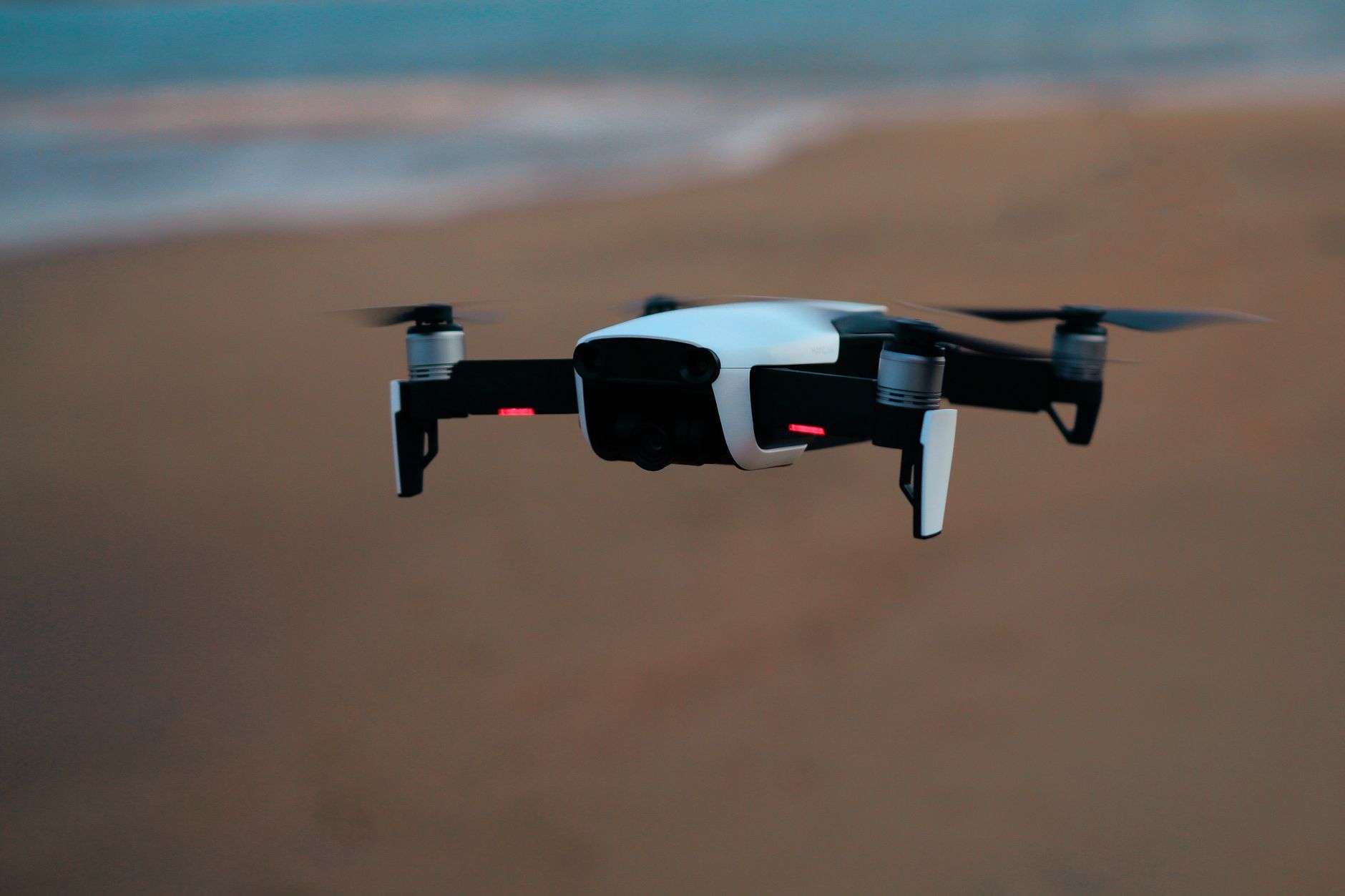
ORANGE BEACH, Ala. — The next unit responding to a struggling swimmer off Orange Beach may arrive from the air, carrying a flotation device, before any human being reaches the water.
Police Chief Trent Johnson has announced a “Drone as a First Responder” program that will deploy an autonomous, self-launching drone to respond to specific dispatch calls. The aircraft can carry different payloads depending on the emergency — flotation devices for swimmers in distress, automated external defibrillators for cardiac events.
The system is designed to serve both the police and fire departments, across beach and residential areas alike.
No Human in the Launch Loop
The defining feature is autonomy. Once a call is entered into the dispatch system, the drone launches automatically, without any manual input from an operator.
That distinction matters more than it may appear. Conventional public safety drone programs require an operator to be notified, reach the aircraft, conduct a preflight check and launch — a sequence that consumes the minutes the drone is supposed to save. A system that launches off the dispatch entry itself removes those minutes entirely.
Estimates suggest the drone can reach any point in the city in about 90 seconds. For comparison, a program in an Illinois city of similar size — about 15 square miles — has achieved a 45-second response time.
The Timeline
The city has arranged a one-year free trial of the program, with no obligation and the option to cancel at any time.
Infrastructure work is scheduled to begin in January 2027, with full operations potentially launching by June 2027.
A no-cost trial with an unconditional exit is a conservative structure for a municipality evaluating unproven technology. The city can measure real performance against the projections before committing budget, and can walk away if the results do not justify continuing.
The Technology
The program uses drones manufactured by Brink that integrate with Motorola software — the same vendor ecosystem that supplies much of American public safety dispatch and radio infrastructure.
That integration is what makes autonomous launch possible. The drone is not a separate system an operator must engage; it is triggered by the computer-aided dispatch entry that already initiates every other response.
The FAA Question
Motorola will help the city obtain a certificate of authentication, enabling Orange Beach to certify its own drone pilots under the Federal Aviation Administration’s Part 107 program.
Officials say that certification is especially important given the city’s proximity to Jack Edwards Airport.
Airspace is the central regulatory challenge for any public safety drone program, and it is sharper near an airport. Part 107 governs commercial and public small unmanned aircraft operations, and flights near controlled airspace require authorization. Operations beyond the pilot’s visual line of sight — which an autonomous citywide response drone necessarily involves — require additional FAA approval.
Bringing pilot certification in-house gives the city control over its own program staffing rather than dependence on an outside provider.
What It Could Do in the Water
Water rescue is where officials expect the clearest benefit.
The drone can deploy a life-saving flotation device to a distressed swimmer even when lifeguards are not immediately on the scene. In the Gulf, where rip currents can carry a swimmer offshore quickly and where the window between distress and drowning is measured in minutes, the ability to put a flotation device in a swimmer’s hands within 90 seconds is a substantial capability.
It does not replace a rescue swimmer. It buys the time a rescue swimmer needs to arrive.
A Second Benefit: Information Before Commitment
The technology is also expected to reduce risk for rescue personnel by giving them a visual look at an emergency before they respond.
That could prevent unnecessary high-speed responses when a situation turns out to be non-threatening. Emergency response itself carries risk — to responders and to the public — and a significant share of that risk is incurred during the drive to a call. Reducing the number of lights-and-siren responses to situations that do not warrant them is a meaningful safety gain independent of anything the drone does at the scene.
AEDs by Air
The cardiac application follows similar logic. Survival from out-of-hospital cardiac arrest declines sharply with each minute that passes before defibrillation, and the interval between collapse and the arrival of a defibrillator is the single strongest predictor of outcome.
Delivering an AED by drone to a bystander who is already performing CPR compresses that interval. It requires a bystander willing to use the device, but AEDs are designed for exactly that — they provide voice instructions and will not deliver a shock unless the rhythm warrants one.
A City With an Unusual Geography
Orange Beach is roughly 15 square miles, with a population that swells enormously during peak visitor seasons. Its layout — a narrow band of beachfront, canals, bays and residential development — means that ground response times vary considerably depending on traffic and location.
An aircraft that flies a straight line over that geography is not subject to the traffic that constrains a patrol car on Perdido Beach Boulevard in July.
What Comes Next
The program remains in its early stages. Infrastructure work begins in January 2027, and the city will evaluate performance across the trial year before deciding whether to continue.
Whether the 90-second projection holds under real operating conditions — wind, weather, competing calls — is the question the trial is designed to answer.