Orange Beach Police Department Welcomes New K9 Officer Gator
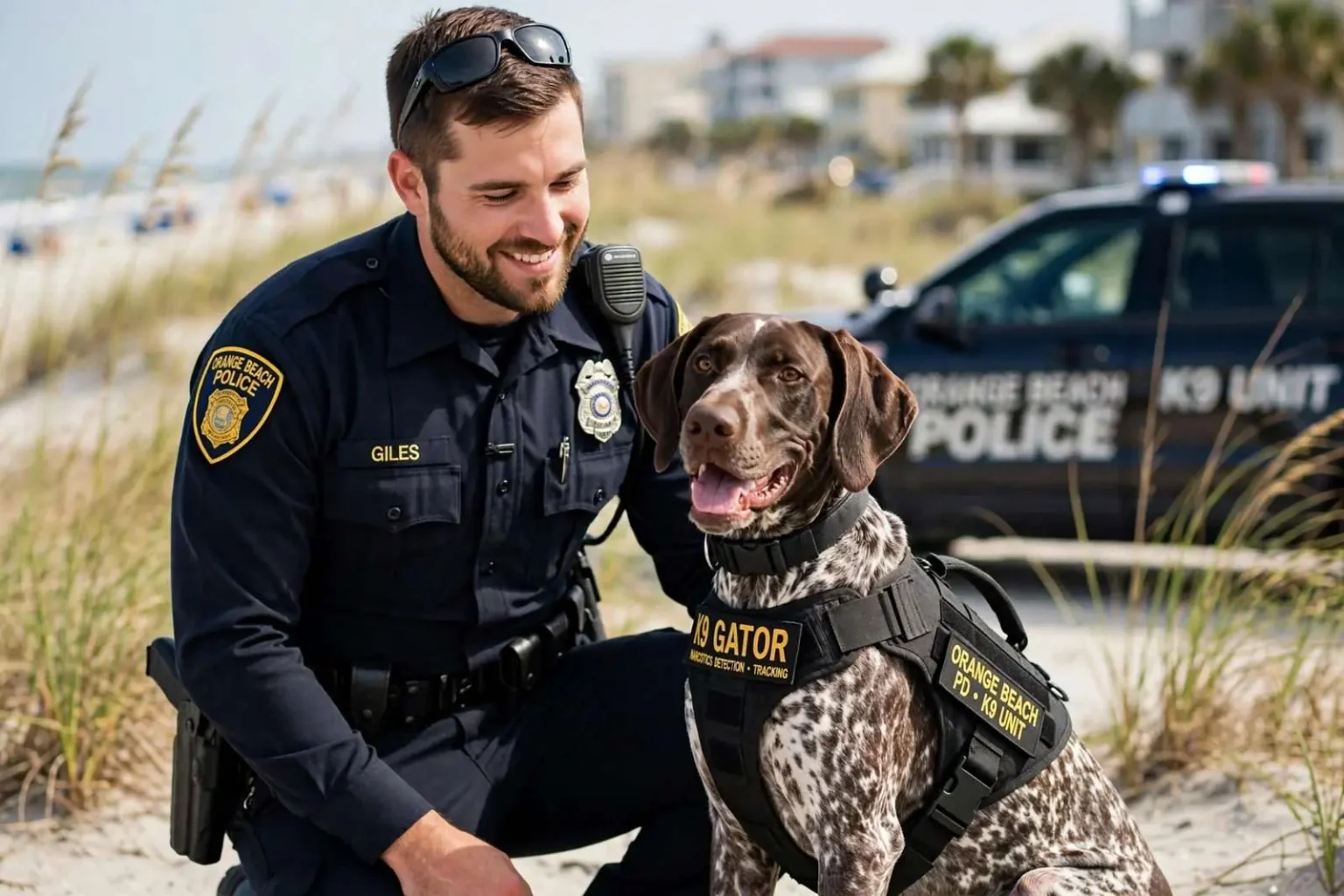
The Orange Beach Police Department has welcomed K9 Gator, a German Shorthaired Pointer trained in narcotics detection and tracking, to its K9 Unit alongside Officer Brennan Giles.
The Orange Beach Police Department has a new four-legged member on its K9 Unit.
K9 Gator, a German Shorthaired Pointer, is partnered with Officer Brennan Giles and trained as a single-purpose narcotics detection dog, with additional training in tracking and trailing to help locate suspects and missing persons.
Gator was born on Aug. 13, 2024. He and Officer Giles began training together on March 16, 2026, and graduated from K9 school on May 21, 2026, before officially beginning service to the community on May 27, 2026.
The pair completed an intensive training program before hitting the streets, and their graduation marked the end of weeks of rigorous preparation — weeks in which handler and dog learned to work as a single unit, building the communication and trust that K9 work demands.
A Young Dog With a Serious Job
Gator’s assignment reflects the way modern police K9 programs have specialized. As a single-purpose narcotics detection dog, his primary role is locating illegal drugs — in vehicles, buildings, and open areas — rather than the dual-purpose patrol work that combines detection with apprehension. The single-purpose model suits a department whose policing is oriented toward community engagement and whose calls for service rarely require a patrol dog, while still giving investigators a powerful search tool.
The additional training in tracking and trailing extends Gator’s usefulness beyond detection. Tracking dogs follow the scent trail a person leaves on the ground and in the air as they move, a capability that has found missing children, wandering elderly residents, and fleeing suspects in communities across the Gulf Coast. In a beach city whose population swells with visitors, the ability to organize a rapid scent search through dunes, maritime forest, and neighborhoods is a resource the department previously had to borrow from neighboring agencies.
German Shorthaired Pointers have become a popular choice for detection work. Bred as versatile hunting dogs, they combine an exceptional scenting ability with the stamina and drive to work long sessions without losing focus, and their friendly, high-energy temperament makes them well suited to departments that want a detection dog who can also appear at public events without intimidation.
Officer Giles and Gator trained together from their first day at K9 school through their May graduation, the standard model in police K9 work: a handler and dog certified as a team, not individually, and deployed together for the length of the dog’s career.
What K9 School Involves
The weeks between March and May that Giles and Gator spent in K9 school are only the visible part of a longer process. Detection dogs begin foundational scent training as puppies, learning to associate a target odor with a reward through hundreds of repetitions before ever seeing a police setting. Formal K9 school then builds the operational skills: systematic searches of vehicles and buildings, alerts that a handler can read instantly, and obedience reliable enough to work in crowds, traffic, and the distractions of a beach town in high season.
For the handler, the curriculum is equally demanding. Giles had to learn to read Gator’s behavior — the subtle change in posture and pace that signals a scent is being worked — and to manage a working dog’s health, conditioning, and career. Certification at graduation tests both halves of the team, and recertification is required periodically to keep the pair deployable.
The department said the team’s specialized skills, including narcotics detection and tracking, add a valuable resource for local law enforcement operations. In a resort city, that resource gets exercise in ways other towns rarely see: vehicles stopped on the beach highway, hotel and rental property calls, and the foot traffic of a tourist district that swells each summer.
A Public Face for the Department
Residents and visitors may spot Gator on patrol or at community events, including school visits and public demonstrations. The department has leaned into the community-relations value of its K9 program, and a young, high-energy pointer is the kind of dog that draws a crowd at a school assembly or a festival booth.
“If Gator is actively working, please allow him to stay focused on his job,” the department said. “If you see him at a community event, feel free to stop by and say hello!”
The distinction the department draws is one K9 handlers everywhere emphasize. A detection dog at work is performing a search that requires concentration, and petting or calling to a working dog is more than a nuisance — it can interrupt the alert sequence that makes the search useful. At demonstrations and events, by contrast, the dog is off duty, and the encounter is part of what the department wants the community to take away.
School visits carry their own purpose. Departments across Baldwin County use K9 demonstrations to teach children how the dogs work and why, and the visits give officers a chance to talk with students in a setting far more relaxed than a traffic stop. For a dog that will spend years searching cars and buildings, the public appearances build the recognition and goodwill that make the work easier.
The K9 Unit in a Tourist City
Orange Beach’s policing environment is unlike most of Baldwin County’s. The city’s population multiplies several times over in the summer months as visitors fill condominiums and rental houses along Perdido Beach Boulevard, and the traffic that comes with them keeps the department’s roads busy from spring break through Labor Day. A K9 team gives the department a tool calibrated to that environment — narcotics detection for the vehicle stops and property calls that a resort city generates, and tracking for the lost visitors and missing persons calls that the beach terrain produces.
The team also plugs into a regional network. Baldwin County’s law enforcement agencies assist one another across municipal lines, and a certified K9 in Orange Beach can be requested by neighboring departments in Gulf Shores, Foley, or the county sheriff’s office when a search or detection need arises. Mutual aid of that kind has long been the norm on the coast, where agencies are small and the tourist wave hits them all at once.
Gator’s arrival also reflects the deliberate pace of building a K9 program. Departments typically budget for the dog’s purchase and training, the handler’s certification course, a modified vehicle, and the ongoing veterinary and equipment costs that a working dog requires. The investment is justified, administrators say, by the capabilities the team brings — and by the public visibility that a K9 generates for the department.
Looking Ahead
The Orange Beach Police Department said it looks forward to many years of service from the new K9 team, calling Gator’s addition another layer of protection for the community.
A working dog’s career typically spans the better part of a decade, and for Gator, still young in months, the years ahead will follow the arc of every police K9: the first seasons of learning the city, the long middle years of steady casework, and eventually a retirement spent as a household pet with Officer Giles, who by then will have spent more time with the dog than with anyone else.
Until then, the team’s schedule will be the city’s own — patrols along the beach road, demonstrations at schools and festivals, and the searches that come without warning. Residents who meet Gator at an event are invited to say hello; drivers who see the K9 vehicle on a traffic stop should remember what the department asked — that a working dog be allowed to work.
For now, Orange Beach’s newest officer has four legs, a nose the department says is among its best tools, and a career just beginning.
Why a German Shorthaired Pointer
The breed choice tells its own story. German Shorthaired Pointers were developed in Germany as all-purpose hunting dogs — pointing game birds, retrieving on land and water, and tracking wounded game across long distances. That breeding produced a dog with an elite nose, boundless endurance, and an eagerness to work with a human partner that trainers prize above almost any other trait.
Police programs have increasingly turned to the breed for detection work, particularly where the dog’s role will include public appearances. Unlike some traditional working breeds, a well-bred GSP is typically sociable with strangers and children, which matters in a department that plans to put its K9 in front of school assemblies and festival crowds. The dog’s short coat and athletic build also suit a coastal climate better than heavier-coated breeds would.
Young dogs like Gator — just past their first birthday when training began — are the preferred recruits, old enough to focus through a full training day but young enough that the career ahead runs long. By the time Gator retired from service years from now, he will have spent more of his life working alongside Officer Giles than not.
The Team Behind the Team
Behind every K9 graduation stands a supporting cast: the trainers at K9 school who shaped the dog’s foundational skills, the department’s command staff who committed the budget, and the veteran handlers at neighboring agencies who answer a new handler’s questions in the first difficult months. K9 work is a small community along the Gulf Coast, and its members lean on one another.
The department’s announcement of Gator’s graduation carried that communal tone — celebrating not just the new team but the weeks of work that produced it. Officers who have handled dogs before describe the certification day as the easy part; the real test is the first live search, on a dark roadside or in a crowded event field, when the training has to hold.
Orange Beach residents can expect to see the team building that experience over the months ahead — on patrol, at schools, and at the city’s busy calendar of public events, where the department’s newest officer will be greeting the public with a wagging tail.