Orange Beach Considered Sewer Rate Increase to Address 2010 Shortfall
Orange Beach leaders considered a 2009 sewer-rate increase as they weighed a projected $1.5 million shortfall and the possibility of cutting more than 20 city jobs.
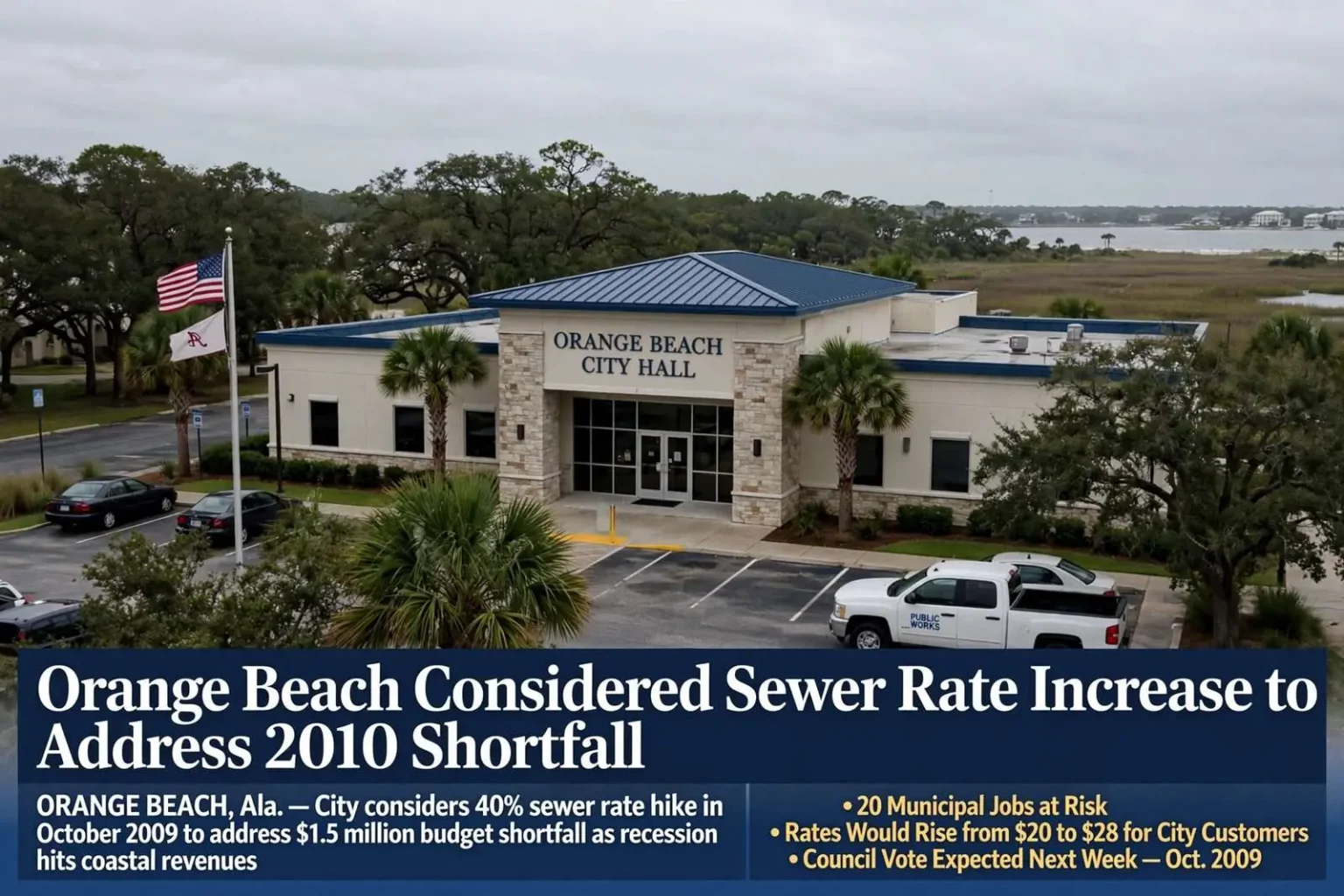
ORANGE BEACH, Ala. — Orange Beach leaders considered raising sewer rates in October 2009 as the city confronted a projected $1.5 million budget shortfall for the coming year.
The proposal before the City Council would have increased the monthly sewer bill for customers inside the city from $20 to $28 — a 40% jump that would have touched every household and business hooked to the city’s system. Customers outside the city limits but within Orange Beach’s utility jurisdiction would have seen their monthly charge rise from $30 to $42, a steeper dollar increase reflecting the higher base rate out-of-city customers already paid.
The deliberations came at one of the hardest moments in the city’s modern financial history. The recession that followed the 2008 financial crisis had drained revenue across the Gulf Coast, and Orange Beach — a resort city whose sales taxes, lodging taxes and permit fees all track the tourism economy — felt the downturn in every account. Fewer visitors meant fewer dollars, and the city’s budget had been built for boom times.
Budget and service tradeoffs
City officials said the additional revenue could help protect more than 20 municipal jobs then at risk. That figure gave the debate its human weight: behind every percentage point on the sewer bill stood positions in public works, utilities, parks, administration and public safety that the city might otherwise have to cut.
Mayor Tony Kennon described the choice as one between reducing personnel and public services or increasing sewer fees to maintain them. It was the central dilemma facing municipal budgets across Alabama and the country that fall — revenue was falling faster than cities could trim expenses without cutting into services residents expected, and user fees were often the least damaging lever left to pull.
The discussion came during a difficult economic period for local governments, when declining revenues forced cities to examine staffing, operations and user fees. Coastal communities faced a double squeeze: their tax bases depend heavily on tourism and construction, two of the sectors hit hardest by the downturn, and their infrastructure costs — water, sewer, roads — do not shrink just because visitors stay home.
Orange Beach City Hall was already facing budget pressure, and layoffs were part of the public debate. Officials had spent the preceding months trimming wherever trimming was possible, and the question before the council was whether the remaining gap should be closed on the backs of utility customers or on the city’s payroll.
Residents raise concerns
Not everyone supported the proposal. One Orange Beach resident questioned whether a utility increase was appropriate while households were dealing with a weak economy — a concern that resonated in a community where many residents work in tourism-dependent jobs that the recession had already squeezed.
The timing was the crux of the objection. A sewer rate increase lands on the same household budgets that a downturn has already tightened, and residents facing reduced hours, slower rentals and tighter credit saw little comfort in the argument that the increase was smaller than the alternative.
City leaders responded that, even at $28 per month, they believed Orange Beach’s sewer service would remain the least expensive in Baldwin County. That comparison became the administration’s central defense: the proposal, however large in percentage terms, would keep Orange Beach’s rate below what neighboring municipalities charged, preserving an advantage for residents even as the city stabilized its finances.
The council was expected to consider the rate change as early as the following week, giving the proposal a fast track from discussion to decision — a reflection of how urgently the budget picture demanded action before the fiscal year began.
Why sewer rates carry the load
Sewer systems occupy a particular place in municipal finance. They are enterprise operations — funded by the customers who use them rather than by general taxes — but their costs are fixed and heavy: treatment capacity, pump stations, lines, permitting and regulatory compliance continue regardless of how much revenue the city collects from tourists. When a resort economy stalls, a city’s general fund suffers first, and utility systems become the fallback source of stability the budget can reach for.
That dynamic explains why utility rates surfaced as the answer to a general-fund shortfall. Rate increases are unpopular, but they are targeted, recoverable and tied to the actual cost of service in a way that broad tax increases are not. For a city of Orange Beach’s size, the spread between $20 and $28 per customer, multiplied across the system’s user base, was enough to matter in a budget measured in millions.
The out-of-city rate difference reflected standard utility practice across Baldwin County. Customers outside the corporate limits typically pay more for the same service, on the theory that city residents — whose taxes support the government that built and maintains the system — deserve preferential rates. Raising the outside rate from $30 to $42 preserved that gap even as both tiers moved up.
The recession-era context
Orange Beach’s predicament in late 2009 was shared across the Gulf Coast. The national recession had cut deep into the tourism and construction revenues that coastal cities depend on, and municipal budgets from Gulf Shores to Pensacola were being rebuilt around lower expectations. Cities delayed capital projects, froze hiring, trimmed staff through attrition and, where the numbers demanded it, raised fees — all while trying to protect the core services that make a coastal city function.
For Orange Beach, the stakes were sharpened by the city’s rapid growth in the years before the downturn. The boom had built infrastructure, staffing and service levels sized for a much larger economy; the bust left the city carrying obligations that lagged the falling revenue. The sewer rate debate was one visible piece of that larger reckoning.
The public debate over the proposal also captured something essential about small-city governance in Alabama. In a community of Orange Beach’s size, budget decisions are made in rooms where the affected residents sit — or stand to speak — a few feet from the council. The resident who questioned the increase had the mayor’s direct answer in the same meeting, and the tradeoff between 20 jobs and a higher monthly bill was argued in public rather than buried in a spreadsheet.
A documented proposal, not a verdict
This report documents a proposal and public discussion from October 2009; it does not establish whether the council later adopted the increase or what final rates took effect. That distinction matters for anyone using the record: the $28 and $42 figures were on the table, but the outcome of the deliberation — adoption, amendment or rejection — is not established by this account.
What the episode establishes is the shape of the decision coastal cities faced during the recession-era budget crunch: whether to preserve jobs and services through higher utility charges, or reduce the workforce and scale back city operations. Orange Beach chose to put that choice before the public, weigh the alternatives openly and compare its rates against Baldwin County’s other systems before acting — a process that reveals how thinly the margin runs between a coastal city’s services and its solvency when the tourism economy turns down.
For residents, the episode remains a useful benchmark. The rates debated in October 2009, the 20 jobs at stake and the $1.5 million shortfall together capture what a $1.5 million hole meant in a city Orange Beach’s size — and why utility bills, however unglamorous, are where a city’s budget debates most often come home to roost.
How coastal cities weathered the downturn
The sewer rate debate fit a pattern playing out in city halls across Baldwin County and the Alabama Gulf Coast during that period. Gulf Shores, Bayou La Batre, Foley and the county’s fast-growing Eastern Shore municipalities all confronted versions of the same arithmetic: revenue streams built on tourism, real estate and construction had contracted sharply, while the cost of running a city — fuel, insurance, utilities, debt service — kept rising.
Municipal leaders had a short menu of responses. Hiring freezes and attrition reduced payrolls without layoffs, but slowly. Service cuts saved money but showed up immediately in residents’ daily lives. Fee and rate increases closed gaps fastest but tested the goodwill of households already squeezed by the economy. Most cities used some combination, sequencing the least painful options first and reaching for rate increases when the remaining choices were worse.
Orange Beach’s deliberations were notable for the transparency of the tradeoff. Rather than trimming jobs quietly through attrition or shaving services gradually, the administration framed the choice in concrete terms — 20 jobs versus a rate increase — and let the public see exactly what each dollar of the increase would buy. That framing invited the community into the decision in a way budget documents rarely do.
The utility jurisdiction factor
The proposal’s two-tier structure also illuminated how far Orange Beach’s utility system reaches beyond its city limits. Cities along the coast often provide water and sewer service to unincorporated pockets and fringe areas where municipal boundaries never followed development, creating a customer base that lives outside the city but depends on its infrastructure. Those out-of-city customers pay premium rates and, in a rate increase, absorb larger dollar jumps — as the $30-to-$42 proposal showed.
The jurisdiction question carries political weight as well as financial. Out-of-city customers typically have no vote in the elections of the council setting their rates, which makes the premium they pay a recurring sore point. When a rate increase lands on both tiers, the out-of-city increase — larger in raw dollars — often draws the louder complaint, even when the percentage change is comparable.
For Orange Beach, the utility jurisdiction represents both an obligation and an asset: the system must serve everyone within its lines, but its customer base extends the revenue foundation beyond the tax base of the city itself — a cushion that proved useful in a downturn when the city’s tourism taxes sagged.
What the episode left behind
Whatever the council ultimately decided, the October 2009 debate became part of Orange Beach’s institutional memory. The city emerged from the recession era having tested its rate structure against its neighbors, its staffing against its revenue, and its budget process against the public’s patience — lessons that shaped how the city approached the next decade’s growth and the next crisis.
The episode also remains instructive for Baldwin County’s newer communities, several of which have since faced their own growth-driven decisions about utility rates and municipal staffing. The questions Orange Beach wrestled with in 2009 — what service levels a city can afford, who pays for infrastructure, how much of a budget gap should fall on utility customers — are permanent questions in coastal municipal finance, arriving again with every economic turn.
The record of that October — a $1.5 million shortfall, a 40% proposed increase for city customers, 20 jobs on the line and a claim of county-leading affordability — stands as a snapshot of a city working through those questions in public, one council meeting at a time.