

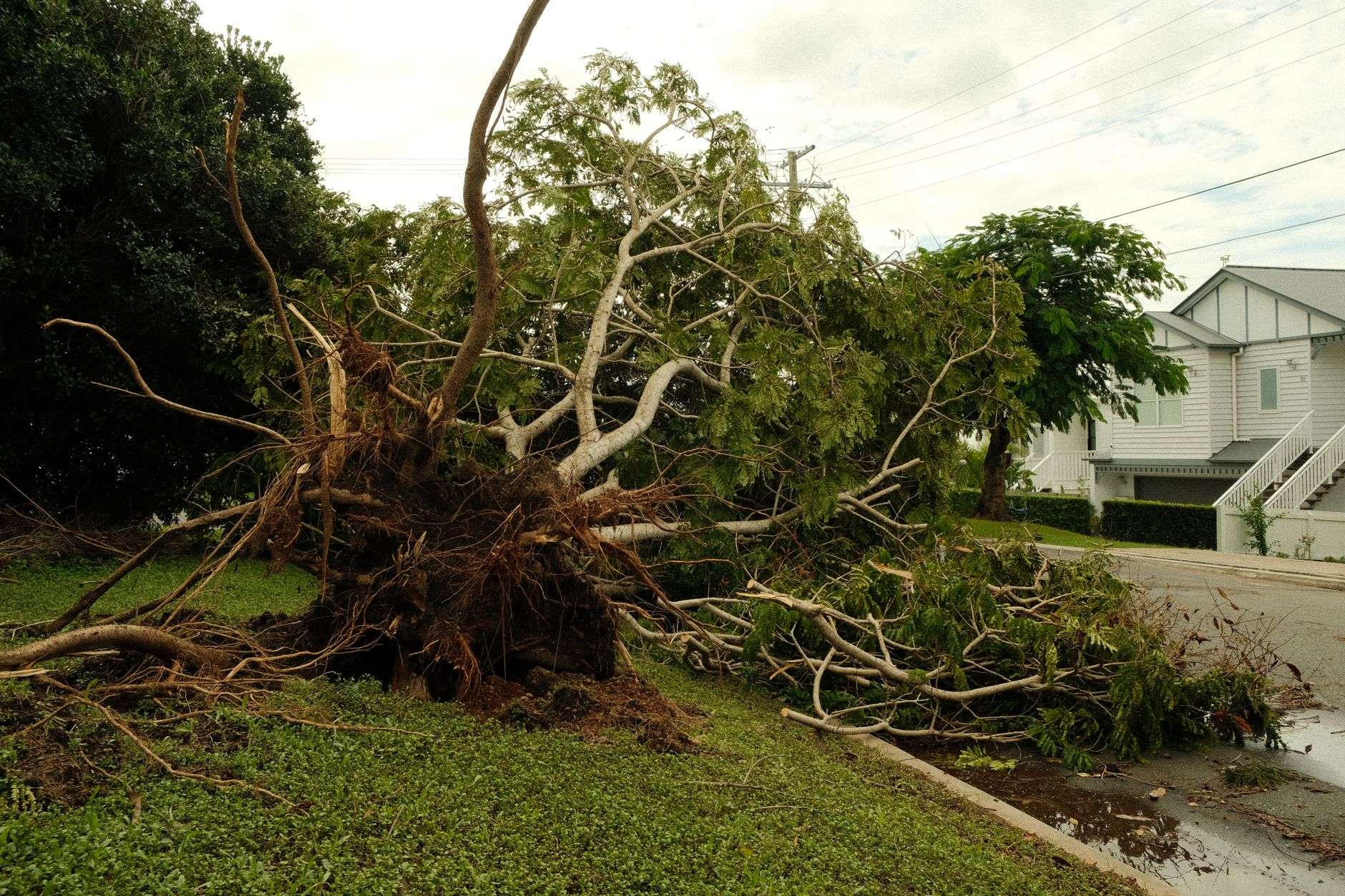
A line of strong storms moving through South Alabama on the evening of July 31 knocked out electricity to tens of thousands of Gulf Coast residents, with Baldwin County bearing the brunt of the outages as utility crews worked to assess damage and restore service.
By 10:30 p.m., Baldwin EMC was reporting nearly 26,300 customers without power across its service territory, while Riviera Utilities, which serves parts of Foley and the surrounding area, logged 106 customers in the dark. In neighboring Mobile County, Alabama Power reported a smaller but still significant outage total of 61 customers affected by the same round of weather.
A Fast-Moving System Sweeps the Coast
The outages came as a fast-moving band of storms pushed across the Gulf Coast, a pattern that is common during Alabama’s late-summer months when heat and humidity combine to fuel strong afternoon and evening thunderstorms. These systems can produce damaging straight-line winds, frequent lightning and heavy downpours capable of snapping tree limbs and toppling power lines with little warning.
Baldwin County’s higher outage count reflects both the storm’s path and the county’s mix of rural roads, wooded corridors and overhead distribution lines, all of which are more vulnerable to wind-driven tree damage than the more urbanized pockets of Mobile County. Utility officials have not yet released a detailed damage assessment, and as of late Friday night, neither Baldwin EMC nor Riviera Utilities had provided a firm timetable for full restoration.
What Affected Customers Can Expect
Power providers across the region generally prioritize restoration efforts based on the scope of damage, starting with critical infrastructure such as hospitals and emergency services before moving to substations and main distribution lines that restore power to the largest number of customers at once. Individual homes and smaller pockets of outages are typically addressed last, meaning some residents may see their lights back on within hours while others could face a longer wait if crews encounter downed lines, broken poles or blocked access roads.
Customers in Baldwin County can check Baldwin EMC’s outage map or call the cooperative’s outage line for updates, while Riviera Utilities customers can use that provider’s online outage reporting tool. In Mobile County, Alabama Power maintains a similar online outage map and mobile app that lets customers view estimated restoration times as crews update the system throughout the recovery process.
Staying Safe Until the Lights Come Back On
Utility companies routinely remind residents to treat every downed power line as if it is energized and to stay well away from fallen lines, reporting them immediately rather than attempting to move or step over them. Households without power are also encouraged to keep refrigerator and freezer doors closed as much as possible to preserve food, unplug sensitive electronics to guard against power surges when service is restored, and, if using a portable generator, run it outdoors and well away from windows and doors to prevent carbon monoxide buildup.
For residents relying on candles or battery-powered lighting during an extended outage, fire officials also caution against leaving open flames unattended, particularly in homes with children or pets.
A Reminder of Storm Season on the Gulf Coast
Friday night’s outages serve as a timely reminder that South Alabama remains squarely in the heart of its severe summer weather season, a stretch that regularly brings pop-up thunderstorms, gusty winds and occasional flash flooding to Mobile and Baldwin counties. Residents are encouraged to keep phones charged, monitor local weather alerts and have a basic emergency kit on hand, including water, non-perishable food, flashlights and a battery-powered or hand-crank radio, in case outages stretch overnight or into the following day.
Southal News will continue to monitor restoration efforts from Baldwin EMC, Riviera Utilities and Alabama Power and will provide updates as more information becomes available.
The scale of the late-July outages in Baldwin County was a sharp illustration of how quickly the Gulf Coast’s power infrastructure can be tested by even a single round of severe weather. Baldwin EMC’s report of more than 26,000 customers without service by 10:30 p.m. represented one of the larger outage events the cooperative has had to manage in recent years, and the gap between the Baldwin EMC figure and the much smaller numbers reported by Riviera Utilities and Alabama Power showed just how much the storm’s impact depended on local geography, the path of the strongest cells, and the configuration of each utility’s distribution system.
Baldwin EMC, formally the Baldwin County Electric Membership Cooperative, is one of several electric cooperatives serving rural and suburban areas across Alabama. Cooperatives are nonprofit, member-owned utilities that were originally created to bring electricity to rural parts of the country that the large investor-owned utilities had not prioritized. Today, electric cooperatives across the United States serve a significant share of the country’s land area, and many of them — including Baldwin EMC — have grown into substantial organizations that serve tens of thousands of members across large territories. Baldwin EMC’s service area covers a substantial portion of Baldwin County, including many of the unincorporated areas and smaller communities that are not served by municipal utilities or by Alabama Power’s distribution system.
Riviera Utilities, the utility that serves Foley and parts of the surrounding area, is a municipal utility owned by the City of Foley. Municipal utilities are operated by cities and towns and generally serve only the territory within their corporate limits or designated service area. The much smaller outage number from Riviera Utilities during the July 31 storm reflected the more concentrated footprint of the utility, the more urbanized configuration of Foley’s distribution system, and the fact that the strongest cells of the storm tracked through other parts of Baldwin County rather than directly over Foley’s service territory.
Alabama Power, the largest investor-owned electric utility in the state, is a subsidiary of Atlanta-based Southern Company and has served parts of Alabama for more than a century. The Mobile County portion of the company’s service territory is a small part of its overall footprint, but it serves a large number of residential, commercial, and industrial customers in the Mobile area. The relatively small outage count from Alabama Power during the July 31 storm reflected both the path of the storm and the more heavily engineered distribution system in the urbanized portions of Mobile.
The pattern of damage that drives these kinds of outage events is well understood by Gulf Coast utilities. Most outages during summer thunderstorms are not caused by failures in the major transmission lines that bring power into a region, but rather by damage to the local distribution system — the network of smaller lines, transformers, and poles that carry electricity from substations to individual homes and businesses. Tree limbs falling on lines, lightning strikes on equipment, and wind damage to poles and transformers are by far the most common causes of storm-related outages, and the rural and wooded areas of Baldwin County are particularly susceptible to that kind of damage because the distribution system runs through corridors with substantial tree cover.
The process of restoring power after a major storm is a well-practiced routine for utilities across the Gulf Coast. Repair crews begin by assessing the damage, usually starting with the largest substations and main distribution lines that, once restored, can bring power back to the largest number of customers at once. From there, crews work out into the smaller branches of the distribution system, with priority given to critical infrastructure like hospitals, emergency services, water and sewer pumping stations, and large residential or commercial developments. Individual service lines to homes and businesses are typically the last to be restored, partly because they require crews to physically reach each affected address and partly because there are many more of them than there are main distribution lines.
The customer-facing tools that utilities rely on during outage events have improved substantially over the past decade. Baldwin EMC, Riviera Utilities, and Alabama Power all maintain online outage maps that update as crews report progress, mobile apps that let customers report outages and view estimated restoration times, and automated phone systems that provide updated information as conditions change. Those tools have become an important part of how the public experiences a major outage, and they have meaningfully reduced the volume of phone calls that utility call centers have to handle during a large event.
The public safety messaging that utilities and fire departments put out during outage events is also worth paying close attention to, because the dangers of a major outage extend well beyond the inconvenience of being without power. Downed power lines, often still energized, are among the most serious hazards, and people who come into contact with them face the risk of severe injury or death. Generator use, when the alternative to running a portable generator, is well understood: it should always be operated outdoors, far from windows and doors, because of the carbon monoxide it produces. Refrigerated food, sensitive electronics, and any medical equipment that depends on power all require their own precautions. For residents across the Gulf Coast, those reminders are familiar, but they remain important to follow every time a major storm knocks out the lights.
The July 31 storm also sits within a broader pattern of summer weather across the Gulf Coast that has been intensifying in recent years. Climate scientists have observed that the Gulf of Mexico’s surface waters have been warming, which has implications for both the intensity of individual thunderstorm cells and the broader patterns of rainfall across the southeastern United States. That warming trend does not change the basic structure of summer weather on the coast — afternoon thunderstorms driven by sea breezes and daytime heating — but it can make the strongest of those storms more energetic, more frequent, and more capable of producing the kind of wind damage that drives widespread outages. The utilities that serve the region are adapting to that reality, both by hardening their systems against wind damage and by maintaining the kind of rapid-response capability that limits the duration of major outage events.