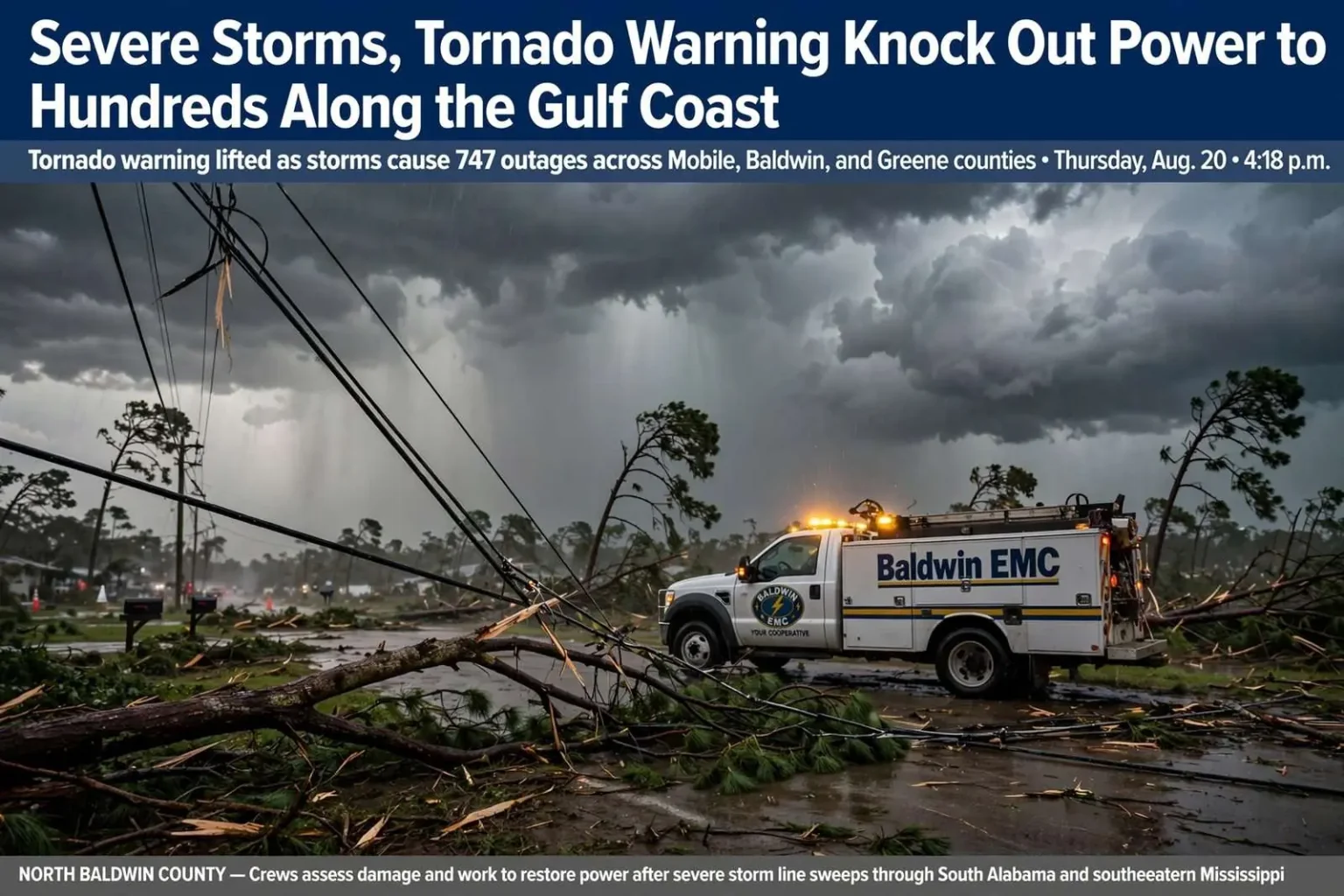
Severe Storms, Tornado Warning Knock Out Power to Hundreds Along the Gulf Coast
Severe storms and a tornado warning in Baldwin County knocked out power to hundreds of homes Thursday, with 747 outages reported across Mobile County, Baldwin County and Greene County, Mississippi.
Severe thunderstorms swept across the central Gulf Coast Thursday afternoon, triggering a tornado warning in Baldwin County and knocking out power to hundreds of homes and businesses across South Alabama and into southeastern Mississippi. The fast-moving line of storms arrived with the kind of sudden intensity typical of late-summer weather along the Gulf, giving residents little time between the first rumbles and the first outages and sending families across the region scrambling for shelter as warnings lit up phones and radios.
As of 4 p.m. Thursday, Aug. 20, utility companies had reported a combined 747 power outages across Mobile County, Baldwin County, and Greene County, Mississippi, according to outage tracking from the affected utilities. The hardest-hit area was North Baldwin County, where Baldwin EMC reported at least 476 outages. The National Weather Service had issued a tornado warning for that part of the county as the line of storms moved through, prompting residents to take shelter before the warning was allowed to expire.
Alabama Power reported at least 136 separate outages affecting roughly 1,726 customers as of 4:18 p.m. Thursday. Across the state line in Mississippi, Singing River Utilities reported 135 outages in and around Lucedale, in Greene County, where the same storm system pushed through on its way northeast. The geographic spread of the outages, from the Mobile Bay area more than a hundred miles inland to the piney woods of southeastern Mississippi, illustrated the breadth of the storm line as it crossed the central Gulf Coast.
Tornado Warning Has Since Been Lifted
The tornado warning that prompted the initial wave of shelter-in-place alerts across Baldwin County has since been lifted, though crews with each of the affected utilities were continuing to assess damage and restore service Thursday evening. Warnings of this kind are issued when Doppler radar shows rotation in a storm or when spotters report a funnel or tornado on the ground, and they remain in effect until the threat passes the warned area. In Baldwin County’s case, the warning expired without a confirmed tornado touchdown, but the straight-line winds and embedded heavy weather within the storm line were more than capable of producing the damage that knocked out power across the northern part of the county.
For residents in the warned area, the sequence followed the familiar pattern of Gulf Coast severe weather: alerts pushed to phones, televisions and radio interrupted with warning text, and families moving to interior rooms or storm shelters until the all-clear arrived. Schools, businesses, and churches across North Baldwin County that regularly participate in severe weather drills put those plans into practice as the storm line approached.
What Causes Storm-Related Outages
Power outages during severe weather events like this one are typically caused by high winds snapping tree limbs onto power lines, lightning strikes on transformers and substations, or straight-line wind gusts associated with the storm cells moving through the area. In the pine forests of North Baldwin County and rural Greene County, overhanging and adjacent trees are the persistent weak point in the distribution system; a limb that may have been deadened by drought or lightning becomes a conductor and a breaker of lines when a strong gust pushes it into the wires above the road.
Utility crews generally prioritize restoring power to critical infrastructure such as hospitals and water treatment facilities first, before moving to residential neighborhoods. The triage process reflects both public safety and practical engineering: water systems and medical facilities cannot tolerate extended interruptions, and once the backbone circuits serving them are re-energized, crews can work outward through the feeder lines that carry electricity to individual streets and subdivisions.
The three utilities touched by Thursday’s storm serve very different territories, which helps explain the shape of the outage map. Baldwin EMC is a member-owned electric cooperative headquartered in Summerdale, with a service territory that spreads across much of Baldwin County’s rural and suburban landscape, including the fast-growing northern end where Thursday’s outages were concentrated. Co-ops like Baldwin EMC maintain long stretches of line per customer compared with city utilities, which means a single storm-path through wooded country can knock out service to hundreds of members at once.
Alabama Power, by contrast, is the state’s largest investor-owned utility, serving customers across Mobile County and much of central and south Alabama. Its 136 separate outages Thursday were typical of a storm event in an urbanized service territory: more incidents, each affecting fewer customers, as localized damage interrupts individual circuits and laterals around the Mobile area. Singing River Utilities, serving Lucedale and the surrounding communities in Greene County, operates in one of the most rural corners of the Mississippi Gulf region, where restoration depends on crews patrolling line miles through pine stands to find the breaks.
What Residents Should Do During and After an Outage
Residents who lost power were urged to report outages directly to their utility provider and to steer clear of any downed lines, which should always be treated as energized and dangerous regardless of whether the outage has been confirmed. Utility officials repeat that guidance after nearly every storm because the consequences of ignoring it are so severe: a line that appears dead can be re-energized automatically by switching equipment or by a portable generator feeding back through the system, and contact with a fallen conductor can be fatal.
Safety officials also remind households using portable generators to run them outdoors, well away from windows, doors, and vents. Generator exhaust contains carbon monoxide, an odorless gas that accumulates quickly in enclosed or partially enclosed spaces, and every severe-weather season brings cases of poisoning in storm-affected neighborhoods. Food safety is another practical concern during extended outages; health guidance generally advises keeping refrigerator doors closed and discarding perishable food after four hours without power, while a full freezer can hold its temperature for roughly a day or more if left unopened.
For residents tracking restoration, the affected utilities publish outage maps and restoration updates online and through their customer service lines, and local emergency management offices use social media to pass along shelter information, road hazards, and storm reports. In Baldwin County, the Emergency Management Agency coordinates with municipal governments and utility liaisons during severe weather events, a structure that has been built out over years of hurricane seasons and severe storm responses along the Gulf Coast.
A Reminder of the Season
August sits at the heart of the Gulf Coast’s severe weather calendar, when afternoon heat and abundant Gulf moisture combine to fuel fast-developing thunderstorm lines capable of producing damaging winds, frequent lightning, and, on occasion, brief tornadoes. Thursday’s event was not a named tropical system, but it delivered the same practical lessons that emergency managers stress throughout the season: have a way to receive warnings at any hour, know where to shelter when a warning is issued for your area, and keep the basic supplies that make a night without electricity manageable.
The lifting of the tornado warning did not end the day’s work for utility crews, who spent Thursday evening patrolling lines and clearing debris in the areas hit hardest. Restoration in storm conditions is a sequential job: damage must be found, trees and limbs cleared from lines, broken hardware replaced, and circuits re-energized section by section, with crews moving on only when each segment holds. Customers in the hardest-hit pockets along the storm’s path through North Baldwin County were likely to be the last restored, as is typical when damage is concentrated on the smaller lines at the edges of the system.
This is a developing story, and outage numbers and restoration times were expected to change as utilities completed their damage assessments Thursday night. For the hundreds of households across Mobile County, Baldwin County, and Greene County that lost power in the storm, the evening brought the familiar routine of candles, battery radios, and quiet streets that accompanies severe weather on the Gulf Coast, along with the assurance that the same storms that interrupted the day had moved on, and that the region’s utilities, practiced by long experience with Gulf weather, were already at work turning the lights back on.
Cooperative utilities such as Baldwin EMC operate on a different model than investor-owned companies, answering to the member-owners they serve rather than shareholders, and that structure shapes how storm response unfolds. Board members live in the service territory, line crews are local, and restoration decisions are made close to the damage rather than at a distant corporate headquarters. In practice, that means members in a storm’s path often see bucket trucks from their own co-op on nearby roads within hours, working the same circuits their neighbors’ homes depend on. The trade-off is scale: a co-op cannot borrow crews from across a multistate system the way a large investor-owned utility can during a major event, so recovery in a widespread outage rests on the diligence of a local workforce and, when warranted, mutual aid agreements with other co-ops across the region.