Storms Knock Out Power to About a Quarter of Thomasville
Storms across Clarke County downed trees and power lines, leaving about 25% of Thomasville without electricity as Alabama Power crews began repairs.
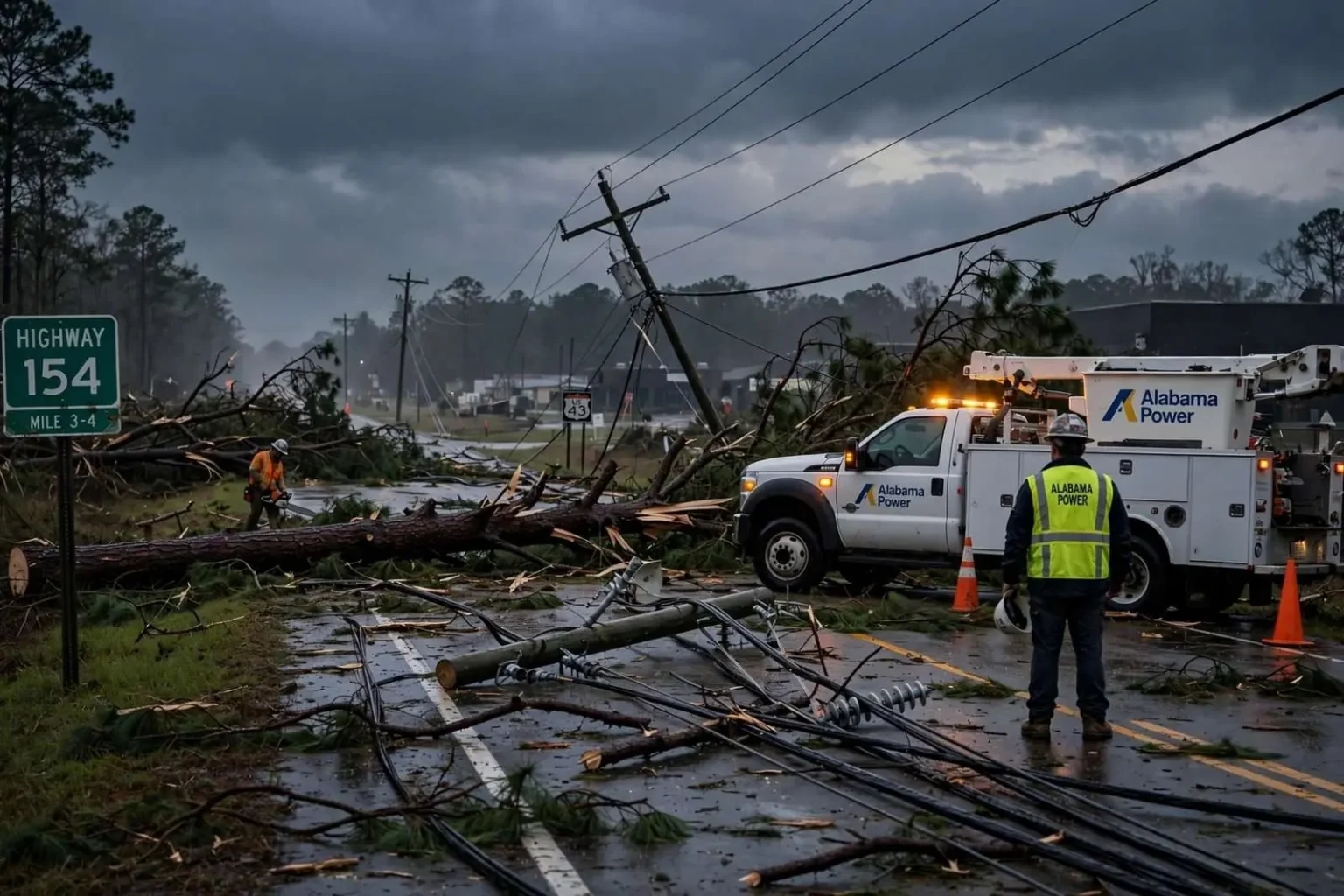
A strong line of storms rolled through Clarke County early Tuesday, tearing down trees and power lines and cutting electricity to roughly a quarter of Thomasville, according to Mayor Sheldon Day. The damage spread across the city and into the surrounding countryside, knocking out power to homes and businesses along several major routes and complicating the morning for thousands of residents.
The mayor identified several trouble spots across the city and surrounding area. Trees and power lines came down along Highway 154 between the three and four mile markers, and additional lines and trees were reported down on Peach Tree Road near the landfill. Outages stretched along U.S. 43 from south of the Thomasville Walmart to just south of the Hardees, as well as along U.S. 154. Phone service was also knocked out in a number of areas, complicating efforts by residents to report damage to authorities and utilities.
Alabama Power crews were on the scene and preparing to begin repairs, the mayor said. Residents were advised to treat any downed line as energized and to stay clear of crews working along the roadways. For a city the size of Thomasville, an outage affecting about a quarter of the community represents a major disruption, touching households, schools, medical needs and the businesses that anchor the town’s commercial corridors.
How the Storm Hit
Early-morning storm lines moving through southwest Alabama arrive in the dark, and that is part of what makes them so damaging to report and so slow to assess. When trees fall across power lines at 3 or 4 a.m., the first signs most residents see are the aftermath — alarm clocks dark, internet routers silent, refrigerators warming — rather than the event itself. In Thomasville, the Tuesday line brought the same combination that downed-tree incidents across the Gulf Coast routinely produce: saturated ground that lets shallow-rooted pines and oaks topple in straight-line winds, and limbs that break across the distribution lines strung along the region’s rural roads.
The geography of the outages tells the story of how power is delivered in a small Clarke County city. Major distribution lines follow the U.S. 43 corridor, which runs north-south through the heart of Thomasville and carries the town’s principal retail district, including the Walmart area the mayor referenced. When a trunk line goes down along that corridor, whole neighborhoods lose service at once, and every side street fed by that trunk stays dark until the main line is repaired. That cascading effect is why a storm that brought down trees at scattered points — Highway 154 between the three and four mile markers, Peach Tree Road near the landfill — could leave a quarter of the city without electricity simultaneously.
The loss of phone service added a layer of frustration that residents of rural Alabama know well. Landline and wireless service both depend on infrastructure that storms can disrupt — copper lines and fiber routes along the same roads as the power lines, and wireless towers that switch to backup batteries when commercial power fails. With phones down in a number of areas, residents who spotted downed lines or blocked roads had difficulty reaching authorities, and officials had to rely on the residents who still had service to funnel reports of damage from across the city.
The Utility Response
Alabama Power, the investor-owned utility that serves most of Clarke County, stages storm response from service centers across its southwest division, and crews working a scene like Tuesday’s follow a deliberate sequence. First they patrol the lines to find every point of failure, because repairing one break on a circuit only reveals the next. Trees and limbs have to be cleared before lines can be re-strung or re-tensioned, and downed lines that have fallen across roads or private property must be treated as live until crews ground and de-energize them. The mayor’s warning to residents — treat every downed line as energized — reflects the deadliest hazard a storm leaves behind: lines that look dead but are not, and lines that can be re-energized without warning as circuits are restored.
Utility workers have their own safety rules that residents watching from the roadside should respect. Crews ask that drivers not stop alongside working trucks, that onlookers keep well back from bucket trucks and downed wires, and that generators never be connected directly to a home’s wiring, where they can back-feed electricity onto lines workers believe are dead. Restoration after storm damage of this kind typically proceeds by priority — trunk lines and critical facilities first, then neighborhoods, then individual service drops — which is why some streets see their lights come back hours before neighbors a mile away.
For households in the outage area, the immediate concerns are practical. Food in refrigerators stays safe for roughly four hours unopened, and freezers hold for a day or more if kept closed. Residents who depend on powered medical equipment are urged to make contingency plans at the start of storm season, and families with wells — common along the rural routes around Thomasville — lose water service along with power, since electric pumps stop when the lines do. Cellular networks, even where towers survive, can become congested in the hours after a storm as everyone in the affected area reaches for their phones at once.
Small-City Storm Recovery
Thomasville, the largest city in Clarke County and a commercial hub for the surrounding rural communities, has weathered significant storm events before, and Tuesday’s damage followed a familiar playbook for city government. The mayor’s office coordinates with the utility, county emergency management and city departments to clear roads, account for outages and communicate with residents — a task made harder when phone service is down and the usual channels are unreliable. City crews handle the tree work on municipal roads while the utility handles the lines, and the two have to work in sequence, since crews cannot safely repair power lines under limbs that have not yet been cut away.
The damage points the mayor listed — Highway 154 between the three and four mile markers, Peach Tree Road near the landfill, the U.S. 43 stretch from south of Walmart to just south of the Hardees, and U.S. 154 — sketch a map of the storm’s path that residents will recognize. Rural stretches took the brunt of the falling timber, while the commercial corridor along U.S. 43 saw the outage effects most visibly, with darkened storefronts and gas stations unable to pump fuel until power returned.
Storms of this kind rarely make statewide news, but they are the defining weather experience of small-town south Alabama. Lines of thunderstorms sweeping in from the Gulf or tracking across the state from the west bring damaging winds that topple trees onto the power system multiple times each year, and the recovery each time follows the same rhythm: a morning of chainsaws and dark storefronts, a day or two of utility trucks along the corridor roads, and a community comparing notes about whose lights came back first. Tuesday’s storm, with a quarter of Thomasville dark and crews moving in at dawn, fit squarely into that pattern — significant disruption, well-practiced response, and a city waiting on the hum of transformers coming back one street at a time.
What Comes Next
In the days following an outage like this one, the focus shifts from emergency response to cleanup and prevention. Fallen trees have to be removed from rights-of-way along Highway 154, Peach Tree Road and the other affected routes, and the debris piles that line rural roadsides for weeks after a storm become a familiar sight. City and county work crews, and the contractors they bring in during larger events, chip and haul the debris while residents sort through the more personal question of insurance — whether a fallen tree damaged a roof, a carport or a fence, and which policy responds. Property owners are generally responsible for trees that fall on their own property, even when the tree came from a neighbor’s land or a utility right-of-way, though lines that damage service entrances to a home are handled differently from lines on the utility’s side of the meter.
The storm also serves as a recurring reminder about preparedness in a county where severe thunderstorms, and the tornadoes they can spin off, are a year-round possibility. Emergency managers across southwest Alabama urge families to keep multiple ways to receive warnings — a weather radio charged by batteries or hand crank, not just a phone — because as Tuesday showed, phone service itself can be part of what a storm takes out. A basic kit of flashlights, water, shelf-stable food and a means to charge a phone in a vehicle costs little and pays off each time a line of storms drops a pine onto a distribution line in the dark.
For now, the count that matters most to Thomasville residents is simple: how much of the city is dark, and how fast it comes back. With Alabama Power crews on the ground from the first hours after the storm, and the mayor’s office relaying damage reports as phone service returns, the city began the work of turning the lights back on even as the last of the storm line moved out of Clarke County — the same choreography this corner of south Alabama has performed after every major storm, and will perform again.