Pine Apple man found dead in Monroe County ATV crash after being reported missing
A Pine Apple man reported missing by family was found dead in a Monroe County ATV crash. ALEA identified him as 38-year-old Chad Brantley of Pine Apple.
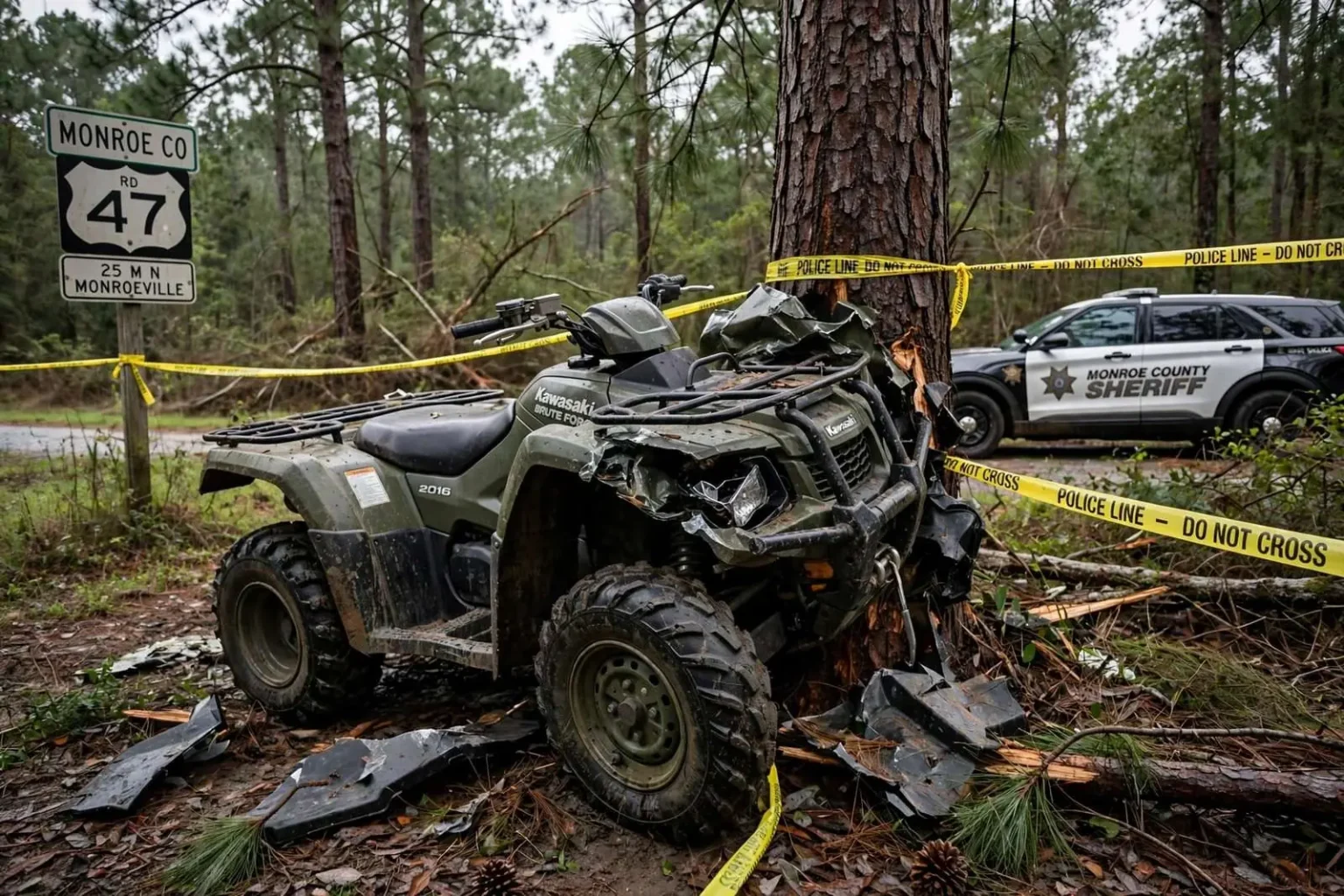
MONROE COUNTY, Ala. — The body of a man reported missing earlier this month has been recovered after an extensive search by friends, family and law enforcement, the Monroe County Sheriff’s Office said.
Sheriff Tom Boatwright said it appears the man, identified by the Alabama Law Enforcement Agency as 38-year-old Chad C. Brantley of Pine Apple, was involved in an ATV accident. ALEA confirmed Brantley struck a tree while riding a 2016 Kawasaki Brute Force.
Family members reported him missing on July 7 after he did not return from riding his four-wheeler. He was last seen in the Old Texas community of Monroe County.
The search
Brantley was reported missing on July 7, the day he set out on his four-wheeler and did not come home. For a family in rural Monroe County, the absence of a rider who knows the local terrain was immediately alarming: ATVs travel on roads and trails where breakdowns leave people stranded out of sight, and a rider who does not return by dark sets off a search that family members typically begin themselves before calling authorities.
The search that followed was extensive, drawing in friends, family and law enforcement across the days after the report. Searches for missing riders in rural Alabama are labor-intensive by nature: the landscape is a patchwork of wooded tracts, fields, creek bottoms and unpaved roads, much of it on private land, and a person or machine can be hidden within a few dozen yards of a searcher unless the ground is covered methodically. Volunteers who know the country — where trails run, where old logging roads cut through the woods — are essential to covering it, and the effort in this case combined that local knowledge with the resources of the Sheriff’s Office.
The search ended on Wednesday, July 13, when a passerby discovered Brantley’s body on Monroe County Road 47, about 25 miles north of Monroeville. The discovery resolved the search with the outcome the family had feared, and the focus of the response shifted from looking for a missing man to documenting how he died.
What ALEA’s findings showed
The Alabama Law Enforcement Agency identified Brantley and confirmed the circumstances of the crash that took his life: he struck a tree while riding a 2016 Kawasaki Brute Force. Sheriff Tom Boatwright said it appears the death resulted from the ATV accident, an assessment consistent with ALEA’s findings at the scene.
ALEA’s Highway Patrol Division investigates fatal crashes on Alabama roadways, including off-road vehicle fatalities where they fall under the agency’s jurisdiction, and its troopers document the scene, examine the vehicle and establish the sequence of events. The single-vehicle crash occurred around 4:30 p.m. on July 7, according to ALEA — meaning Brantley’s accident happened on the same day his family reported him missing, and the search continued for nearly a week before the site was found.
The gap between the crash and the discovery of the site reflects the challenges of rural search work. A single-vehicle crash in heavy woods can be invisible from the nearest road, and the rider thrown or trapped away from the traveled path leaves little sign that searchers can follow. The fact that a passerby ultimately made the discovery on Monroe County Road 47 underscores how easily such sites remain hidden even from sustained searching.
Troopers continued to investigate the crash, the standard course in fatalities where the full circumstances remain under review.
Old Texas and the rural county
Brantley was last seen in the Old Texas community of Monroe County, one of the small, unincorporated communities that dot the rural Black Belt region of south-central Alabama. Monroe County, with Monroeville as its seat, is a county of pine forests, farmland and scattered settlements connected by two-lane roads, and its landscape is one where ATV riding is a common pastime and practical transportation alike.
In communities like Old Texas, four-wheelers are part of rural life. Riders use them to reach hunting land, check on property, ride trails with family and move around areas where distances between neighbors make walking impractical. The familiarity of the machines can mask their risks, and rural counties across Alabama record ATV fatalities every year — often single-vehicle crashes like this one, in which a rider strikes a fixed obstacle on or near a trail with no protective enclosure around them.
Monroe County Road 47, where Brantley was found, sits in the rural network north of Monroeville, the stretch of country about 25 miles from the county seat where paved roads give way to a mix of surfaces and the woods close in along the right of way. It is the kind of country where a missing rider’s trail can vanish at a property line, and where searchers depend on landowners’ permission to cover ground.
Pine Apple’s loss
Brantley was 38 years old and lived in Pine Apple, the historic small town in western Wilcox County on the Monroe County line. Pine Apple is a community of historic homes and deep family roots, the kind of place where a resident’s death after a weeklong search touches people who knew him across the surrounding counties, not just in town.
The search itself demonstrated the social fabric of the region. Friends and family joined law enforcement in the effort over nearly a week, in heat typical of an Alabama July, covering wooded terrain on foot and by vehicle. That kind of mobilization — unpaid, persistent and personal — is how rural South Alabama responds when one of its own is missing, and the outcome was a grief shared across the community that had searched.
Sheriff Boatwright’s public statements walked the line the situation required: confirming the identification and the apparent cause while ALEA’s troopers completed their documentation of the crash. For a small county’s sheriff, a case like this one involves the office in the family’s ordeal directly, from the missing-person report to the scene where the search ended.
ATV safety in rural Alabama
The circumstances of the crash — a rider striking a tree — reflect the leading pattern in ATV fatalities. Fixed-object collisions account for a large share of deaths involving off-road vehicles, and they occur at speeds and angles that leave the rider without the protection a passenger vehicle provides. Rural riders traverse terrain where trees, ditches and fences sit close to the traveled path, and a momentary loss of control at speed is enough to produce a fatal impact.
The vehicles themselves add to the exposure. A 2016 Kawasaki Brute Force is a utility ATV designed for work and trail riding, with no cab or restraints beyond the rider’s grip and positioning. Safety guidance for such machines emphasizes helmets, riding within sight lines and terrain the rider knows, and avoiding roads never designed for the vehicles — but the realities of rural riding mean many trips mix all of these at once.
For Monroe County and communities like Pine Apple and Old Texas, Brantley’s death is a reminder of the margin that separates a routine ride from a fatal crash, and of the weeklong search that followed when a rider did not come home. The investigation by ALEA’s troopers will complete the record of what happened on Monroe County Road 47 on the afternoon of July 7, closing the case the search opened.
How missing-person searches work in rural counties
The search for Brantley followed the pattern that rural Alabama counties have developed for missing-person cases, combining official resources with community mobilization. When the family reported him missing on July 7, the Sheriff’s Office took on the case, and the search unfolded across the days that followed — an effort the department described as extensive and one that included friends and family alongside deputies.
Rural searches present problems of scale that urban ones do not. The area a missing rider might occupy spans square miles of terrain that vehicles cannot cross and that searchers on foot cover slowly. Deputies coordinate with volunteer searchers, establish patterns based on where the person was last seen, and pursue leads about sightings or contacts. In Brantley’s case, the last-seen point was the Old Texas community, which anchored the search’s geography, and the terrain — wooded, privately owned and laced with trails — dictated the pace.
The role of a passerby in the eventual discovery is not unusual in such cases. Roads remain the most traveled parts of rural landscapes, and someone moving along Monroe County Road 47 noticed what organized searchers had not yet reached. Discoveries by passersby happen because rural roads carry regular traffic — neighbors, loggers, mail carriers — whose daily presence covers ground that formal searches cannot continuously monitor.
Once the body was found on July 13, the response shifted: law enforcement secured the site, ALEA documented the crash, and the search effort’s participants received the answer they had been pursuing for nearly a week.
The coroner and medical examiner process
In a death of this kind, the recovery of the body begins a formal sequence that runs parallel to the crash investigation. The county coroner takes jurisdiction over remains in Alabama when a death occurs outside medical care, arranging for the examinations needed to establish cause and manner of death and to confirm identity.
That process matters to the family both legally and personally. Official determination of the cause of death, combined with ALEA’s crash findings, completes the documentation that settles questions of what happened and allows the family to proceed with arrangements. The timeline for such determinations varies, and the public record of the case grows as each step is completed — the identification by ALEA, the sheriff’s assessment, the crash confirmation and the ongoing investigation by troopers.
For the record, the established facts as reported were these: a 38-year-old man from Pine Apple, reported missing July 7 by his family after he did not return from riding his four-wheeler; last seen in the Old Texas community; found dead on July 13 by a passerby on Monroe County Road 47, about 25 miles north of Monroeville; identified by ALEA as Chad C. Brantley; and confirmed by the agency to have struck a tree while riding a 2016 Kawasaki Brute Force in a single-vehicle crash that occurred around 4:30 p.m. on July 7.
A community’s week
The week between Brantley’s disappearance and the discovery of his body was lived by his family and the searchers who joined them. Accounts of rural searches describe the rhythm of them: mornings assembling at a staging point, days covering assigned ground in the heat, evenings regrouping to plan the next day’s areas, and the strain of holding hope while the hours accumulate.
Law enforcement’s role in that week is both operational and personal. Deputies know the families they serve in a county the size of Monroe, and a missing-person case engages the office’s familiarity with the terrain and the people. Sheriff Boatwright’s public statements reflected that position — the county’s chief law officer speaking about a resident whose disappearance had mobilized the community around him.
The conclusion of the search on July 13 brought the week to its hardest ending. The passerby’s discovery answered the question the search had been asking, and the findings that followed — the crash confirmation, the identification, the ongoing trooper investigation — began the work of establishing on the record what happened to Chad C. Brantley on the afternoon he rode out from Old Texas.
For the family in Pine Apple and the friends who searched, the findings close the search but not the loss. What remains is the record: a rider missed, a community that looked for him for six days, and the crash on Monroe County Road 47 that explained where the ride ended.