
Pod of Whales Spotted in Gulf Off Dauphin Island
A pod of whales was captured on video about 75 miles south of Dauphin Island, thrilling a local fisherman aboard the IXOYE.
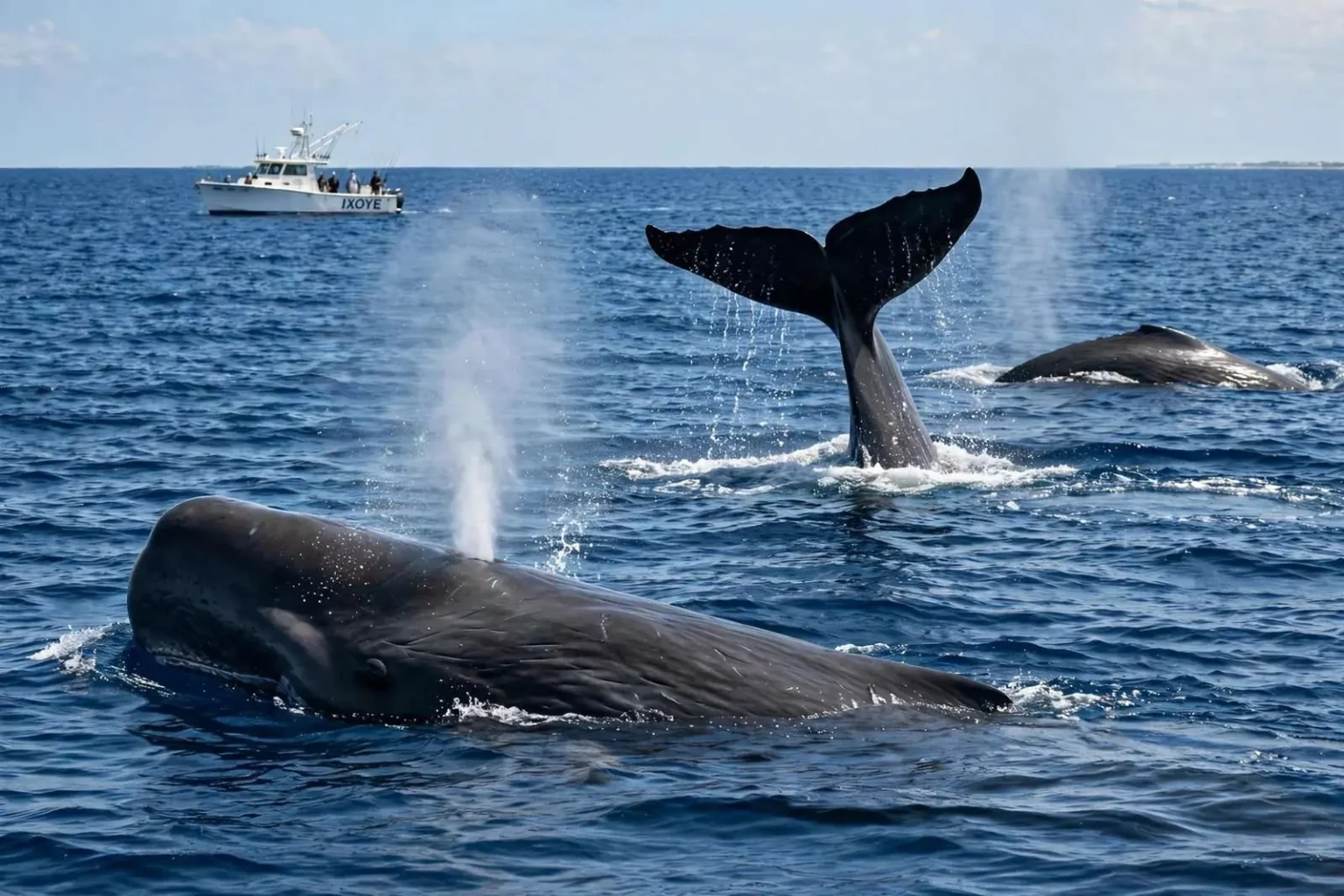
Pod of Whales Spotted in Gulf of Mexico Off Dauphin Island
A pod of whales was captured on video moving through the Gulf of Mexico about 75 miles south of Dauphin Island, giving boaters a rare close look at some of the ocean’s largest animals in home waters. Kurt Tillman spotted the group from aboard the vessel IXOYE and shared the footage on social media, where it quickly drew attention from viewers along the Gulf Coast.
The video shows the whales surfacing for air and showing off their large tail fins as the pod moved through the open water. Moments like this are uncommon even for experienced offshore anglers and boaters, who can spend decades working the Gulf without a single sighting of a whale at the surface. The location — roughly 75 miles south of the Dauphin Island barrier island at the mouth of Mobile Bay — places the encounter in deep offshore waters, far from the routes most recreational vessels travel.
While seeing the giant marine mammals in person is uncommon, the Gulf of Mexico is home to many species of whale, and others pass through its warm waters in search of food. The Gulf’s whale population has drawn increasing scientific attention in recent years, particularly as researchers work to understand and protect the species that live there year-round.
Whales That Call the Gulf Home
The Gulf of Mexico’s best-known resident whale is the sperm whale, the largest toothed predator on Earth, which lives in the deep waters beyond the continental shelf. Sperm whales in the Gulf are considered a distinct population segment under federal law, and scientists estimate only a few hundred remain in these waters. They favor depths where they can hunt squid and deepwater fish, which places them in the same sort of offshore zone — 75 miles out and beyond — where this pod was filmed.
In addition to sperm whales, the Gulf hosts an endangered baleen whale species that scientists confirmed as distinct in recent years and that feeds in the waters between Florida and Louisiana. With a population believed to number fewer than a hundred individuals, it is one of the rarest whales anywhere in the world, and every documented sighting of it contributes to research efforts. Various other species — pilot whales, dwarf and pygmy sperm whales, and several kinds of beaked whales — are also known from the region, though most are seen rarely and identified mainly through strandings and survey work.
Without confirmation from the footage, experts generally caution against identifying a whale pod from a distance or from video alone. Tail shape, surfacing pattern, blow shape and body size all factor into identification, and even experienced marine mammal observers rely on photographs and measurements. What the video unambiguously shows is that whales were active, feeding or traveling through the area, and comfortable enough to surface repeatedly near a vessel.
Why the Deep Gulf Attracts Whales
The northern Gulf of Mexico’s seafloor drops off dramatically beyond the shelf edge, plunging into waters more than a mile deep. That deepwater environment, rich with squid and mesopelagic fish, is precisely what sperm whales and other deep-diving species require. The whale habitat overlaps with other users of the deep Gulf — commercial shipping lanes, oil and gas operations and longline fishing grounds — which is why marine mammal protection has become a significant part of Gulf resource management.
Dauphin Island, sitting at the mouth of Mobile Bay, is a natural departure point for offshore excursions into those waters. Recreational fishing crews, charter captains and private boaters run south from the island to reach deepwater fishing grounds, and the 75-mile mark from the island is well within the range of a day trip for a capable offshore vessel. The IXOYE’s crew was far enough offshore to be in genuine whale country, though even there, encounters remain a special-occasion event.
What Boaters Should Do Around Whales
Federal rules protect marine mammals in U.S. waters, and boaters who encounter whales are expected to keep their distance. Regulations and federal guidelines direct vessels to stay well clear of whales, avoid cutting off their path, reduce speed nearby and never attempt to touch, feed or swim with the animals. Approach distances are stricter for certain species, and aircraft and drones are also restricted in how close they may operate.
Sightings like the one filmed from the IXOYE are valuable to researchers as well as thrilling for the people who experience them. NOAA Fisheries encourages boaters and anglers to report whale sightings, including the location, time, number of animals and photographs when it can be done safely. Those reports help scientists track where whales are spending time in the Gulf, which in turn informs protections for habitat and helps planners reduce risks from vessel traffic and industrial activity.
Responsible reporting also helps distinguish one species from another. A photograph of a tail fluke, for example, can allow researchers to identify an individual whale, since fluke markings are as distinctive as fingerprints. Over time, photo-identification catalogs built from public sightings have become one of the main tools for studying Gulf whale populations.
Social Media and the Gulf’s Wildlife-Watching Boom
Tillman’s decision to share the footage on social media fits a pattern that has transformed how Gulf Coast residents experience offshore wildlife. Smartphone cameras and widespread connectivity mean that an encounter once known only to the crew aboard a single vessel can now reach thousands of viewers within hours. Videos of whale sharks, manta rays, dolphins and whales surface regularly from the waters off Alabama, Mississippi and Florida, and they have built a broader audience for the Gulf’s offshore ecology.
That visibility carries both benefits and risks. It raises awareness of the animals that live in Gulf waters and builds support for their protection, but it can also draw crowds of boaters to areas where protected species have been seen. Wildlife agencies consistently pair such sightings with reminders about lawful viewing distances, noting that harassment of marine mammals is a federal offense and that repeated disturbance can drive animals away from important feeding grounds.
For the crew of the IXOYE, the sighting is the kind of memory that keeps offshore boaters heading south past the barrier islands. Few days on the Gulf produce footage of whales surfacing and throwing their tails, and fewer still happen 75 miles from Dauphin Island on a routine trip. The video stands as a small window into the deep Gulf’s hidden wildlife — animals that live in the nation’s sea year-round, far beyond where most of their human neighbors ever venture.
The Science of Studying Whales in the Gulf
Research on Gulf whales relies heavily on vessel surveys, passive acoustic monitoring and satellite tagging. Hydrophones moored in deep water record the clicking vocalizations sperm whales use to hunt, allowing scientists to estimate how often animals occupy particular areas. Aerial and shipboard surveys count animals along transect lines, and tags reveal where whales travel between surface intervals. Together these methods have produced a much clearer picture of Gulf whale ecology than existed a generation ago, though the populations remain small and vulnerable.
Threats to Gulf whales include ship strikes, entanglement in fishing gear, underwater noise from industrial activity and vessels, and the long shadow of oil spills that reached deepwater habitat. Each of these pressures lands on populations that reproduce slowly — whales invest years in raising a single calf — so even modest losses compound. Conservation measures have included speed advisories for vessels, restrictions on certain activities in identified habitat, and ongoing monitoring funded by restoration programs tied to earlier spill settlements.
Public sightings contribute a layer of data that formal surveys cannot match, since research vessels sample only a fraction of the Gulf each year. A pod filmed by a fishing crew 75 miles south of Dauphin Island occupies a place on the map that no survey may cover that season, which is why agencies treat citizen reports as a genuine scientific resource rather than a novelty.
A Reminder of What Lives Beyond the Horizon
For most people along the Alabama coast, the Gulf means beaches, bay boats and nearshore fishing. The open Gulf 75 miles out is a different world entirely — deep blue water where the continent’s shelf gives way to the abyss, home to squid, tuna, swordfish, deep-diving sharks and whales. Sightings like the one Tillman captured are a reminder that Mobile Bay’s doorstep opens onto habitat used by some of the largest animals on the planet.
They are also a reminder of how much of that world remains poorly understood. Whales travel enormous distances, dive far beyond the reach of casual observation and surface only briefly, so even the basic question of how many whales live in the Gulf carries real uncertainty. Every video, photograph and location report nudges the science forward a little.
Boaters fortunate enough to make their own encounter can do their part by keeping the distance the law requires, moving slowly away if the animals approach, logging the exact position and time, and sending the details to NOAA Fisheries for the record. The whales will continue their travels through the Gulf’s warm waters either way; the footage they leave behind is what turns one crew’s rare morning into a community’s shared glimpse of the deep Gulf.


