Port City Media Launches JustLiveMusic, a Weekly Show Built Around Full, Uncut Sets
Port City Media's new show JustLiveMusic airs full, commercial-free band sets, giving Mobile-area musicians a weekly TV platform.
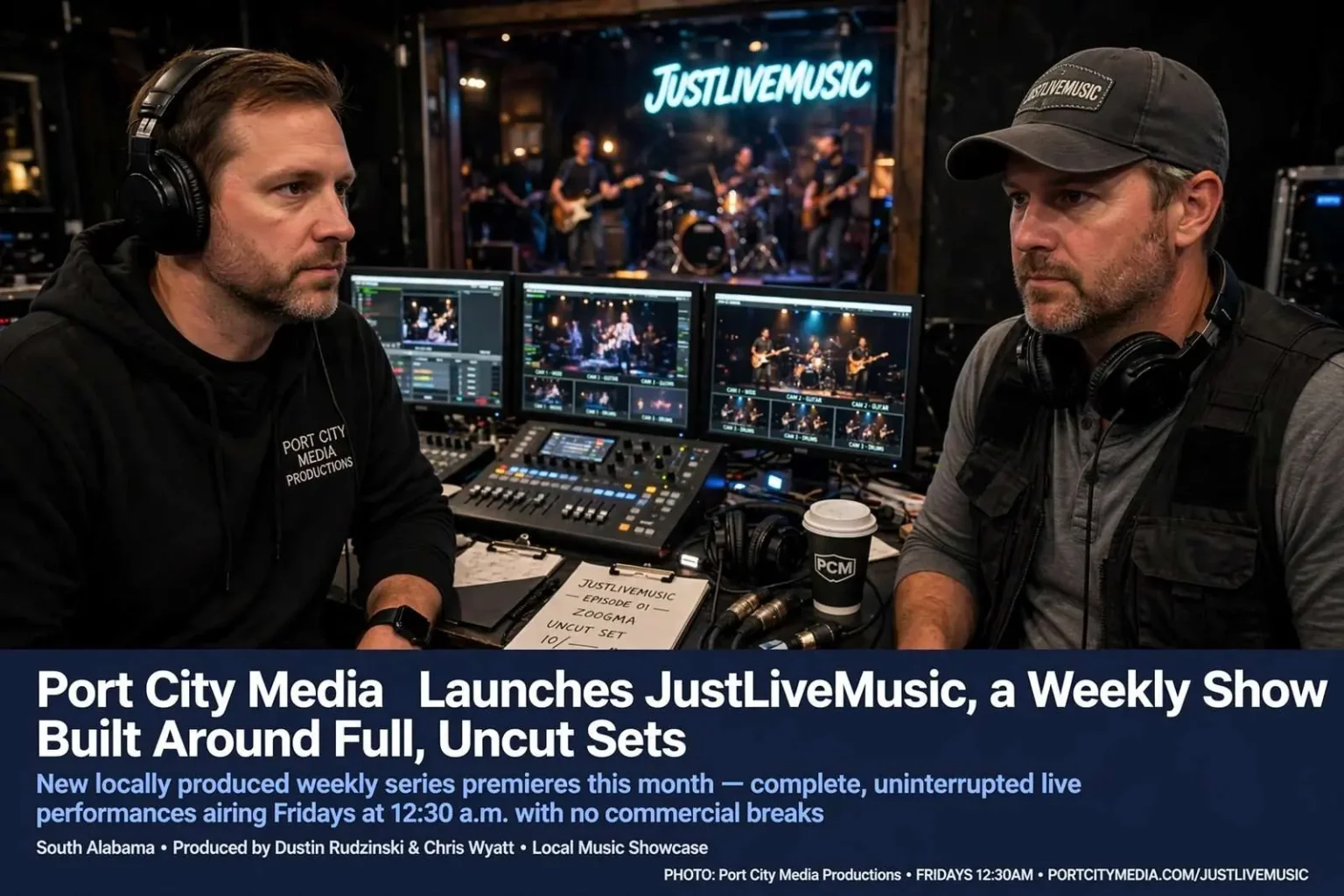
A new locally produced television show is giving South Alabama musicians a weekly platform to reach viewers well beyond the club circuit. JustLiveMusic, created by Port City Media Productions, began airing this month with a format built around uninterrupted live performances rather than the quick-cut concert clips typical of music television. The show comes from Dustin Rudzinski and Chris Wyatt, who together have spent more than 13 years producing concert video. In an interview, Rudzinski said the goal is to put live music, local and otherwise, in front of a wider audience without cutting away for commercials once a band starts playing.
The concept is simple but, in the current television landscape, almost countercultural. Where music programming on broadcast and cable has largely shrunk into highlight reels, countdown shows and heavily edited festival packages, JustLiveMusic promises viewers the thing that draws people to clubs in the first place: a complete performance, start to finish, with the rough edges intact. Each episode features a single act, filmed with a full multi-camera crew, and lets the set run as the band intended it.
How the Show Works
“JustLiveMusic was created by Port City Media Productions, Dustin Rudzinski and Chris Wyatt. We have been in the video production industry for over 13 years and have produced hundreds of concert videos,” Rudzinski said. “The goal of the show is to promote live music, but we do not stick to only local acts. We will also travel to other areas to film a show, since we love all music and not just local stuff. However, we do fully support our local scene and will gladly serve as a platform for local acts to gain exposure.”
Each episode opens with a brief interview with the featured band before moving into a full, uncut set. The interview segment gives viewers context about who is playing and what the act is about, which matters for bands from the Gulf Coast who may be unfamiliar to audiences outside the region. Then the cameras roll and stay rolling. For a touring band, that uninterrupted format is a form of documentation as much as promotion — an accurate record of what a show actually sounds and looks like, rather than a highlight package stitched together from the best sixty seconds of the night.
“We will never allow commercial interruptions to stop the music from playing,” Rudzinski said, explaining that the production instead pays its bills through a small banner ad displayed at the bottom of the screen during the broadcast. The banner-ad model is a deliberate trade-off. It forgoes the revenue of traditional commercial breaks in exchange for a core promise to the bands and the audience: once the first note sounds, the show does not stop. The approach keeps episode runtimes predictable and preserves the arc of a live set, including the between-song banter that fans of a band rarely get to see on television.
JustLiveMusic airs Friday nights at 12:30 a.m., immediately following the Late Late Show with Craig Ferguson. The late-night slot puts the program in the time band long associated with adventurous television viewing — the hours when music shows, movies and cult favorites have traditionally found their audiences. For bands, the slot also means the show is available to night owls and service-industry workers, two groups that overlap heavily with the live-music crowd.
For the Mobile-area scene, the arrival of a weekly television showcase is notable because local acts have historically had few ways to reach broadcast audiences. The Gulf Coast’s clubs — rooms in downtown Mobile, along Dauphin Street, across the bay in Fairhope and Daphne, and down the highway in Gulf Shores and Orange Beach — sustain a working circuit of original bands and touring acts, but exposure beyond those rooms usually depends on streaming clips and social media. A television show that films a full set with professional cameras gives bands a polished artifact they can use in booking pitches, festival applications and press kits.
Port City Media Productions brings an unusual depth of concert-video experience to the project. Rudzinski and Wyatt have spent more than 13 years filming shows across the region, building up the camera packages, audio capture techniques and editing workflows that live production demands. Concert video is a specialized discipline: the crew must balance stage lighting that changes song to song, capture clean audio from the front-of-house mix, and keep cameras positioned where they will not interfere with the audience’s experience. Hundreds of produced concert videos mean the team has already made — and corrected — the mistakes that sink first-time live productions.
Local Acts on Deck
The series opened with a set from Zoogma, and Rudzinski said Good Enough for Good Times is up next. Additional acts already lined up include Grayson Capps and the Lost Cause Minstrels and Atmosphreak, with more bookings to come.
The early lineup reflects the breadth of the scene the show hopes to serve. Zoogma brings a genre-blending sound that fuses electronic music with live instrumentation and improvisation, the kind of act whose extended jams benefit directly from an uncut format. Good Enough for Good Times has been a fixture of the local circuit, drawing crowds with a groove-oriented live show. Grayson Capps and the Lost Cause Minstrels represent the songwriting and roots side of Gulf Coast music, an act whose storytelling earns as much attention as its playing. Atmosphreak rounds out the list with a sound built for late-night listening — a fitting choice for a program that airs at half past midnight.
Booking across genres is a stated strategy rather than an accident. A weekly show needs variety to keep viewers sampling, and the region’s scene supplies it: songwriters, jam bands, funk outfits, electronic acts and touring national groups all pass through South Alabama venues in a given season. By mixing homegrown acts with bands from elsewhere, the producers can draw local viewers in with familiar names while giving out-of-town audiences a reason to keep watching — and, in the process, quietly introduce the Gulf Coast scene to wherever the signal reaches.
Port City Media also plans to send a crew to the Bear Creek Music Festival to film performances for future episodes, extending the show’s reach beyond the Mobile area while keeping a foothold in the region’s live music scene. Festival shoots multiply the value of a single production trip: one weekend of filming can supply material for multiple episodes, and festivals assemble lineups that individual club dates rarely match. For a young series working with a modest budget and banner-ad revenue, that efficiency matters.
The show’s reliance on a single sponsor banner rather than commercial breaks also mirrors how music itself circulates now. Audiences accustomed to streaming full albums and watching complete sets online have little patience for interruption-heavy formats, and bands increasingly measure exposure in complete performances rather than teaser clips. By committing to uncut sets, JustLiveMusic positions itself closer to the way fans already consume live music on video platforms, while offering the legitimacy of a broadcast television slot.
For local venues and promoters, the show could have practical side effects. Bands that appear on television tend to see spikes in attention around their next area dates, and a full uncut set gives potential ticket buyers an honest preview of what they would see in person. Owners of small rooms — the places where most Gulf Coast acts hone their material — have long argued that the scene’s biggest constraint is not talent but visibility, and a weekly broadcast slot adds a visibility channel that did not previously exist in the market.
The timing is also telling. As music television has retreated nationally, the remaining appetite for filmed performances has migrated to online video and, in some markets, to locally produced programs like this one. Mobile’s media community has a history of exactly this kind of production: the city supports commercial video firms, film crews and a festival circuit, and the skills those industries cultivate feed back into projects that document the local arts scene. JustLiveMusic is, in that sense, a natural product of the infrastructure that already exists in the Port City.
What happens next depends largely on whether the show can build a consistent Friday-night audience. Late-night slots are hard to grow in the best circumstances, and a locally produced program starts without the marketing budget of network fare. But the formula the producers chose — one band, one interview, one complete set, no interruptions — is inexpensive to sustain, easy to understand, and friendly to the musicians whose cooperation the show depends on. If the early lineup draws viewers, the pipeline of regional acts is deep enough to keep the cameras busy for a long time.
For now, the bands are the draw, and the producers appear content with that. “We do fully support our local scene and will gladly serve as a platform for local acts to gain exposure,” Rudzinski said — a mission statement that, in a market where most local bands’ only video record is a shaky phone clip from the back of the room, may be the show’s most valuable contribution. South Alabama’s musicians now have a standing invitation: play a complete set in front of professional cameras, and let the audience find you at half past midnight on Friday.