Private Tour Company Eyes Fort Conde for New Downtown Mobile Attraction as Welcome Center’s Future Remains Unclear
Gulf Coast Ducks is negotiating to turn Fort Conde into a rotating colonial history attraction as Mobile weighs the welcome center's future.
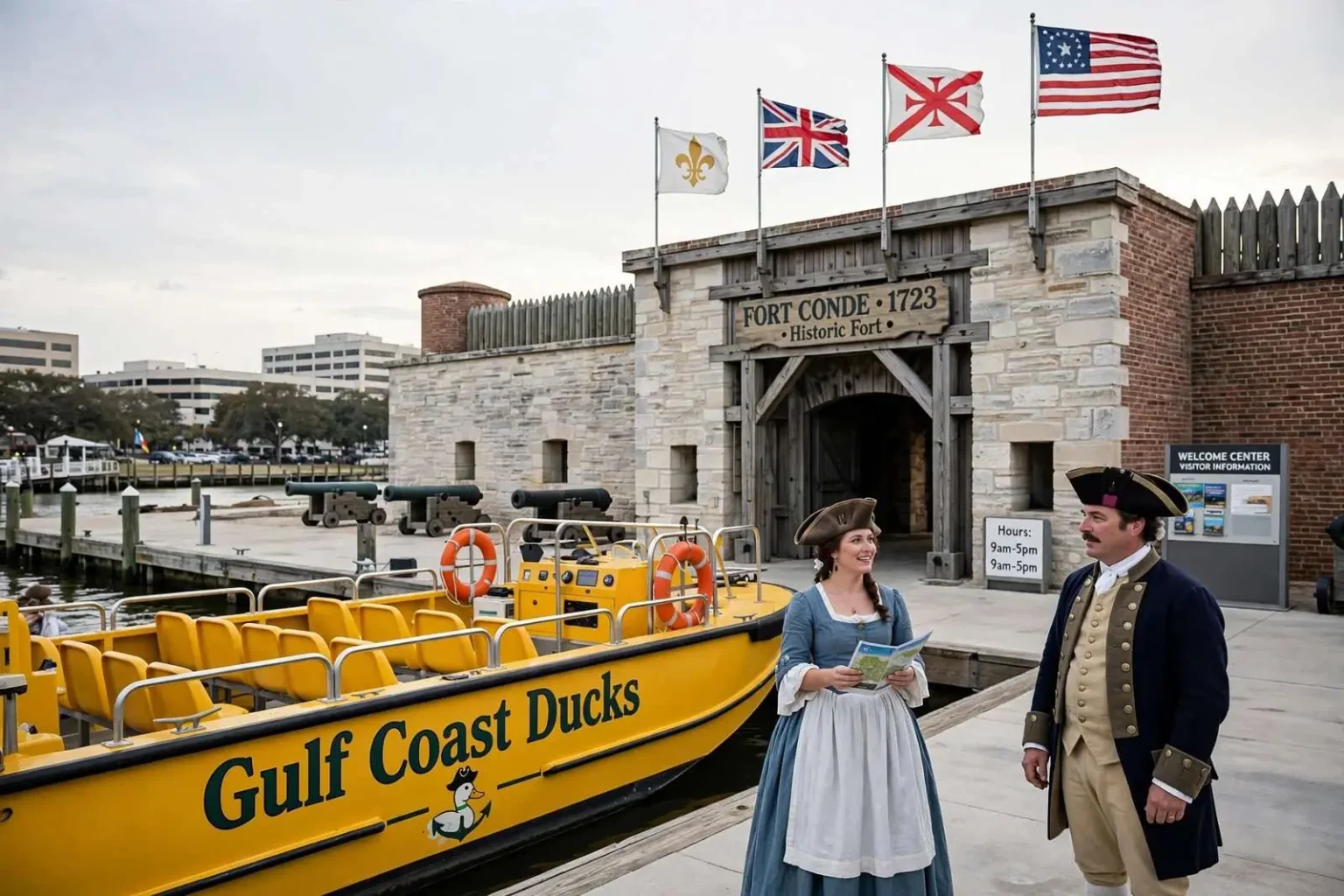
A private tour company is in talks to take over operations at Fort Conde, with plans to transform the historic downtown Mobile site into a new interactive attraction highlighting the city’s colonial past.
Scott Tindle, co-owner of Gulf Coast Ducks, Inc., told the Mobile City Council that his company is negotiating a contract with the History Museum of Mobile to rent the space and turn it into a rotating museum experience. The company’s ownership group includes Tindle along with Grant and Matt Zarzour.
The proposal would put the replica fort — the recognizable full-scale reconstruction that anchors the foot of Royal Street across from the Arthur C. Guy letterbox of city museums and the riverfront — into the hands of operators whose entire business is showing visitors around Mobile. Gulf Coast Ducks runs the amphibious duck-boat tours that depart downtown carrying sightseers past the city’s historic districts and onto the water, making the company one of the most visible private tourism operators in the city.
According to Tindle, the museum would rotate quarterly to represent the Spanish, French, British and American periods that shaped Mobile’s early history, with staff dressed in period-appropriate colonial attire.
“We want to make it vibrant and fun,” Tindle said in an interview. “It will be Mobile’s colonial fort.” He added that the new attraction would charge admission once it opens.
The quarterly rotation is the heart of the concept. Mobile’s colonial history is unusually layered: founded by the French, ceded to the British, retaken by the Spanish and finally absorbed into the American republic, the city changed imperial hands more often than almost any other in the United States. A rotating exhibit plan would give each of those four periods its own season of focus, giving repeat visitors — school groups, cruise passengers returning on later voyages, local families — a reason to come back four times a year.
A Welcome Center Without a Clear Future
The announcement comes amid uncertainty over the future of the welcome center housed inside Fort Conde, a concern raised by longtime volunteers and members of the local tourism industry during Tuesday’s council meeting. Management of the welcome center has shifted between Visit Mobile and the History Museum of Mobile in recent years.
During budget negotiations in September, the city told council members it would take over management of the center directly, a move that cut $200,000 from its budget while maintaining $600,000 in level funding for Visit Mobile.
Those budget figures frame what is at stake. The welcome center at Fort Conde is frequently the first stop for visitors arriving downtown — the place where maps, brochures, restrooms and a friendly orientation live — and its management has now been passed between the city’s tourism promotion arm and the museum that operates the fort site. Each transfer has left volunteers and tourism operators unsure who is actually responsible for the operation, and the September decision to bring management in-house did not end the uncertainty; it changed which office held the question.
Mobile resident Ronald Hunt told council members that volunteers still don’t have clarity on what will happen to the space going forward.
“The visitor center has been a shell game for five years,” Hunt said.
Hunt argued the center needs a full-time manager and asked each council member to contribute $5,000 annually from their discretionary accounts over the next five years to help fund the position.
Councilman Fred Richardson said that request wasn’t legally possible, citing the Zoghby Act, the law that established Mobile’s current form of government.
“I don’t think the issue is money,” Richardson said. “I don’t know what the issue is, but I don’t think it’s money.”
The Zoghby Act — the local legislation that reorganized Mobile’s city government and governs how council districts and their funding operate — draws the lines around what individual council members can do with discretionary money, and a pooled multi-year contribution to a single staff position fell outside them. Richardson’s larger point cut in a different direction: with the city already directing six figures toward tourism promotion and the welcome center’s budget having just been restructured, the problem was not the absence of dollars but the absence of a decision about what the center is supposed to be and who runs it.
Council President Gina Gregory told Hunt that Mayor Sandy Stimpson has said he’d personally prefer to relocate the welcome center out of Fort Conde altogether, potentially to the Arthur R. Outlaw Convention Center, where Visit Mobile’s offices are currently located.
“Wherever you put it in the city, it needs a manager,” Hunt responded. “It needs somebody dedicated to its mission.”
A relocation to the convention center would follow a pattern common in cities of Mobile’s size: putting visitor services where the visitor traffic already is. Convention attendees arrive with free hours and no orientation, and a welcome desk at the Outlaw Convention Center — connected to downtown’s hotels and entertainment districts — captures an audience the fort location reaches only incidentally. But the fort itself would then need a purpose of its own, which is precisely the gap the tour company’s proposal is designed to fill.
The Tourism Industry Weighs In
Owners of two other local tour companies also addressed the council, echoing calls for a stronger focus on tourism citywide.
Arthur Clevenger, of Gulf Coast Tours, said that while he remains passionate about Mobile, he has noticed declining enthusiasm within the local tourism industry, pointing to the closure of the GulfQuest maritime museum, a lack of free visitor parking and adequate signage, and a recent dispute between the city administration and council over branding as contributing factors.
“We have so much to offer,” Clevenger told council members. “We can become a tourism destination, but we need your support.”
Clevenger’s list of grievances read as an industry diagnosis. GulfQuest — the National Maritime Museum of the Gulf of Mexico, an ambitious waterfront attraction years in the building — had closed after struggling to sustain operations, removing one of downtown’s anchor family attractions. Free parking is the perennial complaint of every downtown tourism operator: visitors who find a metered garage, a confused wayfinding system and no signage pointing to the next attraction spend less time and less money. And the branding dispute between the administration and the council had left the city’s public identity — the logo and name that appear on everything from brochures to billboards — unsettled at exactly the moment competing Gulf Coast destinations were spending heavily on their own.
Ross Peterson, of Bay City Convention and Tours, also urged the council not to underestimate the importance of the welcome center to the city’s tourism efforts.
For the tour operators who addressed the council, the welcome center is not a city amenity but a sales channel: the desks, brochures and referrals that turn a visitor’s first stop into bookings for duck boats, trolleys, ghost tours and historic house visits. An unmanaged or closed welcome center starves the private operators who depend on walk-in traffic, which is why three separate tour companies showed up to the same council meeting to talk about it.
For now, the future of the welcome center remains undecided, and Tindle said any final decision about its location and management rests with the city administration.
The fort-side proposal and the possible relocation are not mutually exclusive, and that is the subtlety in the debate. If the city moves visitor services to the convention center and leases Fort Conde to a private operator running an admission-charging colonial museum, downtown could end up with both a professionally managed welcome operation and an attraction inside the fort’s walls — a better outcome for visitors than either change alone. If instead the fort sits without a tenant while the welcome center question stays open, the city’s most recognizable downtown landmark becomes an empty stage set at the entrance to the Museum district.
In Other Business
In other business Tuesday, the council unanimously approved a $288,519 contract with Constantine Engineering for program management services tied to several 2017 capital improvement projects.
Architectural Engineering Director Kimberly Harden told council members the contract would allow the firm to help manage 56 projects currently beyond the capacity of city staff. Harden said funding for the contract was built into each individual project’s budget, and that the work spans projects in all seven of Mobile’s council districts.
Program management contracts of this kind are the standard response to a capital backlog: a city with dozens of street, drainage, park and facility projects moving at once hires an outside engineering firm to track schedules, review designs and administer construction on the city’s behalf, with the fee charged proportionally to the projects it manages. The detail that the work reaches all seven council districts underscored its breadth — this was not a single neighborhood’s project but citywide infrastructure management, funded inside each project’s own budget so that no district’s allocation is spent managing another’s work.
Together, the two items on Tuesday’s agenda showed the city working both ends of its economic development strategy: private operators pitching new ways to make the city’s historic assets pay their own way, and the council funding the professional management needed to keep hundreds of infrastructure projects moving underneath the tourism economy those assets depend on.