Quarter-Century Later, 1993 Irvington Murder of Renee Bergeron Remains Unsolved
The brutal 1993 killing of Renee Bergeron near Irvington has gone unsolved for over 25 years. Investigators believe it was a message killing.
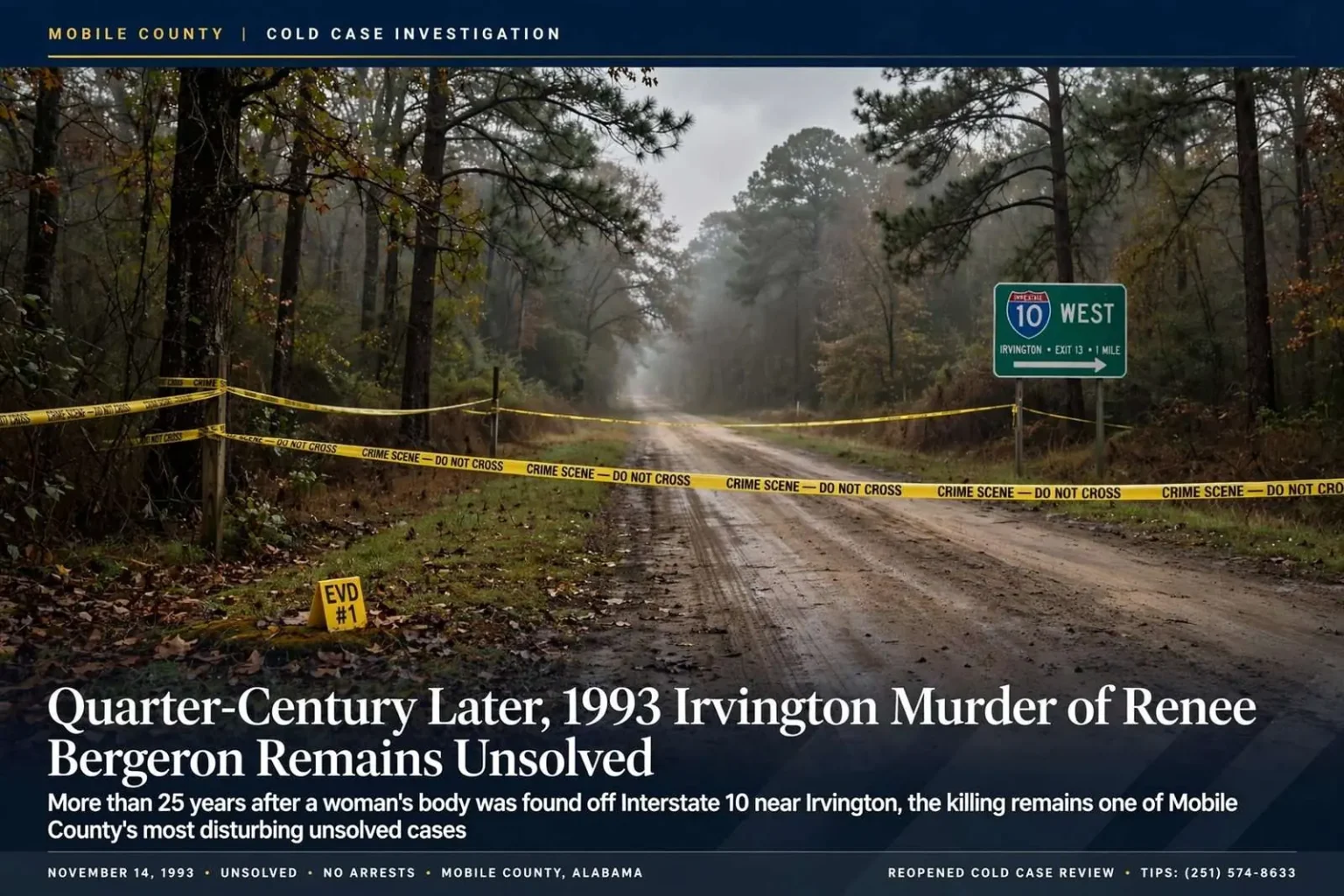
More than 25 years after a passerby discovered a woman’s body along a dirt road off Interstate 10 near Irvington, the brutal killing of 27-year-old Renee Bergeron — also known as Maria Martinez of Theodore — remains one of the most disturbing unsolved cases in Mobile County history.
The body was found on Nov. 14, 1993, dragged face-down in a manner that caused severe mutilation. The victim’s head was missing; search dogs located it the following day. The decapitation was accompanied by the severing of the breasts and mutilation of the sex organs.
Then-Sheriff Tom Purvis called it one of the worst cases he had seen in his career. Purvis, who led the Mobile County Sheriff’s Office through more than two decades that included some of the county’s most notorious crimes, had seen enough homicide scenes that such a description carried weight with deputies and reporters alike.
For investigators, the savagery of the scene presented both a horror and a hypothesis. Killings of this character are rarely random, veteran detectives reason; mutilation of this kind tends to reflect rage, terrorization or a calculated intent to dehumanize — and in the decades since, experts in cold-case murder have often pointed to such scenes as signature evidence that killer and victim were connected.
Irvington sits in southern Mobile County, a small community along the old coastal highway corridor between Theodore and Bayou La Batre, where Interstate 10 now carries the through-traffic. In 1993 the area was even more thinly populated than today, a landscape of farms, fish camps and wooded tracts stitched together by county roads — the kind of place where a dirt road off the interstate could go unobserved for hours at a time.
The discovery location mattered to the investigation. A body left in remote south Mobile County, far from where the victim lived, told detectives that the killer had transportation and knowledge of the area’s quiet corners — or that the victim herself had been carried along a route someone knew well.
A Life That Complicated the Case
Bergeron had a criminal history — arrests for drugs, prostitution, and a robbery charge represented by Mobile attorney Rick Williams. Williams described her as someone who “ran in a pretty bad circle” and may have had knowledge of criminal enterprises in the Theodore area.
That background cut both ways for investigators. On one hand, it expanded the pool of people who might have wanted to harm her — associates in the drug trade, customers from the sex trade, people who feared what she knew. On the other, it threatened to lower the priority the case received, a pattern victim advocates have long criticized when murdered women carried arrest records.
Williams, a veteran of the Mobile criminal defense bar, knew Bergeron through representing her, and his portrait of her circumstances came from that professional relationship. His observation that she may have known about criminal operations around Theodore pointed investigators toward the possibility that the killing was silencing as much as savagery.
After the body was found, Bergeron’s boyfriend, who also had a record, was questioned but passed a polygraph. He told investigators Bergeron had recently returned from working at strip clubs in Chicago and Texas and may have become involved with unsavory people there.
That account opened a second investigative track — her months away from Mobile — that could never be fully run down. A woman moving between cities in the early 1990s sex trade left few records: no cell phone data, no rideshare logs, no digital trail of any kind. Detectives were left to reconstruct her movements from the recollections of people who themselves often wanted no part of police attention.
“I think it was somebody trying to send a message,” Williams said. “If you go against us and you don’t do what we tell you to do, or you rat on us, or you try to inform on us, then this is what you’re going to be facing. This is the punishment you’re going to get.”
Williams believes the killer was likely someone Bergeron knew — someone she had crossed or who feared what she knew. The theory fits the scene as investigators read it: a killing staged to terrify anyone who saw it, and a body displayed in a way that suggested the murderer wanted the discovery to be noticed.
Bergeron left behind young children who lived with family in Louisiana. One of them contacted Williams just last year seeking details about the circumstances of her death — a call that illustrates how cold cases never really end for the people they touch, and how the children of murder victims often reach adulthood still trying to assemble the story of what happened to a parent they barely knew.
For families of the missing and murdered, the absence of an arrest is its own kind of wound. Children grow up with an unfinished sentence: a parent’s death without a cause, a funeral without a perpetrator named. Advocates for cold-case families say that uncertainty shapes lives — career choices, family decisions, the simple inability to stop wondering who did it and whether they are still nearby.
The passage of time has changed what investigators have to work with, in some ways for the better. DNA analysis that did not exist in 1993 can now develop profiles from evidence samples that sat in storage for decades, and genealogical genetic techniques have cracked cold cases across the country by tracing family trees from crime-scene DNA. Whether such evidence survives from the Bergeron scene is a question that has come to define what is possible in cases of this vintage.
Time has also worked against the case. Witnesses have died, memories have faded, and the south Mobile County landscape along the interstate corridor has been developed and rebuilt. The people who moved through Theodore’s criminal underworld in 1993 are now a generation older, and some of the answers detectives most need may be buried with them.
The investigative tools of 1993 were a generation behind what homicide detectives now take for granted. There was no statewide DNA database in common use for cases like this, no cell tower records to place suspects near a scene, no surveillance cameras at gas stations along the highway. Identification of the victim, witness interviews and physical evidence gathered by hand were nearly all the detectives had — which makes the quality of what was documented in those first weeks all the more important a quarter-century later.
Purvis’s era at the Sheriff’s Office spanned a period of enormous change in county policing, through hurricanes, a growing suburban population and the crack-era crime wave of the late 1980s and early 1990s. His office worked the Bergeron case alongside federal partners, and the investigation drew on deputies from patrol divisions across the southern part of the county in its early days.
South Mobile County in the early 1990s was a stretch of small communities — Irvington, Grand Bay, Bayou La Batre, St. Elmo, Theodore — where locals knew one another’s business and outsiders stood out. Detectives working the case understood that someone from the area, or someone who knew the area well, had chosen that dirt road deliberately; such knowledge rarely belongs to a stranger.
A Case That Went Cold but Not Forgotten
Despite the brutality of the crime and the investigative resources devoted to it, no one has ever been charged. The case file remains open with the Mobile County Sheriff’s Office.
Cold cases hold a particular place in county law enforcement. Detectives periodically re-examine unsolved homicides as new techniques emerge or new tips arrive, and agencies across Alabama have found renewed success in recent years by pairing old evidence with modern forensic capability. The Sheriff’s Office has worked with state and federal partners on cold-case reviews, and advances in fingerprint and DNA technology have solved decades-old murders in jurisdictions across the Gulf Coast.
The Sheriff’s Office maintains its unsolved case files with the understanding that tips can arrive at any time — sometimes decades after the fact, when a witness finally decides to talk, or when an offender, facing other charges or the end of his own life, chooses to unburden himself. Confessions and deathbed statements have closed cold cases elsewhere in Alabama, and detectives keep files like this one ready for the moment.
Anyone with information about the killing is asked to come forward, and authorities note that tips can be provided anonymously. The Mobile County area’s Crimestoppers program allows callers to submit information without giving their names, and rewards are available for tips that lead to arrests in unsolved cases.
Investigators stress that no detail is too small. A vehicle seen on that dirt road in November 1993, a rumor repeated in a Theodore tavern, a name that surfaced in a conversation years ago — such fragments, put together, have broken open cold cases across the country long after investigators stopped hoping for them.
For Bergeron’s children, now grown and long separated from the Gulf Coast, the case remains a question that only the truth can close. For Mobile County, it remains a test of whether the passage of a quarter-century — a generation of change in forensics, policing and the community itself — is enough to answer for a crime whose savagery has never been explained, much less punished.