
Report: Dauphin Island Has Mobile County’s Most Expensive Homes
A Stacker report using Zillow data names Dauphin Island Mobile County's priciest housing market at $447,083 typical home value, up 82.5% in five years.
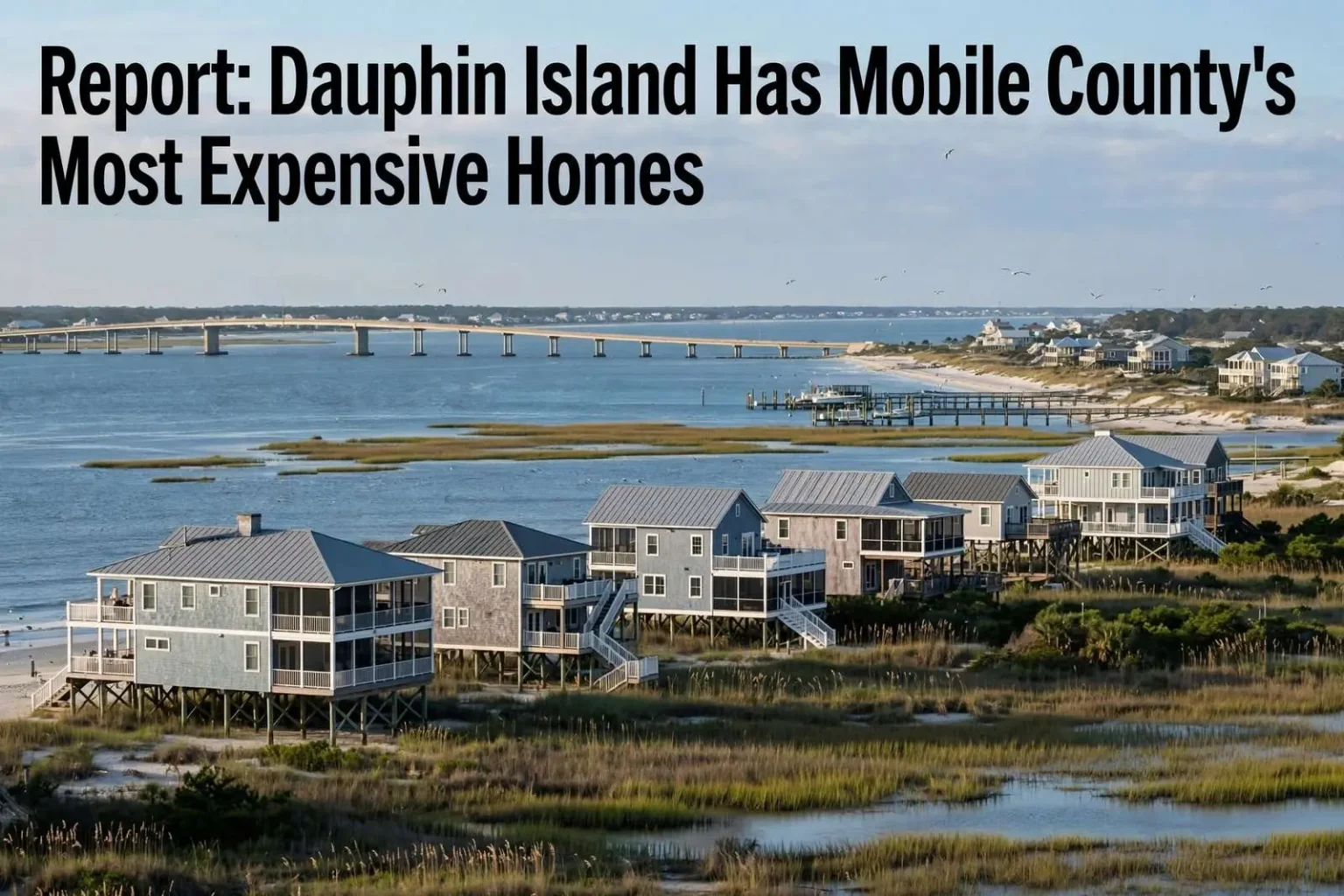
DAUPHIN ISLAND, Ala. — Dauphin Island tops the list of Mobile County communities for home prices, according to a new analysis — and it isn’t close. The report, compiled by Stacker using Zillow data, ranked Mobile County cities by typical home value along with one-year and five-year price changes, and the barrier island came in far ahead of everything else on the mainland.
The barrier island’s typical home value now stands at $447,083, more than double the next city on the list. Dauphin Island values climbed 11.3 percent over the past year and a striking 82.5 percent over five years — the strongest long-run appreciation of any community in the county. No other municipality in the analysis approaches that five-year figure, a gap that reflects what happens when waterfront scarcity meets surging demand for coastal property.
The numbers capture a market few mainland buyers fully see. Dauphin Island is a three-mile-long barrier island at the mouth of Mobile Bay, reachable only by the Gordon Persons Bridge from the end of Alabama Highway 193, with a permanent population measured in the low thousands that swells each summer with vacationers. Most of its housing stock consists of elevated beach houses, many of them second homes and short-term rentals, built on lots that by definition cannot multiply — the island is not getting any bigger.
Scarcity by Geography
That geographic ceiling is the engine behind the island’s price curve. Every lot on Dauphin Island sits either on the Gulf, on the bay, or within a short walk of both, and the supply of buildable land is fixed by nature. When demand for coastal property rises — as it has across the Gulf Coast since 2018 — the only adjustment available to the market is price. Mainland communities can grow outward; Dauphin Island can only grow more expensive.
The island’s housing mix amplifies the effect. A large share of homes serve the vacation market, bought by out-of-town owners who rent them to families visiting for a week of fishing, beachcombing and birding at the Audubon Bird Sanctuary that occupies the island’s eastern end. Competition among those buyers for the limited inventory of quality homes has pushed the typical value well beyond what year-round island residents — teachers, fishermen, town employees — would pay on local wages alone.
The five-year window in the analysis covers a period of successive shocks to the coastal housing market: the pandemic-era migration that sent buyers searching for space and shoreline, historically low mortgage rates, and the remote-work shift that made living at the beach a practical option for professionals who once needed a commute. Each wave of demand crashed against the same fixed supply, and the typical value on the island rose 82.5 percent as a result.
Wide Spread Across the County
Semmes ranks second with a typical home value of $220,616, up 7.7 percent in a year and 49 percent over five years. The city in northwest Mobile County has grown from a rural community into one of the county’s expanding suburbs, drawing families with its schools and new subdivisions while keeping prices well below the island’s — though its five-year gain shows the same regional demand at work.
At the other end of the spectrum sits Prichard, where typical homes are valued at just $40,435 — though prices there have still risen 4 percent in a year and 37.5 percent over five years. The contrast between the county’s two bookends is stark: a typical Dauphin Island home is worth more than ten times a typical Prichard home, a spread that maps the distance between waterfront scarcity and the challenges of an aging urban core just north of downtown Mobile.
Prichard’s low values tell a story of decades in the making. The city grew rapidly in the mid-twentieth century as workers moved to jobs at Brookley Field and the shipyards, then lost population and investment in the decades after those employers shrank. Its housing stock aged, and the market that remained centered on lower-priced homes. Yet even there, the data show appreciation — 37.5 percent over five years — as buyers priced out of stronger markets and investors seeking rental returns pushed values up from a very low base.
Between the extremes lie the county’s established suburbs and its inland towns. Communities such as Saraland, Satsuma, Creola, Chickasaw, Bayou La Batre and Citronelle each occupy their own niche, with values shaped by school quality, commute distance, flood zone and the age of the housing stock. The Stacker analysis, by ranking them side by side, made visible a spread that residents feel in their daily lives but rarely see in a single table.
What the Figures Do — and Don’t — Say
The “typical home value” in the Zillow data is a statistical middle for all homes in a community, not the price of any particular house or the average of recent sales. On Dauphin Island, where a waterfront estate and a small inland cottage can sit blocks apart, the typical value smooths an enormous internal range. The same is true in every community on the list.
The one-year and five-year changes are similarly broad brushstrokes. A single year’s gain — 11.3 percent on the island, 7.7 percent in Semmes — reflects the specific conditions of that market period, while the five-year figures smooth out the pandemic-era spike and the normalization that followed. Read together, they describe direction and momentum rather than a prediction.
What the figures underscore, as the analysis itself notes, is how sharply coastal waterfront property has appreciated across south Mobile County since 2018, far outpacing gains elsewhere in the metro. Dauphin Island’s 82.5 percent and Semmes’ 49 percent lead a county where even the slowest-moving markets managed more than a third of that pace — a rising tide, uneven but unmistakable.
The Island Market Beyond the Numbers
Anyone who has shopped for a home on Dauphin Island in recent years knows the practical reality behind the statistics: inventory is thin, good listings move quickly, and competition often comes from buyers outside the area. Real estate agents who work the island describe a market where the best waterfront properties rarely linger, and where the difference between a Gulf-side lot and a bay-side one can be measured in hundreds of thousands of dollars.
Insurance and building costs shape the market as much as views do. Homes on the island must be built to coastal code, elevated on pilings, and insured against wind and flood — expenses that add to carrying costs and filter into asking prices. Buyers weigh those ongoing costs against the intangible return: sunsets over the Mississippi Sound, fishing off the public pier, and a beach town with no traffic light in its residential core.
The town itself watches the trend with mixed feelings. Rising values protect the wealth of existing owners and swell the property tax base that funds municipal services on an island with a small year-round population. But they also press against the teachers, first responders and tradespeople who keep the community running, and they convert more housing stock to short-term rental use with each sale. Managing that balance — between a valuable coastal market and a living, year-round town — is the quiet challenge behind the county’s most expensive housing.
For now, the data confirm what the ferry riders and bridge crossers already suspected: the most expensive address in Mobile County is the one with sand at the end of the street, and the gap between the island and the mainland has never been wider.
How Dauphin Island Compares Regionally
The island’s lead over the rest of Mobile County mirrors patterns along the entire Gulf Coast. Barrier island and waterfront communities from Gulf Shores and Orange Beach on the Alabama coast to the waterfront enclaves of the Florida Panhandle have posted similar appreciation curves, driven by the same shortage of buildable shoreline and the same influx of buyers with mainland money. Dauphin Island, long the quieter and more affordable option among Alabama’s coastal destinations, has been catching up to its neighbors as buyers discover it.
That catch-up dynamic explains part of the five-year surge. For years, the island traded at a discount to the resort communities down the coast — a working fishing village with a public beach rather than a gated resort town. As prices elsewhere climbed beyond many buyers’ reach, attention shifted to the island, and its discount narrowed. An 82.5 percent five-year gain is what a narrowing discount looks like in the data.
Some of the demand also traces to the island’s unique amenities. The Audubon Bird Sanctuary ranks among the top birding sites on the Gulf Coast during migration seasons, the fishing off the island’s piers and surf is a regional draw, and Fort Gaines on the island’s eastern tip anchors a tourism season that stretches from spring through fall. These attractions support the rental market that underpins much of the island’s housing value.
The Years Behind the Numbers
The five-year window in the analysis reaches back to a market that looked nothing like today’s. In 2018, the island’s typical value sat at a fraction of the current figure, in a period when coastal Alabama housing was steady but unremarkable. Then came the pandemic years, when buyers from across the region — and the country — went looking for beaches, space and rooms to work from, and found them on Alabama’s barrier islands at prices far below Florida’s.
Mortgage rates amplified the run. With borrowing costs at historic lows for much of the period, monthly payments stretched further, and buyers who could not afford waterfront in better-known markets found they could afford it on the Gulf Coast. When rates rose later, they froze inventory rather than prices: owners holding low-rate mortgages stopped selling, tightening supply further and supporting the values that had already been established.
The result is the snapshot the Stacker analysis captured: an island market that more than doubled in five years while the rest of the county — new suburbs, old neighborhoods, inland towns — rose at a healthy but far slower pace. For owners on the island, the gains have been extraordinary. For the next buyer, they set a higher bar to climb.
Looking Ahead
Where the island market goes from here depends on forces larger than any one community. Insurance costs along the Gulf, storm history, mortgage rates and the national appetite for coastal property will all shape the next five years as they shaped the last. The one constant is the supply side: no new Dauphin Island is being built, and every year the island’s fixed inventory becomes a scarcer commodity in a region that keeps growing.
For Mobile County as a whole, the analysis is a reminder that its housing map contains multitudes — an island of $447,083 typical values, a suburb at $220,616, and a city at $40,435, all within a half-hour’s drive of one another. The same data that crowned Dauphin Island the county’s priciest address also charted the rise of Semmes and the slow, steady gains in Prichard. In every case, the direction was the same: up.


