

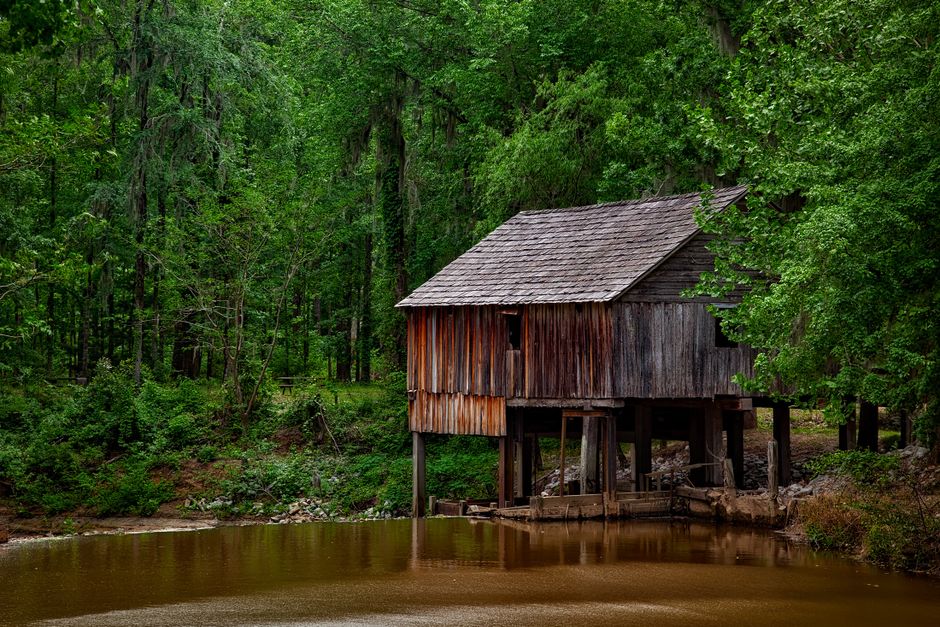
At the far northeast corner of Baldwin County, where the county’s suburbs give way to longleaf pine country and the state line sits a stone’s throw east, the Perdido River runs clean, dark, and quiet toward the Gulf. It is one of the least-developed coastal rivers left on the northern Gulf — and one family has spent generations making sure a mile of it stays that way.
Riverbend, the Perdido River retreat of fifth-generation landowner Warren Slay and his partner Deborah, is not a resort, and that is precisely the point. Reached by appointment through Airbnb under the listing “The Farmhouse at Riverbend,” it is a working piece of family land where guests can paddle a reclaimed stretch of river, shoot sporting clays, watch the September hummingbird migration, and sleep under a sky with almost no light pollution. For visitors from Fairhope, Mobile, or the beaches, it is a crash course in the ecosystem that made this corner of Alabama what it is.
The river and the longleaf country around it
The Perdido rises in the piney woods north of Bay Minette and runs roughly south, forming the boundary between Alabama and Florida before widening into Perdido Bay near Lillian. The watershed it drains has become one of the most ambitious conservation stories on the Gulf Coast. Long ago, more than 90 million acres of longleaf pine forest swept from east Texas across the Gulf Coast and up to Virginia — an estimated 29 million acres in Alabama alone. Timber cutting, farming, and fire suppression reduced that to a fraction, and today conservation groups and state agencies are working to restore what remains.
Along the Perdido, that effort has real geography. The 18,448-acre Perdido River Wildlife Management Area, open to public recreation since 2007 and assembled through the state’s Forever Wild Land Trust with partners including The Nature Conservancy, protects miles of the river corridor on the Alabama side. South of the retreat, Splinter Hill Bog Preserve safeguards one of the Southeast’s great pitcher plant bogs — carnivorous white-topped pitcher plants growing in dense pink-veined fields beneath the pines — and the Betty and Crawford Rainwater Perdido River Reserve continues longleaf restoration on the Florida side. Together they shelter gopher tortoises, rainbow snakes, swallow-tailed kites, Henslow’s sparrows, and the red-cockaded woodpecker, the endangered bird that depends on old, decaying pines for its nest cavities.
Slay can walk you through all of it from his porch. A fifth-generation landowner who spent his youth in Fairhope and summers on the family property, he speaks about the land the way a docent speaks about a museum — with the added conviction of a man who sees himself as temporary caretaker. “What we have to offer is privacy,” he says. “I have never thought of myself as the owner of this land, rather, I am its caretaker while I am here. It is my responsibility to pass it down to the next generation in better condition than it was when I got it.”
Reclaiming a river, one log at a time
Years ago the upper Perdido along the property was a logjam — decades of timber-era debris choking a channel that should have run clear. Slay began clearing logs and snags by hand, season after season, and reclaimed a navigable stretch where guests now paddle canoe, kayak, or float through country that feels genuinely remote. Fishing the same water, he has landed his favorite prize: the chain pickerel, a prehistoric-looking freshwater predator with a mouth full of teeth that Gulf anglers might mistake for a barracuda.
The land around the river is managed the old way. Slay watches the grasses, plans his burn season after they go dormant, and walks the property mapping the underbrush that prescribed fire needs to clear. Standing dead pines left by lightning strikes stay standing — habitat, he explains, for the red-cockaded woodpeckers that depend on decaying pines. “They are symbiotic,” he says. Hummingbirds and other migrants mass along the river in September, fattening up before the flight across the Gulf; Alabama Audubon groups and environmental journalist Ben Raines have made their way here to see it.
The Farmhouse
A couple of years ago, Slay and his son Morgan — who runs the family’s Riverbend men’s clothing and gift shop in downtown Fairhope — built the Farmhouse, a two-bedroom, two-bath retreat with a bunk room, full kitchen, Wi-Fi, and satellite television. It sits on the rise where the original homestead stood a century ago, facing east for sunrises and moonrises, with a wrap-around porch built for exactly two activities: watching wildlife and doing nothing. Cypress cabinets and interior doors inside were milled from trees blown down on the property by Hurricane Sally — the storm’s one useful contribution.
Deborah, a fanciful artist who turns old rakes and farm implements into yard art hung from the surviving turpentine-era trees, tends a serious garden with Warren, who keeps beehives and harvests half of each year’s honey as what he calls a bee landlord. Steps from the house, a four-station sporting clays range stretches across an open field; Warren shoots with an Italian-made custom 20 gauge, treats the range as his golf course, and misses fewer targets than he should. Troy University fraternity brothers make an annual pilgrimage to compete; friends come most weeks.
What a stay actually looks like
Guests should not expect turndown service. The attraction is the opposite: a sunrise with good coffee, a mile of clear river to float, deer and turkey in the food plots, the possibility of a bald eagle overhead, and silence deep enough to hear the difference. Warren is a storyteller with a long career in retail behind him and a workshop that once produced walking sticks sold at craft shows across the country, and guests who want company will get it — guests who want solitude will get that too.
For readers who want to see the wider landscape, the public holdings along the river make an easy extension of a visit: the Perdido River Wildlife Management Area for hunting, hiking, and paddling, Splinter Hill Bog Preserve for the pitcher plants in spring, and the paddling trails that now connect the upper river toward the bay. Warren’s advice for first-timers is characteristically unsentimental — come to slow down, book a weekend when the mornings are cool, and let the piney woods do the rest.
Riverbend is the rare retreat that leaves its guests knowing more than when they arrived — about fire, about longleaf, about a family’s century on one piece of ground — without ever feeling like a lesson. Bookings are available through Airbnb under “The Farmhouse at Riverbend,” and a stop at the Riverbend store at Section Street and De La Mare Avenue in Fairhope is the natural preview: part menswear, part gift shop, all Eastern Shore.