

Andrew Saunders built two boatyards on the Alabama coast — and then spent a remarkable share of his life making sure the water in front of them stayed worth boating on. The founder of Saunders Yachtworks, now chairman emeritus of the family marine-services business, has kept a parallel career going for decades: conservation work, most notably as a former state board chair of the Alabama chapter of The Nature Conservancy.
Both sides of his life came together on a recent afternoon when Saunders invited a small group of friends aboard a 47-foot trawler for a cruise up the Perdido River, the blackwater stream that divides Alabama from Florida, to a swimming hole near Seminole Landing. The run — from Orange Beach Marina up the winding, tea-colored river and back — covered some of the most pristine scenery on the Gulf Coast, and some of the acreage Saunders’ conservation work helped protect.
The company that keeps the coast floating
Saunders Yachtworks began in 1959 as Saunders Engine & Equipment Company in Mobile, founded by Andrew Saunders Sr., who built the business on a simple principle: “If you did a man a good job, he would call you back.” The family operation expanded to the coast with a mechanical service facility in Orange Beach for smaller boats, then in 2012 opened a full-service yard on 14 acres along the Gulf Intracoastal Waterway in Gulf Shores, accommodating vessels up to 130 feet with the largest recreational lift capacity in the northern Gulf of Mexico.
The yards handle everything from mechanical and electrical work to painting and total refurbishing. But what distinguishes Saunders Yachtworks in the industry is how the work gets done: the yards exceed all EPA requirements for effluent control and runoff elimination, field-service teams contain oils, coolants, refrigerants and paints when repairing boats in the water, and the company became the first facility in Alabama certified as a Clean and Resilient Marina by the Mississippi-Alabama Sea Grant Consortium — a designation recognizing both pollution-prevention practices and disaster resilience.
“We’ve been keeping things clean since the beginning with Saunders Engine Company in Mobile,” Andrew Saunders said when the certification was announced. “We continued that tradition by engineering our facility in Gulf Shores with environmental sensitivity in mind, making provisions to decrease our impact on the local waterways.”
Conservation as a second career
Saunders’ environmental commitment extends well beyond his own boatyards. As former State Board Chair for the Alabama chapter of The Nature Conservancy, he helped lead private fundraising efforts that have purchased and protected many of the state’s most threatened natural preserves — with much of that conservation work concentrated in coastal communities: Bayou La Batre, Bon Secour, Mobile Bay and the Perdido River watershed, among others.
Asked which conservation group does the most to preserve the coastal area — whether there’s a master blueprint for protecting the region’s natural treasures — Saunders gave an answer that regulars in Alabama conservation circles quote often: “They are all important because each organization attracts different groups of people that care about our natural resources. The more people you have involved, the greater impact we will all have.”
Message delivered; message received.
Why the Perdido matters
The Perdido River cruise put the stakes on display. The river forms the boundary between Alabama and Florida for most of its length, and its watershed — bottomland forests, white sand bars and dark tannin-stained water — remains one of the least developed river systems in the Florida panhandle region. Conservation organizations, with The Nature Conservancy at the fore, have spent years securing parcels along the river and its tributaries to keep it that way, protecting habitat and guarding the water quality that makes the river’s swimming holes and sandbars so popular with boaters.
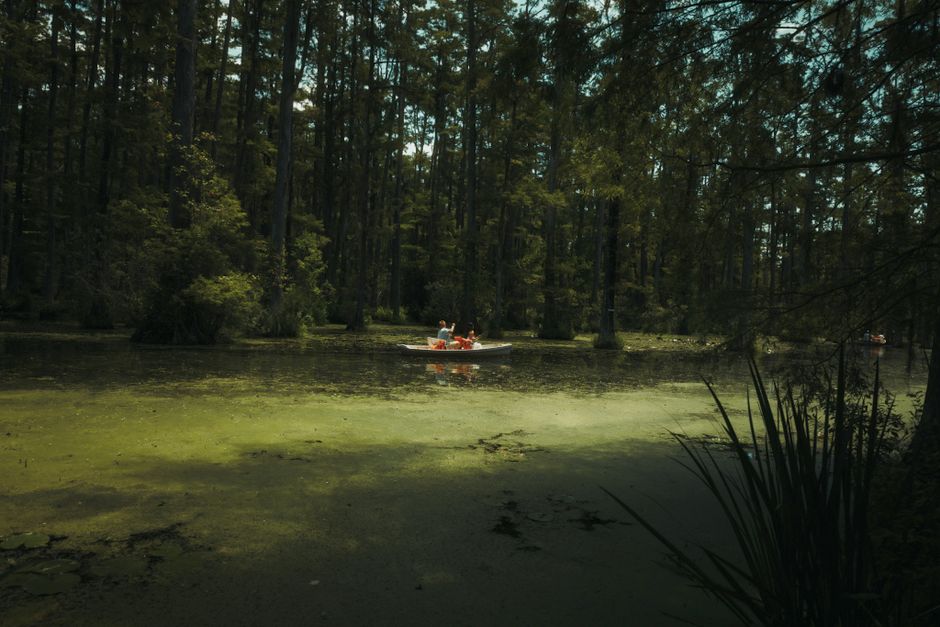
The day of the cruise delivered the postcard version: a specular 47-foot trawler meandering up the river past cypress and tupelo, friends and good food on deck, and a refreshing swim near Seminole Landing. For Saunders, whose yards sit within sight of these waters, the outing was equal parts reward and reminder — the landscape his conservation colleagues work to protect is exactly the one his customers boat on.
For residents and visitors alike, the Perdido offers a rare experience on the developed Gulf Coast: a river trip where the shoreline looks much as it did centuries ago. That it still does is not luck. It is the accumulated result of people like Andrew Saunders — boatyard builders who decided the water was part of the product — and the organizations they chair, fund and drag their friends onto boats to see.