

Sixty-Five Years of Grease, Grit and Clean Water: The Saunders Yachtworks Story
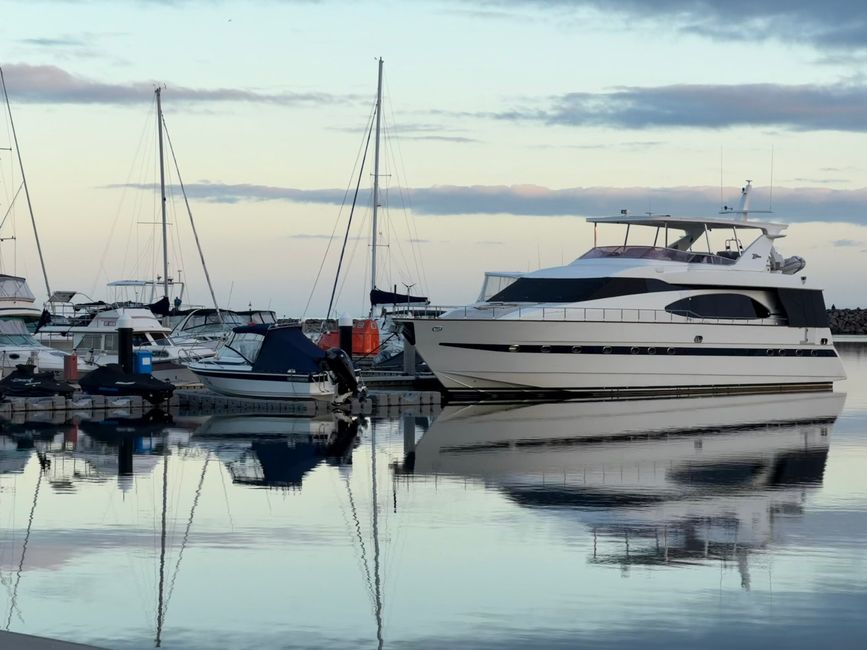
Travel Canal Road between Gulf Shores and Orange Beach and you cannot miss it: a sprawling yacht service facility and basin on the Intracoastal Waterway, its docks lined with gleaming sportfishing yachts, its yard full of boats resting on blocks. Saunders Yachtworks is the largest yacht service facility on the Central Gulf Coast — and one of the region’s most remarkable family-business stories, one that began not with yachts at all, but with industrial diesel engines on Mobile’s waterfront.
In 2024, the company marked 65 years in business. Today, Saunders Yachtworks in Gulf Shores can lift a 125-foot aluminum or 120-foot fiberglass yacht clear out of the water on the largest recreational boat lift on the Northern Gulf Coast — a 150-ton Travelift that has become a symbol of how far the company has traveled from its founding.
From Diesel Engines on the Mobile Waterfront
The company began as Saunders Engine Company, an industrial diesel engine service and repair center on Mobile’s waterfront, founded by Andrew Saunders, Sr. His son, Andrew Saunders, took over the business his father started and built it into a company with 130 employees and a second facility in Panama City, Florida, servicing both truck and marine diesel engines.
By the mid-1990s, Andrew had identified a distinction that would reshape the company: servicing industrial vessels and servicing recreational yachts are different businesses, requiring different people and different expectations. That insight led to the creation of a Yacht Service Division, and in 1995, to the launch of Saunders Yachtworks at Orange Beach Marina as a separate LLC with outside investors. The operation began with eight to ten employees, and Andrew set the tone from the start — he wanted yacht-savvy technicians in white vans and tennis shoes who could walk into the engine rooms of large yachts and be welcomed there. “He always said talent attracts business,” John Fitzgerald recalls, “and he is right.”
By 1998, Saunders Engine Company had brought the young yachtworks operation into the fold.
The Math Teacher Who Wrote a Letter
The president who would grow Saunders Yachtworks into its present form did not come from boating at all. John Fitzgerald grew up in Arlington, Virginia, earned an education degree at the University of North Carolina, and spent five years teaching middle school math before completing a master’s degree in school administration at the University of Virginia. There he met Andolyn Saunders, who was studying counseling in the School of Education. They married in Mobile in 1995; by then John was a high school assistant principal in Virginia, and the couple’s first child arrived in 1996.
Andrew and his late wife, Carolyn, wanted their daughter and son-in-law back in Mobile. Andrew created a human resources position at the company hoping to entice Andolyn home; she preferred to stay home with a growing family, but her husband was intrigued. “This was all a new relationship,” John says. “At that point, Andrew didn’t know me well and expressed that the position was strictly to entice Andolyn to move home.”
John was drawn by what he saw at a company Christmas party: employees who behaved as if the business were their own. “It was like one big family.” In 1997, he put his case in writing — a formal letter and resume requesting consideration for the position. Andrew famously turned him down, explaining the job had been designed for Andolyn. The next year, Andrew and Carolyn tried again with a different arrangement: if John and Andolyn could get to Mobile on their own, Andrew would consider him. John took a job at Callaway Smith School in the Mobile County School System, in Detonti Square, near the engine company’s Conception Street facility — and spent his afternoons talking company with Andrew.
A year later, the HR Manager job was his. He started in the summer of 2000, in the shadow of Y2K anxieties and a parade of consultants. Andrew made two decisions that would shape John’s education. First, John would report not to Andrew but to CFO Mike Hofto — “Mike was tight with money and always wanted to assess the risk and reward before moving on something. Andrew is a big thinker. It was a nice balance.” Second, the mature, stable company with little turnover meant personnel systems already worked, freeing John to learn every corner of the business.
Learning the Business From the Call Rotation
Fitzgerald’s fast-track came through an unusual door: the 24-hour on-call rotation. After a seminar taught him that the thing employees disliked most was being on around-the-clock call, he asked to be put on the rotation himself. “This created a whole new opportunity for me to learn what our people were dealing with day-to-day,” he says. Riding along with mechanics on service calls, he learned the mechanical side of the business, built trust between employees and management, and made himself genuinely useful. “We became totally interdependent.”
By 2006, a deep study of the yachtworks side revealed its growth potential, and John asked to become Vice President of Yacht Services. By then he was living in Spanish Fort, spending most of his time at the Orange Beach facility, and had helped hire 80 percent of the Yachtworks staff.
Reorganization, Relocation, Recession
What happened next transformed the company. In 2007, Florida Detroit Diesel bought the Panama City division. Six months later, Kirby Corporation purchased Saunders Engine Company in Mobile. In January 2008, the company reorganized around the yacht business: Andrew retired from day-to-day management to become Chairman of the Board, and John became President.
At the same moment, Saunders Yachtworks leased 13 acres on the Intracoastal Waterway from the City of Gulf Shores. The Orange Beach Marina site had been squeezed — “we were on top of each other and our 60-ton Travelift was completely landlocked,” John says. “Boats were getting bigger, and we were limited to three or four boats at a time. We needed more capacity.” Financially secure and not beholden to anyone, the company built a new facility that opened in January 2009 and celebrated its 50th anniversary that May.
Then came the double blow. By the end of 2009 the recession was in full swing — business was down 25 percent from 2008 — and 20 percent of employees were laid off. In 2010, the BP oil spill emptied the beaches for a year, with oil reported in Perdido Pass. “It was a strange, uncertain time for everyone,” John says. The company claimed a two-year business loss, settled early, and was, in his word, made whole — and within two years, every laid-off employee was offered their job back.
A Public-Private Partnership and a 150-Ton Lift
Recovery came partly through Andrew’s discovery of a Department of Commerce Economic Development grant — 80 percent federal, 20 percent municipal — that had to be applied for by a municipality. The City of Gulf Shores, struggling in the oil spill’s aftermath, qualified; Saunders Yachtworks covered the city’s 20 percent share to put in the service bay. The yacht basin next to the facility came together in June 2012. “It was a public/private partnership in the truest sense,” John says.
At the grand opening, the first yacht lifted by the new 150-ton Travelift was a 102-foot Broward. “That was quite a day, and the entire company celebrated.” Today the lift can handle a 125-foot aluminum or 120-foot fiberglass yacht — the largest recreational boat lift on the Northern Gulf Coast.
Clean Floors, Clean Water
Visitors to the Gulf Shores yard — including the crowds who arrive for the annual Saunders Yachtworks Boatyard Bash, held in conjunction with The Wharf Boat & Yacht Show each spring — often notice the same thing John hears constantly: the place is immaculate. “Andrew has always been a stickler for presentation,” he says. “Anyone should be able to walk through our shop, whether you are a banker, a truck driver, a doctor, or a boat owner. We gained a lot of clients by keeping our facilities clean and orderly.”
The cleanliness is more than aesthetics; it is the visible half of an environmental ethic that runs through the company’s mission. “Conservation is a big part of our mission. Without clean water, we don’t have a business,” John explains. “There are no 70-foot Viking sportfishing yachts if there aren’t 600-pound marlin in the sea.” Nothing goes into the water at the facility — the shop mantra is “don’t let it slip” — and the company aims to exceed EPA requirements. “It feeds our environmental mission, but it’s also good business.”
The ethic traces back to Andrew Saunders, who served as chairman of the Alabama board of The Nature Conservancy and remains active in coastal conservation around North Wolf Bay as Chairman Emeritus.
Boats, Economics and the Next Generation
Fitzgerald is clear-eyed about the business cycle. “Nobody needs a recreational boat. Period,” he says. “You may want it, but you don’t have to own one.” Demand for boats under 40 feet has softened as inflation and interest rates bite, and the pandemic-era dealer backlog has cleared. Saunders Yachtworks, a high fixed-cost business operating on thin margins, counters with volume and efficiency — and, he notes, with opportunity: for boat owners considering a repower, the economics are suddenly attractive.
The bigger challenge is people. Post-COVID retirements and turnover — “as high as I have ever seen it,” John says — have made recruiting and retention critical. The company is deliberately building its next team, looking for young people with energy, skills, and ambition, and a servant-leadership mentality. “My goal is to position the company in a healthy state for the next generation to keep it going.”
As for the future, Fitzgerald is confident. People will always come to the water, and in Baldwin County, they come by boat. “We are blessed to live and work here. We are well-positioned for the future. There will always be boats here, so business should be good.”
Saunders Yachtworks operates its yacht service facility and basin on the Intracoastal Waterway in Gulf Shores, serving the Central Gulf Coast’s recreational fleet.