Retired Soldier Pulls Elderly Enterprise Woman and Caregiver From Burning Home, Fire Chief Says
A retired Army soldier carried an elderly Enterprise woman and her caregiver out a bedroom window as fire spread through their Bellwood Road home, the.
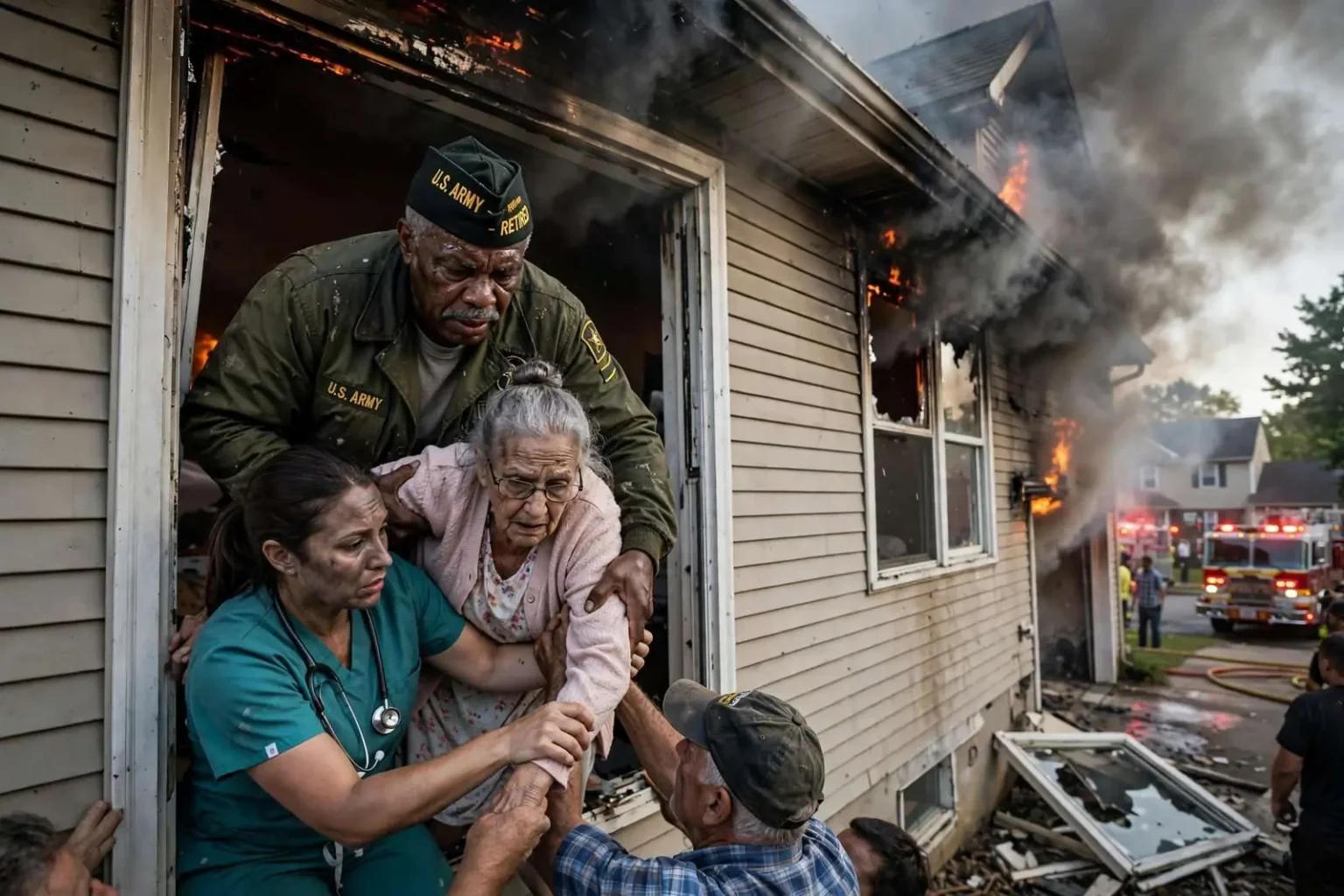
A neighbor who ran toward a burning house on Bellwood Road instead of waiting outside for crews likely saved two lives Sunday afternoon in Enterprise, according to the city’s fire chief. Flames were showing from the two-story home when Marvin Pinckney, who lives a few doors down, went inside to reach an elderly resident and her caregiver, both of whom were trapped as smoke filled the house. The fire was already at the stage most people are taught never to confront — visible fire, smoke spreading through the structure — which is what makes the decision to enter so consequential, and so rare.
Pinckney, who retired from the U.S. Army after 30 years of service, said the fire had already cut off the normal ways out. “We couldn’t go out the back, we couldn’t go through the front because there was so much smoke, so the only way out was a bedroom off to the front of the house,” Pinckney said. “I pushed out the screen. By that time neighbors were in the front and was able to pass her through the window and got the other occupant out as well.” His account describes the grim arithmetic of a house fire in its early minutes: exits closing one by one as smoke banks down from the ceiling, and a window becoming the only remaining path between the occupants and the worst outcomes of a structure fire.
Fire officials across the country repeat a consistent warning that civilians should not enter burning buildings, and Pinckney’s rescue does not change that guidance. What it shows instead is how a fire’s timeline works: crews were still en route when the two women’s survival window was closing, and the neighbor who happened to be close enough to act used it. Rescue outcomes in structure fires are measured in minutes, and the people already on the scene when a fire breaks out are always the first responders in the literal sense.
Chief: the outcome would have been different
Enterprise Fire Chief Chris Davis said his engine companies reached the scene within minutes of being dispatched, but that the fire was advancing quickly enough that a few more minutes could have been fatal for the two women. “He’s the epitome of my brother’s keeper. He didn’t have to act, he could have just called 911 and made no further steps,” Davis said of Pinckney. “As progressive as the situation was, it is quite clear that we would have had a different outcome if he had not acted. He’s a very humble man.”
Davis credited the rescue with the condition both women were left in. “If they were in there any longer, it is very likely that one or both of the occupants would not have made it out of that house,” the chief said. The assessment from the department that answered the call carries particular weight: crews who arrive at a working fire see the difference between occupants who got out minutes earlier and those who did not, and Davis’s account places Pinckney’s decision directly on the right side of that line.
Pinckney said the only thing on his mind inside the house was the two people he was carrying out. “All I kept saying to myself is don’t let them be hurt, don’t let anything happen to them,” he said. “The house can be replaced, but they are special people and I am very fond of them both.” His description of the elderly resident and her caregiver as people he was fond of points to the neighborhood relationships that made the rescue possible: a long-time resident two doors down, familiar with who lived in the house and who was home on a Sunday afternoon, recognizing immediately who was in danger.
The retired soldier’s 30 years of Army service is more than a biographical detail in a story like this. A career in the military builds the composure, physical conditioning and habit of moving toward a problem rather than away from it that a split-second civilian rescue demands. Coffee County sits next to the Fort Novosel military reservation, the Army’s aviation training center, and the region is dense with veterans and active-duty families; Pinckney’s Sunday afternoon reflects a community where that background is part of the social fabric.
Both women expected to recover
Both women were taken to a hospital for observation and were reported to be in good shape afterward. That outcome — two people out of a burning two-story home and well enough to be held for observation rather than intensive treatment — is the exception in structure fires, where smoke inhalation alone sends survivors to intensive care and deaths are often caused by the smoke before the flames. It reflects how early in the fire’s progression the women were reached, and why the chief’s minutes-count framing is not rhetorical.
The rescue also underscores the particular vulnerability of the two people inside. Elderly residents face the highest fire fatality risk of any age group, slowed mobility and slower reaction to alarms combine with medications and health conditions to shorten the time available to escape. Homes where a caregiver is present are safer than homes where an elderly resident lives alone, but a daytime fire with both occupants inside and exits blocked puts both in the highest-risk category — which is exactly the situation Pinckney encountered on Bellwood Road.
Davis said the cause of the fire had not been determined, but that investigators believe it started in the garage or toward the back of the home. The distinction matters for the investigation that follows: garage fires have a well-documented profile of their own, often linked to electrical equipment, stored vehicles, fuel containers, battery chargers and the appliances and tools that accumulate in the enclosed spaces where households keep what the living areas do not. An origin point toward the back of a two-story home versus within the attached garage changes what investigators look for, from appliance records to wiring runs, and the state fire marshal’s office typically assists municipal departments with causes that take days or weeks to pin down.
The two-story construction shaped the rescue as well. Second stories change a fire’s escape math, since occupants above the fire cannot simply exit through a door and the window rescue Pinckney executed becomes the difference between escape and entrapment. Fire departments across the region use two-story homes as the standard scenario for search-and-rescue training for precisely this reason, and the Bellwood Road fire will likely circulate internally at the Enterprise department as a case study in how fast a residential fire blocks its own exits.
What the rescue means in Enterprise
For the Enterprise community, the episode is the kind that reshapes how a neighborhood sees itself. A quiet residential street where most residents know one another is what allowed a neighbor to know two women were inside a burning house and to reach them before the first engine arrived. Fire chiefs in small Alabama cities consistently identify that neighbor-first dynamic as the X factor in survival outcomes — departments can only shorten response times so far, and the first minutes belong to whoever is already there.
The Enterprise Fire Department, which protects a city that anchors the northern side of the Fort Novosel area, routinely handles residential fires across its coverage area, and the department’s leadership has used rescues like this one in public safety messaging about smoke alarms, escape plans and the value of knowing one’s neighbors. Bellwood Road will go back to being a quiet street, the damaged house will be repaired or rebuilt, and the investigation will settle the cause in time. What remains is the account that Davis gave from the scene: a retired soldier two doors down who had every reason to stay on the sidewalk, went in instead, and brought both women out through a window while the fire still had the doors — the plainest definition of a life saved that the fire service has.
The details of how the rescue unfolded offer a window into why smoke, more than fire, is the killer in residential blazes. Smoke from a house fire is thick, toxic and fast: it fills a room from the ceiling down, cuts visibility to a few feet within minutes and carries carbon monoxide and other gases that incapacitate before flames ever reach a victim. Pinckney’s account of front and back exits made impassable by smoke describes the standard progression of a two-story house fire — doors that were usable at the fire’s start become walls of smoke within the time it takes a neighbor to cross the street. The women survived because someone reached them while they were still conscious enough to move, through a window that had not yet become a chimney.
Neighbors who passed the elderly resident through the window performed the second half of the rescue, and the team effort is part of what made it work. A single rescuer inside a smoke-filled house cannot carry two people out through a window; the handoff from inside to outside requires people at the sill receiving them. The scene that Davis described — one neighbor inside pushing out a screen, a group in front receiving the occupants — is a civilian version of the coordinated entry that fire crews train on, assembled in the moment by people who live on the same block.
The recovery ahead
For the two women who were pulled from the house, the observation period at the hospital will check for smoke inhalation effects that can appear hours after exposure, and recovery from even a minor structure fire involves more than medical clearance: temporary housing, replacement of belongings and the disruption of care arrangements for an elderly resident whose routine was upended on a Sunday afternoon. Neighborhoods typically absorb that burden the way this one absorbed the rescue, with the people next door handling what institutions cannot move fast enough to cover.
As for Pinckney, the account that emerges from those who dealt with him matches the chief’s description: humble, uninterested in attention, focused entirely on the two people he got out. Fire departments see a handful of civilian rescues each year across an entire state, and the ones that end with everyone alive almost always share the same anatomy — someone close by, willing to act inside the first minutes, before the professionals can arrive. Bellwood Road’s version of that story ended with two women in good condition at a hospital, a house that can be replaced, and a retired soldier who says what he kept telling himself inside was simply not to let anything happen to them.