

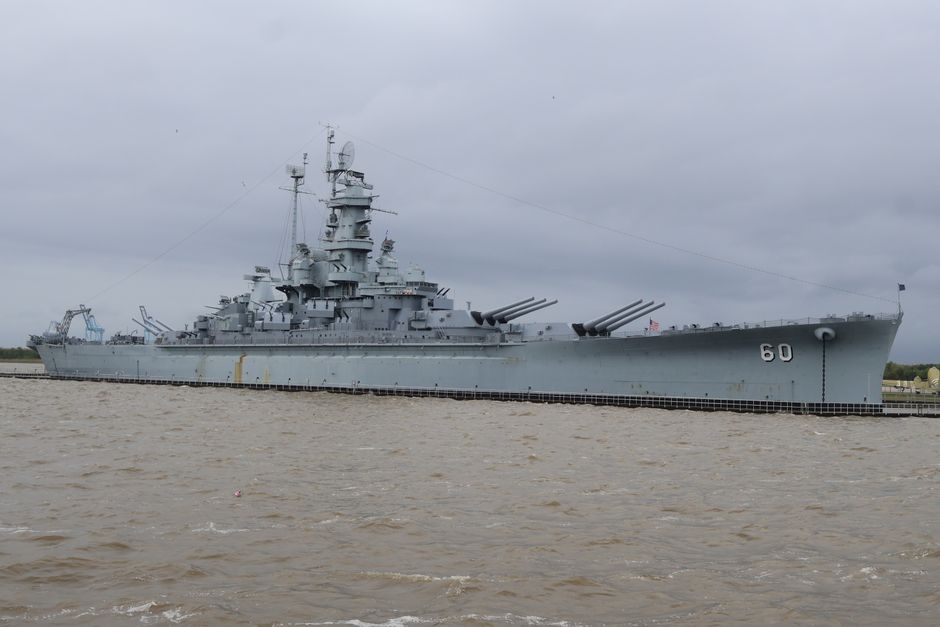
Every so often it is worth remembering that one of the great museum ships in America sits ten minutes from downtown Mobile, big as a city block and nine stories tall, resting where tugs left her more than sixty years ago. The USS Alabama — the Mighty A — draws visitors from around the world, but locals have a habit of treating her like furniture: always there, easy to overlook. A recent afternoon spent walking her decks again was a reminder of how much history sits on that stretch of Mobile Bay.
Battleship Memorial Park is easy to take for granted from the Causeway, where the gray silhouette of the South Dakota-class battleship rises above the waterline of the artificial peninsula built from dredged bay bottom. Up close, the scale is different. The ship runs 680 feet at the waterline, displaces roughly 35,000 tons, and carries a main battery of nine 16-inch guns capable of throwing 2,700-pound shells more than twenty miles. More than 2,500 sailors called her home during the war.
A war record worth the walk
The USS Alabama (BB-60) was commissioned on August 16, 1942, at the Norfolk Navy Yard. After shakedown along the East Coast, she deployed to the North Atlantic in 1943, escorting convoys bound for the Soviet Union and screening Allied forces during the invasion of Sicily before transferring to the Pacific later that year. There she joined the fast carrier task forces, her early-warning radar earning credit in the great Marianas air battles — the “Great Marianas Turkey Shoot” cost Japan hundreds of aircraft — and she survived a typhoon in December 1944 that sank three destroyers. Her war ended in Tokyo Bay, where she led elements of the American fleet into the harbor following Japan’s surrender in September 1945.
By the time she tied up in the Pacific Reserve Fleet at Bremerton, Washington, on January 9, 1947, the Alabama had logged more than 200,000 miles, earned nine battle stars, and shot down 22 enemy aircraft. For nearly two decades she sat in the mothball fleet, until 1962, when the Navy decided she was headed for the scrapyard unless someone else would pay to take her.
How the Mighty A came home
What happened next is the part of the story every Alabama schoolchild used to know. A citizen campaign led by Mobile civic leaders and a new state battleship commission raised roughly $800,000 — including something in the neighborhood of $100,000 in coins and lunch money donated by Alabama schoolchildren, who received lifetime admission cards for their trouble. The Navy transferred the ship in 1964, and tugs began a 5,600-mile journey through the Panama Canal and across the Gulf, delivering the battleship to Mobile Bay on September 14, 1964. The park opened to the public on January 9, 1965 — eighteen years to the day after her decommissioning — and the ship now stands as a National Historic Landmark that has hosted millions of visitors.
That second act is part of what makes a walk aboard so moving. Every other battleship of her class was scrapped or sunk as a target. The Alabama is the one that came home, because children emptied piggy banks to save her.
The Drum, the planes, and the park
The battleship is only the headliner. Moored alongside is the USS Drum (SS-228), the fleet submarine donated to the park in 1969 and now the oldest American submarine open for public tours — a fitting tribute to the Silent Service crews who fought the Pacific war in spaces barely bigger than a Fairhope living room. Walking the Drum’s cramped passages, it is hard not to think of the men who served on sister boats that never came home.
The Aircraft Pavilion and the grounds hold one of the most varied historic aircraft collections in the Southeast. Among the most visited are two planes donated by Jimmy Buffett: the amphibious Grumman Goose that carried the Mobile-born singer to his beloved islands, and the Boeing Stearman biplane featured in the video for his duet “Trip Around the Sun” with Martina McBride. Just a few steps away sits a restored helicopter used by five U.S. presidents, an A-12 Blackbird spy plane, a Vietnam-era B-52 bomber, and a P-51 Mustang of the kind flown by the Tuskegee Airmen. Reading the placards alone is an education; the docents and volunteers add the rest.
Odd gigs and lasting memories
The park has a way of producing stories no one plans. Musicians who have played private events on the battleship’s wooden deck describe the strange acoustics of music surrounded by thick steel, the midnight quiet of a ship with no tourists aboard, and the surreal logistics of a load-in that included driving a car up the ramp and parking it on the deck. A wedding reception on a battleship is the kind of assignment a bass player never expects — and never forgets.
That mix of the ceremonial and the everyday is part of the park’s charm. School groups pile off buses to explore the turrets; veterans’ organizations hold reunions in the shadow of the guns; families picnic on the lawns while the Drum’s conning tower catches the afternoon light. On a blue-sky afternoon with a stiff breeze off the bay, it can feel less like a museum than a reunion the whole state was invited to.
Worth the drive, again and again
For visitors plotting a first trip, the practical advice is simple: give it more time than you think, wear real shoes for the ladders and passageways, and consider one of the guided tours or special events the park offers throughout the year — the lectures and commemorative gatherings add a depth the placards only hint at. Locals who have not been aboard since a childhood field trip will find that the ship reads differently at 40 than it did at 10, particularly standing in the cramped crew quarters, imagining the 20-year-olds who lived there.
For anyone who grew up hearing a father’s or grandfather’s stories of a war fought on ships like this one, an afternoon aboard the Alabama is as close as the past gets to being walkable. The Mighty A has been holding the waterfront now for over sixty years — patient, enormous, and still teaching anyone willing to climb aboard.