

A hundred acres of quiet on the Tensaw River
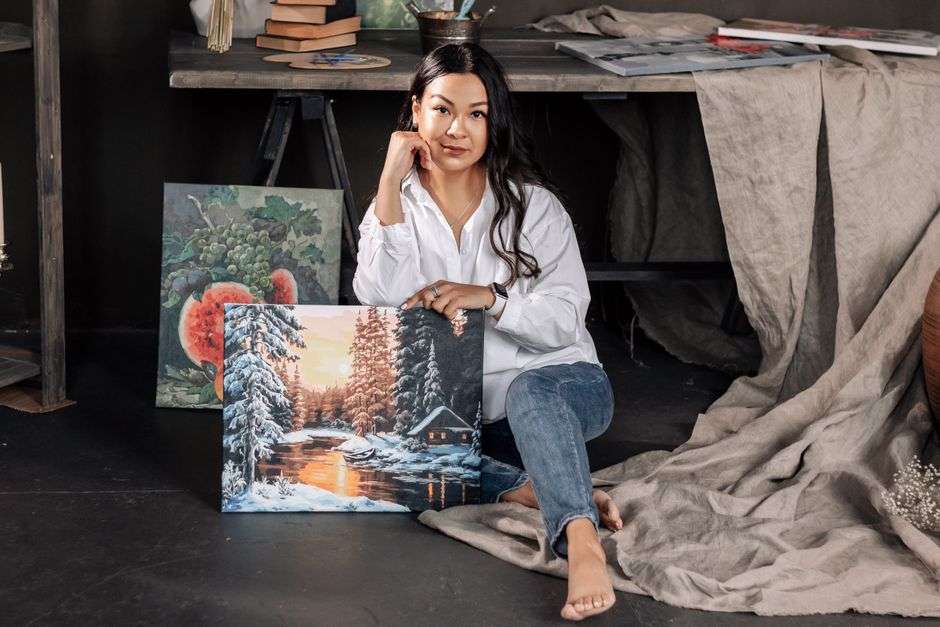
Follow the rivers north of Spanish Fort into the Mobile-Tensaw Delta and the subdivisions thin out fast. Past the last paved turns in the Baldwin County community of Tensaw, the landscape opens into bottomland forest and river oxbows, the kind of country that has changed little in a century. It is here, on 150 acres of family land, that artist Diana Rell Dean built the Riverhouse Workshop and Artist Retreat — part home, part studio, part ongoing argument for the idea that wilderness and art belong in the same place.
Dean’s roots in Tensaw run deep. She was born in the community and still has family there, but her path to it was anything but direct. Her father was a petrochemical engineer who spent 29 years working overseas, and her childhood unfolded in chapters: eleven years in Venezuela, four more in Buenos Aires, Argentina, and a family ritual of returning to the United States every two years. Those homecomings followed a set route — docking in Miami, then working north and west to Tensaw, where her grandmother still lived, for stays of three months at a time.
“Here she felt a sense of place, the power of Mother Nature,” as she tells it, and the pull of that delta landscape never let go.
Dance, then paint
Before she was a painter, Dean was a dancer — a serious one. She attended Carleton College in Minnesota, where she earned a degree in comparative dramatic literature while studying modern and concert dance under Margaret Dietz and Hanya Holm, two of the lead teachers in the lineage of German expressionist pioneer Mary Wigman. She went on to earn a master’s in the arts in education from Columbia University’s Teachers College while teaching dance to schoolchildren, and later a second master’s, in Spanish literature. She speaks the language fluently.
“I’ve taught dance to people aged 3 to 60 years old,” she says. “I taught them how to make dances, as well as how to dance.” Teaching dance carried her from schoolchildren in New York to a decade raising her son in Greenwich, Connecticut, and then to Stuart, Florida, where she moved to care for her mother and, along the Atlantic shoreline, fell into a second calling: sailing.
The sailing took her across the Caribbean and far beyond — Belize, Tahiti, Corfu, Croatia, Saint Martin. On one Caribbean passage, the colors of the water proved too much to leave unpainted. “Let me see if I can figure this out,” she told herself, and started working with a brush. The paintings that followed have a folk-art directness, but collectors and juried shows have taken to them: her work has been selected for juried member shows at both the Eastern Shore Art Center in Fairhope and the Pensacola Museum of Art.
Coming home to build
The retreat itself is recent history. Three years before the Riverhouse opened, Dean’s cousins approached her about buying a piece of the family land — acreage that had been in the family for more than a century. She bought in, then set about building. Fairhope architect Bob Chatham designed the home, builder Cade McMurray constructed it, and Dean converted the garage into her art gallery almost immediately.
She credits Patty and Steve White, artists from her Florida days who had resettled in Fairhope, with pushing her to turn the long-held idea of an artist retreat into something real. Plans call for a dedicated workshop building on the property where visiting students can spend weekends working with a teacher and, in her phrase, “feel the power of Mother Nature” while they grow.
The name Riverhouse Workshop comes from her years on the St. Lucie River in Stuart. The philosophy comes from a lifetime of movement. “I’m a nature freak,” she says, “and I love wilderness canoeing.” Her plan for the retreat is to give people a way to step out of city stress and back into a connection with art and wild country — the same connection her family’s homecomings to Tensaw gave her every two years of her childhood.
One foot in the country, one in the city
Dean has no intention of disappearing into the woods. She is buying a condo in Pensacola’s Brent Lofts, a century-old historic building on Palafox Street, to keep her connection to a city art scene. She has worked with Sam Nettles, the sculptor and teacher at First City Arts in Pensacola, and plans to split her time between the river and the city, exhibiting and teaching in both places.
The retreat’s first season gave a preview of what she has in mind. Alongside a two-day show called “Threads” at the property, she brought together four other artists: quilters Angelous Barr and Kimberly McKeough, weaver Jacqueline Roesch-Sanchez, whose loom-woven scarves have built a following of their own, and fabric artist Van Nguyen, who translates Dean’s paintings into a silk clothing collection called Pura Vida — shirts, trousers, dresses and scarves.
For now, the property hosts one-day retreats while the lodge is completed. The setting does most of the persuading: 150 acres of quiet, a river running through it, and a studio full of work that manages to look happy. Visitors leave, as more than one has put it, with their eye on a few pieces and a plan to come back.
After forty years of teaching — dance, movement, art — Dean has settled into the place her family kept for a century, making the case in paint that the wild places along the Tensaw are worth paying attention to. The Riverhouse Workshop is her evidence.