

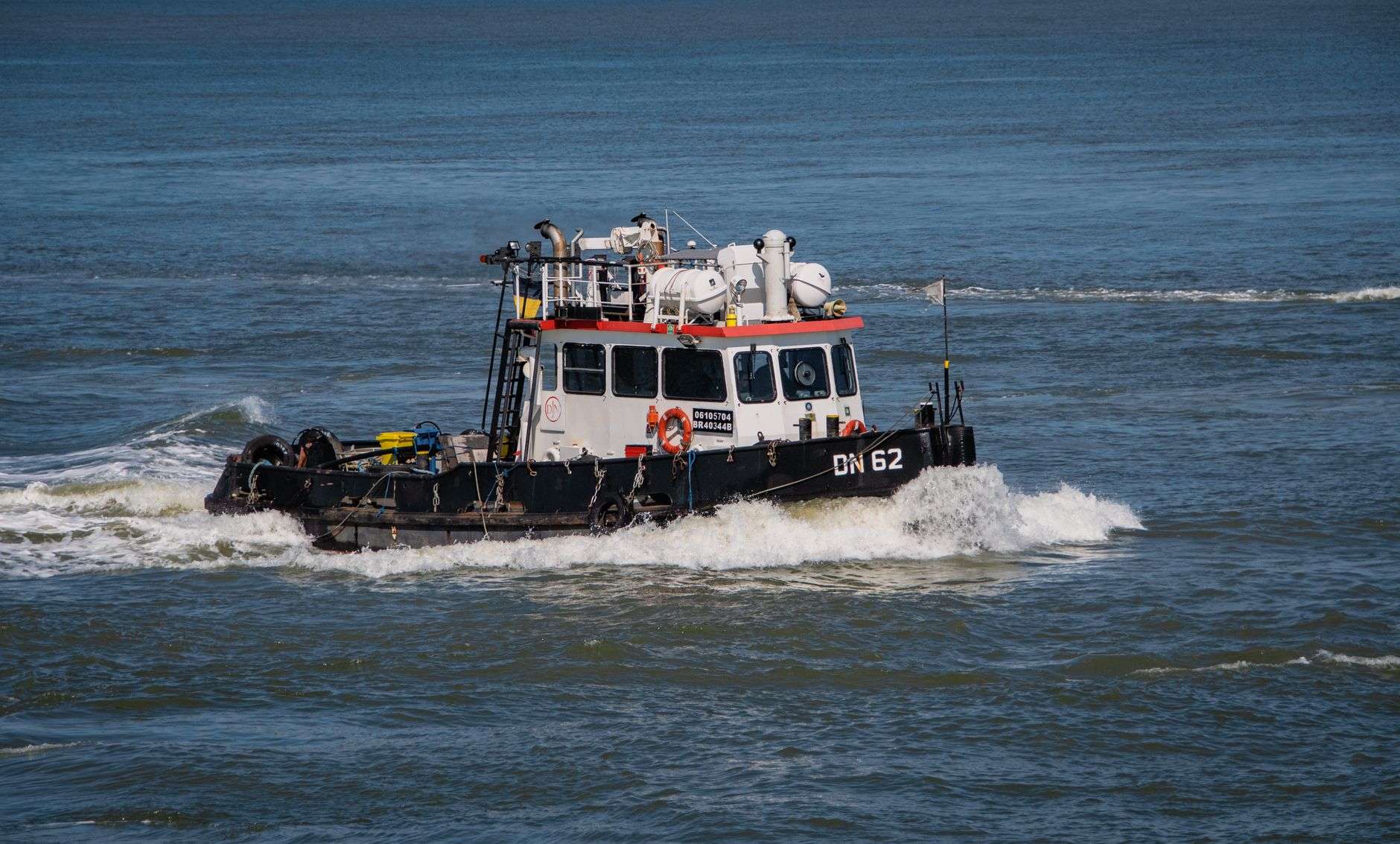
FAIRHOPE, Ala. — Salvage crews spent Monday working to raise a small tugboat or barge that sank Friday night in rough weather off the eastern shore of Mobile Bay, according to the U.S. Coast Guard. The operation brought together federal, state, and local responders on a stretch of shoreline better known for its parks and piers than for maritime emergencies, and it left boaters along the eastern shore with a new hazard to avoid while the work continued.
The vessel went down near Mullet Point Park along County Road 1, with only its pilothouse left visible above the waterline. Mullet Point Park sits on the bayfront south of Fairhope’s downtown, a spot where residents launch small boats and anglers work the shallows along the shoreline. The location placed the wreck close to shore — close enough that residents watching from their own piers could see the entire episode unfold through binoculars and spotting scopes as it happened.
The Coast Guard said the boat measures 20 feet by 12 feet and is owned and operated by S and J Construction. Vessels of that size are workhorses along the bay, used to shift barges and move equipment on projects around the shoreline, but they are small enough that rough weather on open water can quickly overwhelm them. Mobile Bay, though sheltered compared to the open Gulf, is wide enough — roughly 25 miles across at its mouth — that a strong storm can raise steep, confused seas close to shore.
A marine radio warning has been issued advising boaters to avoid the area while salvage work continues. Boaters traveling the eastern shore between Fairhope and the causeway were urged to give the sunken vessel a wide berth, both because of the hazard it poses to navigation and because salvage crews were actively working around it.
A Nighttime Rescue at the Boat Launch
Witnesses said two crew members were rescued and brought safely to the boat launch at Mullet Point Park on Friday night. No injuries were reported. The Alabama Law Enforcement Agency’s Marine Patrol responded to the scene, according to the Coast Guard, joining the response as the crew came ashore.
“Blue lights started coming from across the bay right in front of us and turns out, the volunteer fire department showed up at the park so it was all lit up,” said Blackie LeBlanc, who lives on the bay and was among those waiting at the boat launch when the crew was brought ashore. “They got them off it fine. There wasn’t any injuries or nothing but they were a little shook up,” LeBlanc said.
According to LeBlanc’s account, the trouble aboard began with the engine. “Evidently the engine had overheated, and they shut it off and when they went to start it back up, the batteries were dead and they started taking on water,” LeBlanc said. With no power, the small vessel sat low in the water and helpless against the conditions, unable to run for shallower water or make its own way to the launch.
LeBlanc said a storm moving through the area at the time contributed to the sinking. “They were just in a bad place at a bad time,” he said. The combination — an overheated engine, dead batteries, and rising water in the hull, all amid a storm — left the crew with little recourse beyond a radio call for help and whatever the conditions allowed rescuers to do.
LeBlanc said he watched the scene unfold through a spotting scope from his pier over the weekend. From his vantage point on the bayfront, the wreck remained in view day and night, a small dark shape with its pilothouse above the waterline and the rest of the hull hidden beneath the bay. For shoreline residents, the sunken boat became an unexpected spectacle — and a topic of conversation — as the weekend wore on and word spread about what had happened and who had been aboard.
Conditions had calmed by Monday, allowing salvage workers to attempt to float the vessel, which remained visible above the water as of Monday afternoon. Calmer seas made the difference between a workable salvage job and an impossible one. Raising even a small vessel requires divers or riggers to secure straps and patches, and none of that work can proceed safely when the wreck is rocking in chop. The weather window opened just enough on Monday for crews to begin.
How Salvage Operations Work on Mobile Bay
Raising a sunken vessel is a deliberate, methodical process. Salvage crews typically begin by assessing the wreck’s position and condition, then seal openings where possible, attach lifting points, and use cranes, lift bags, or a combination of both to bring the hull back to the surface. Water pumped or lifted out along the way has to go somewhere, and any fuel, oil, or other fluids aboard become a contamination concern the moment the hull leaves the bay floor.
That last point was among the open questions as the week began. The Coast Guard has not said when the salvage operation is expected to be completed or whether any fuel or environmental concerns are associated with the sunken vessel. Even a small workboat can carry enough diesel to create a sheen on the water, and responders generally deploy containment boom as a precaution when a wrecked vessel is raised. The Coast Guard, which maintains the Eastern Shore and Mobile Bay as part of its patrol area, typically keeps a salvage case open until the hazard to navigation is resolved and any pollution threat is addressed.
Small-boat sinkings are not unusual on the bay, particularly during storm season, when squalls can build with little warning. What made this case notable was the location — a popular park and boat launch within sight of homes along County Road 1 — and the fact that the entire rescue and salvage story played out in full view of the neighborhood.
For the volunteer fire department that responded to the park, the call was a familiar kind of emergency. Baldwin County’s volunteer fire departments handle a wide range of water-related calls along Mobile Bay’s eastern shore, from medical emergencies at boat launches to rescues in the bay itself, often in coordination with the Marine Patrol and the Coast Guard.
The Eastern Shore’s Working Waters
The waters off Mullet Point Park see steady traffic from commercial and recreational boats alike. Construction companies, marine contractors, and landscape crews working along the shoreline use small tugs and barges to move equipment and material to sites accessible only by water. Recreational boaters, kayakers, and fishing boats share the same stretches of water, which is why a partially submerged wreck in a popular area draws an immediate warning to the boating public.
County Road 1, the scenic two-lane highway that traces the eastern shore through Fairhope and points south, is lined with homes, piers, and public access points. Residents there are accustomed to watching the bay’s traffic — everything from shrimp boats to oyster harvesters to weekend sailors — and many keep a keen eye on anything unusual on the water. That familiarity is what put witnesses like LeBlanc at the boat launch within minutes of the rescue on Friday night, and what kept a small audience watching the salvage work through the weekend.
The rescue itself highlighted the layered response network that covers Mobile Bay. The Coast Guard provides search and rescue coordination and patrol assets; ALEA’s Marine Patrol brings state law enforcement authority and rescue capability; and volunteer fire departments provide the local, fast-arriving presence at parks and launches. In this case, the crew made it safely to the Mullet Point boat launch, where emergency lights illuminated the park as the rescue played out.
Being “a little shook up” but uninjured was, by any measure, the best outcome available under the circumstances. Cold water, darkness, a sinking vessel, and a storm all work against a crew in that situation, and bay waters can turn dangerous quickly even close to shore. The fact that both crew members came ashore without injuries meant responders could focus entirely on the vessel rather than on medical care.
Waiting on the Salvage Clock
By Monday afternoon, the focus had shifted entirely to raising the boat. Salvage timelines are notoriously difficult to predict — they depend on weather, the condition of the wreck, the availability of equipment, and what divers or riggers find once they can get hands on the hull. A small vessel like this one can sometimes be refloated in a day; complications, such as a holed hull or shifting mud, can stretch the work across several days.
Until the vessel is raised and removed, the marine radio warning remains in effect, and boaters in the area are urged to heed it and give the site a wide berth until the wreck is cleared. A submerged hull sitting just below the surface is a serious hazard to props and hulls alike, and the partially visible pilothouse makes the full extent of the obstruction hard to judge from a passing boat.
For now, the pilothouse above the waterline serves as its own marker, but officials caution that relying on sight alone is risky, particularly at low light or in chop. Boaters with any reason to pass through the area were advised to monitor marine radio broadcasts and route well clear of the park.
What Comes After the Raise
Once the vessel is back on the surface, the work is not over. The owner is generally responsible for the vessel after salvage, and the Coast Guard’s interest continues until any pollution threat is resolved and the navigation hazard is eliminated. Fuel tanks, oil reservoirs, and batteries all require attention on a raised workboat, and inspectors will want to understand what caused the sinking in the first place.
The circumstances described by witnesses — an overheated engine, dead batteries, and water coming aboard during a storm — illustrate how quickly small-vessel emergencies develop. An engine that shuts down in rough weather leaves a boat at the mercy of the seas; a dead battery removes the ability to pump out, maneuver, or call reliably for help; and a hull taking on water compounds all of it. Marine safety instructors along the Gulf Coast use incidents like this one to underscore the importance of backup power, working bilge pumps, and flotation gear within reach.
The two crew members’ rescue without injury stands as the episode’s clearest takeaway. Rough weather on Mobile Bay will always test small boats, but functioning radios, coordinated responders, and a shoreline full of people ready to help at the nearest launch made the difference between a salvage story and a tragedy.
Whether any regulatory findings follow the salvage — from the Coast Guard, the Marine Patrol, or S and J Construction’s own review — had not been announced as of Monday. The Coast Guard has not said when the operation is expected to be completed or whether any fuel or environmental concerns are associated with the sunken vessel, and updates are expected once the vessel is raised and assessed.
In the meantime, life along the eastern shore resumes its rhythms around the wreck. Boaters launch from Mullet Point with a caution in mind, residents watch the salvage crews work from their piers, and a small tugboat sits half-visible in the bay — waiting on calm water, good equipment, and a crew patient enough to bring it home.