Elderly Saraland Man Dies While Burning Yard Debris
A 95-year-old Saraland man died at his home while burning trash in his yard after the fire got out of control.
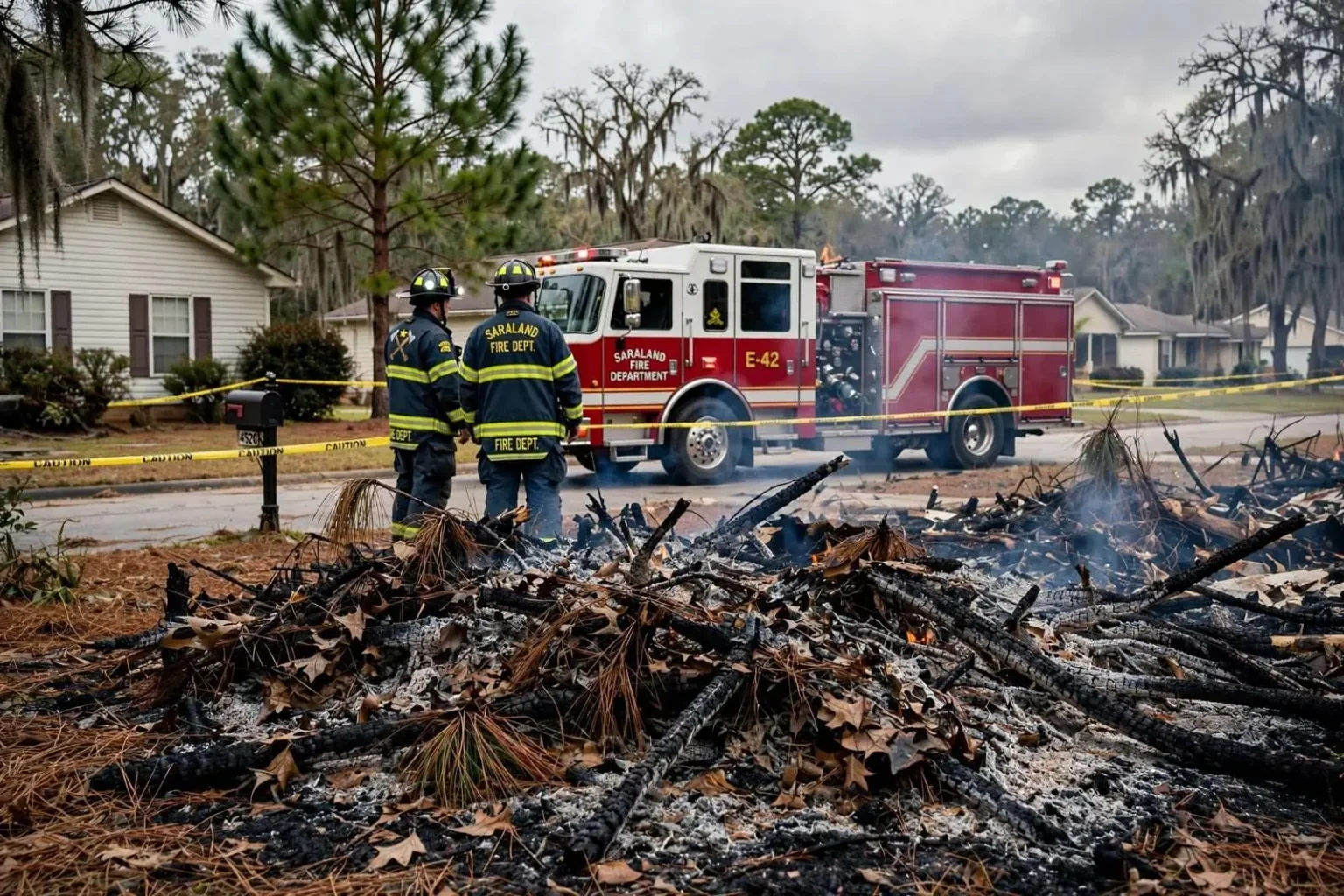
A 95-year-old Saraland man died Thursday while burning debris in his yard, according to local fire officials, after the blaze grew larger than he could control. The man had reportedly been working outside his home, burning trash as many residents in the area routinely do, when the fire escalated unexpectedly. His wife called the fire department after realizing the situation had become dangerous.
When firefighters arrived at the scene, they found the man had already died. Officials have not released an official cause of death, and an investigation into the exact circumstances remains limited in publicly available detail. Neighbors who knew the man said he had existing health problems, which may have contributed to the tragic outcome, though that has not been officially confirmed.
The incident has prompted renewed reminders from local fire officials about the risks associated with outdoor burning, particularly for elderly residents or those with underlying health conditions. No further details about the man’s identity or additional circumstances of his death have been made publicly available as of this report.
A Common Practice With Real Risks
Open burning of yard debris remains a common practice in parts of Saraland and other rural and suburban areas of Mobile County, but it carries real risks, especially during dry conditions or when burns are left unattended even briefly. On lots shaded by pines and oaks, a yard fire rarely stays as contained as it looks: pine straw, dry leaves and last season’s yard waste can carry flame across a lawn in seconds, and a light afternoon breeze is all it takes to push embers toward a fence line, a storage shed or the house itself.
Saraland sits in the northern reaches of Mobile County, where lots tend to be larger and municipal services thinner than in the older neighborhoods closer to the city. That geography explains both why burning remains routine and why it remains dangerous. Homeowners clearing branches after storms, or simply tidying acres of leaf drop in the fall, often find that hauling debris away is impractical and that a pile in the yard and a box of matches is the traditional answer — the same answer their parents and grandparents used on the same ground.
The Gulf Coast’s climate complicates the habit. Long stretches of humidity are punctuated by dry, windy spells — often in the fall and during spring cold fronts — when vegetation dries to kindling and fires that would smolder harmlessly in August can race. Fire officials across the region track those conditions closely, and burn bans are declared when drought or wind makes outdoor fires untenable.
What Fire Officials Recommend
Fire officials generally recommend that anyone planning to burn yard waste keep a water source nearby, avoid burning during windy conditions, and never leave a fire unattended, even for a short period. A garden hose already connected and turned on, or a bucket-filled source within arm’s reach, buys the seconds that matter when a fire jumps its pile. Wind is the most consistently underestimated factor: a calm morning can turn breezy by midday, and gusts carry embers far beyond the visible fire.
Clearing a perimeter matters as well. Officials advise burning well away from structures, fences and overhanging branches, raking bare ground around the pile before lighting it, and keeping the pile small enough to control — adding debris gradually rather than stacking everything at once. Burn barrels, while still seen in rural areas, concentrate heat and send sparks into the air, and many departments discourage their use in favor of open piles in cleared ground.
Older adults or those with respiratory or cardiac conditions are especially encouraged to have someone else present or to avoid burning tasks altogether given the physical exertion and smoke exposure involved. Standing over a smoldering pile in heat and humidity is hard work for anyone; for a person managing heart or lung disease, the combination of exertion, smoke inhalation and the stress of a fire that starts to escape can turn dangerous quickly, and a few seconds of delay in calling for help can be decisive.
Permits, Rules and Who to Call
The Saraland Fire Department, along with other departments across Mobile County, routinely responds to yard fires that escalate beyond what homeowners initially intend, and officials continue to encourage residents to check local burn permit requirements and safety guidelines before starting any outdoor fire. Rules vary across the county: some municipalities restrict or prohibit open burning outright, while unincorporated areas and smaller cities operate under county and state forestry rules, and the Alabama Forestry Commission maintains burn permit requirements for larger prescribed burns. A phone call before striking the match costs nothing and can spare a homeowner a citation, a liability claim or a destroyed fence.
Residents are also urged to know what may never be burned. Treated lumber, painted wood, plastics, tires, roofing material and household trash containing such items release toxic smoke when burned, and open burning of garbage is restricted in much of the county for exactly that reason. Yard debris — leaves, limbs, pine straw and grass clippings — is the only material most local rules contemplate, and even then only under the conditions outlined above.
Fire departments would rather answer a question than a call. Departments across Mobile County, including Saraland’s, generally field calls from residents asking whether burning is advisable on a given day, and many post guidance during bans. Neighbors noticing an unattended or spreading fire are encouraged to call 911 immediately rather than attempt to fight it themselves; volunteers and career firefighters can reach most of the county within minutes, and early calls keep small fires from becoming structure fires.
The Human Cost Behind the Statistics
The death in Saraland is a reminder that behind the routine language of safety guidance are real, and often preventable, losses. Nationwide, outdoor burning escapes and debris burns are a persistent source of fire deaths and injuries, and older adults are overrepresented in both categories — a pattern that holds in Alabama, where much of the state remains rural enough that burning yard waste is a way of life. The victims are frequently people doing ordinary chores on their own property, alone, with no one nearby to notice when something goes wrong.
The wife’s call in this case came quickly, but the distance between a fire getting out of hand and a fatal outcome can be measured in moments, particularly for someone whose health already left little margin. Fire officials note that the most valuable safety device at any burn is a second person: someone to watch the fire while the other rests, to make the 911 call without hesitation, and to pull a person away from a pile that begins to behave unpredictably.
For Saraland neighbors, the loss lands close to home in a community where many residents knew the couple. The reminders circulating from fire officials in the days since are the practical legacy of the man’s death — keep water close, watch the wind, never burn alone, and never walk away — small rules that cost nothing to follow and that exist because, somewhere, someone learned their necessity the hardest way.
How Yard Fire Calls Unfold
When an outdoor burn does escape, the sequence that follows is familiar to every volunteer department in the county. A resident calls 911, often reporting a “small grass fire,” and the first engine arrives to find either a contained pile or a fire already working through dry vegetation toward a structure. Attack lines are laid, a boundary is cut around the burn with rakes and water, and crews spend the next hour making sure nothing is still smoldering — because root systems and buried debris can hold fire for hours and re-emerge after the trucks leave.
The cost of an escaped burn is rarely limited to the homeowner’s yard. Fires pushed by wind cross property lines in seconds, and a department that arrives to find a shed or a porch involved is responding to a call that began as someone’s yard debris. In dry years, departments across south Alabama have watched debris burns become woods fires requiring mutual aid from several neighboring companies, along with help from the Alabama Forestry Commission, which handles wildland response across the state. Every one of those escalations ties up equipment and volunteers that a neighboring community may need at the same moment.
That is the arithmetic fire officials want residents to weigh before burning at all: the convenience of one afternoon of burning, set against a small but real chance of a fire that threatens people, property and the neighbors’ homes. For most of the year, alternatives are practical — curbside yard-waste collection in many municipalities, or simply letting debris decompose in an out-of-the-way corner of the lot, as Gulf Coast vegetation does quickly.
Officials in Saraland and across Mobile County will continue repeating the same short list of precautions, because the list works when it is followed. Keep a hose or water source at hand. Burn on calm days, in cleared ground, in small piles. Stay with the fire until it is dead out. And anyone who is elderly, or whose health makes exertion and smoke a hazard, should hand the task to someone else. In this case, the fire was called in quickly, and it was not enough. Fire officials hope the lesson reaches residents while it can still be applied to a fire that has not yet been lit.