
Second man arrested in connection with May murder in Atmore
A second man, Wiley Tait Jr., has been arrested in connection with a May 2023 murder in Atmore, Alabama, that left Robert Starks dead, police said.
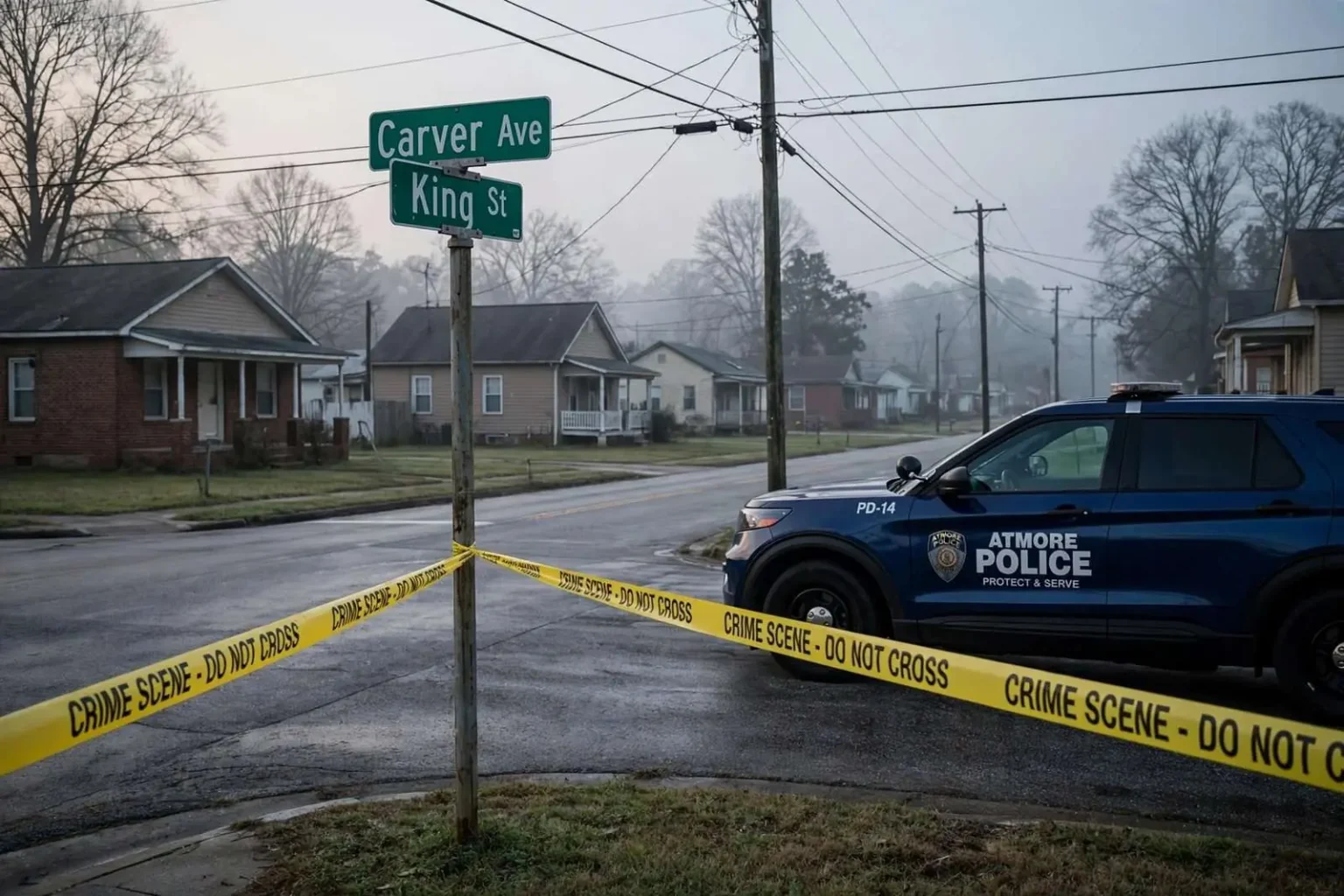
ATMORE, Ala. — A second man has been arrested in connection with a May 2023 murder in Atmore, according to the Atmore Police Department. Wiley Tait Jr., 42, was taken into custody on Oct. 4 after investigators obtained a warrant charging him with murder in the death of Robert Starks, a 31-year-old Atmore man.
Officers with the Atmore Police Department were dispatched to the area of Carver Avenue and King Street shortly before dawn on May 29, responding to a report of shots fired in the neighborhood at around 2:15 a.m. When officers arrived, they found Starks suffering from a gunshot wound. He was provided aid at the scene, but authorities said he later died from his injuries.
With Starks’ death, the case became the city’s homicide investigation of 2023, and detectives with the Atmore Police Department began working to identify those responsible. The early-morning shooting on a residential street drew immediate attention in the community of roughly 8,000 people, where violent crime of this magnitude is uncommon and news of an arrest tends to travel quickly by word of mouth and through local media.
The arrest of Tait on Oct. 4 came more than four months after the shooting, a timeline that reflects the pace at which murder cases typically move through the investigative stage. Detectives must gather physical evidence, canvass for witnesses, collect surveillance footage where it exists, and present their findings to a prosecutor before a warrant can be obtained. In this case, that process produced a first arrest in June and a second in October.
The case’s first arrest came in June
Tait is the second person arrested in connection with Starks’ death. According to police, a warrant had previously been obtained for Eric Mitchell, 44, who was taken into custody on June 29. The monthslong gap between Mitchell’s June arrest and Tait’s October arrest suggests investigators continued developing the case after the initial apprehension, work that in many homicide investigations involves re-interviewing witnesses as relationships and loyalties shift with time.
Charging more than one person in a single killing is not unusual in Alabama. State law allows accomplices to a crime to be charged as principals, meaning a person who intentionally aids or abets a murder can face the same murder charge as the person who fired the fatal shot. Prosecutors in Escambia County will ultimately decide how to proceed against each defendant based on the evidence investigators have assembled.
After his arrest on Oct. 4, Tait was booked into the Escambia County Detention Center, the county jail facility that houses defendants awaiting trial from across Escambia County, including those arrested in Atmore, the county’s largest city. Booking records at such facilities typically document the charges a defendant faces, the warrant that was served, and any bond amount set at or after an initial appearance.
A murder charge in Alabama is a Class A felony when the death results from certain underlying conduct, and it carries the most serious penalties available under state law short of those reserved for capital murder. Defendants charged with murder in cases like this one typically appear before a district judge for an initial hearing, at which bond conditions are addressed and the case is bound over to a grand jury for indictment review.
What happens after a murder arrest in Escambia County
The path from arrest to resolution in a murder case is a long one. After booking, a defendant makes an initial appearance before a magistrate or district judge, who informs the defendant of the charge and addresses counsel. The investigative file then goes to the district attorney’s office, which presents the case to an Escambia County grand jury. If the grand jury returns an indictment, the case moves to circuit court, where pretrial proceedings, motion practice, and plea negotiations can extend for many months before a trial date is ever set.
That procedural reality means the October arrest of Tait and the June arrest of Mitchell represent a beginning rather than an end for the families involved. Court calendars in rural Alabama counties, including Escambia, often move slower than those in larger metropolitan jurisdictions, and murder cases in particular are frequently continued as both the prosecution and defense await lab results, complete additional interviews, or resolve other matters that bear on trial strategy.
The Escambia County Detention Center, where Tait was booked, serves as the primary holding facility for the county sheriff’s office and for municipal agencies such as the Atmore Police Department and the Brewton Police Department when arrestees cannot be released on bond. Defendants charged with murder frequently remain in custody pending trial because of the severity of the charge and the bond amounts that accompany it.
Atmore police and the challenge of violent-crime investigations
The Atmore Police Department is the primary law enforcement agency for the city, a community of roughly 8,000 residents located in the northwest corner of Escambia County near the Florida state line. The department handles the full range of municipal policing — patrol, investigations, and traffic enforcement — while relying on county, state, and federal partners for specialized resources such as laboratory analysis of evidence.
Small departments investigating homicides often lean heavily on those partnerships. The Alabama Law Enforcement Agency can assist with forensic services, and the Alabama Department of Forensic Sciences performs the autopsies that establish cause and manner of death in cases such as Starks’. Those lab and autopsy findings, along with ballistics and digital evidence, form the backbone of the case file that prosecutors will review.
For residents of the neighborhood around Carver Avenue and King Street, the October arrest may bring a measure of reassurance after months of uncertainty. Police officials in communities like Atmore consistently emphasize that arrests in shooting cases often depend on residents coming forward with what they saw or heard, even when that information arrives weeks or months after the fact.
What comes next in the case
Neither Tait nor Mitchell has been tried, and an arrest warrant and charge are accusations, not findings of guilt. Both men are entitled to the presumption of innocence as their cases move through the Escambia County court system. Any trial, plea, or dismissal will occur in circuit court proceedings that are public and open to coverage.
As of the October arrest, authorities had not announced additional arrests or indicated whether investigators believe other individuals participated in the events of May 29. The Atmore Police Department has not detailed the evidence that led to the warrant for Tait, which is typical at this stage, since prosecutors generally avoid releasing investigative details that could complicate future court proceedings.
For now, the case stands as the kind of slow, methodical work that defines homicide investigation in small Alabama cities: a 2:15 a.m. call about shots fired on a residential street in late May, a 31-year-old man dead by morning, a first arrest by the end of June, and a second by early October — with the courts now holding the case for as long as it takes.
Context: violence and enforcement in Escambia County
Atmore sits along the CSX rail line and U.S. Highway 21 in a county where the sheriff’s office and municipal departments split responsibility for public safety across a largely rural landscape. The city is also home to the William C. Holman Correctional Facility, part of the Alabama prison system, and the Poarch Band of Creek Indians’ reservation lands border the city — features that make law enforcement in and around Atmore a matter of overlapping jurisdictions and cooperation.
The Escambia County Sheriff’s Office operates the county detention system, and municipal arrestees like Tait are typically housed there until bond or trial resolves their status. Prosecution falls to the Escambia County District Attorney’s Office, based in Brewton, the county seat, about 20 minutes north of Atmore along Highway 21.
Residents of Atmore and the surrounding county have in recent years watched a series of high-profile violent-crime cases move through the local courts, and homicide prosecutions there draw close attention in a community where courthouse news is a staple of daily conversation. The murder of Robert Starks, with two arrests now logged, will follow the same route — grand jury, indictment, and eventually either a trial or a negotiated resolution.
The four-month gap between the May shooting and the second arrest also illustrates why police departments ask for patience in such cases. Witness recollections sharpen or fade, physical evidence requires laboratory analysis that can take weeks, and the legal standard for a murder warrant — probable cause supported by an affidavit reviewed by a judge or prosecutor — demands more than suspicion. Investigators who move too early risk a case falling apart before trial; those who wait often build the file that makes a conviction possible.
A family, a neighborhood, and a community waiting
Behind the procedural timeline is the loss of a 31-year-old Atmore resident whose family spent the summer of 2023 without answers, followed by the slow steps of two arrests. Local coverage of the case has been careful to note the facts as police released them — the shots-fired call, the gunshot wound, the death, the warrants — and to avoid details that investigators have not confirmed publicly.
The Atmore Police Department has not said whether additional arrests are anticipated. In Alabama, murder cases with multiple participants sometimes produce later indictments as evidence is developed, meaning the two arrests to date do not necessarily close the investigative chapter of this case.
What is clear is the sequence: a late-May shooting on Carver Avenue near King Street, the death of Robert Starks, a June 29 arrest of Eric Mitchell on a murder warrant, and an Oct. 4 arrest of Wiley Tait Jr., who was booked into the Escambia County Detention Center. The courts of Alabama’s First Judicial Circuit, which includes Escambia County, will now determine what the evidence supports.


