Daphne Sunflower Field Opens Again to Raise Money for Volunteer Medical Flights
The annual Sirmon Sunnies Sunflower Project at Sirmon Farms in Daphne invites the public to walk the fields and gather sunflowers, with donations going to Pilots for Christ in memory of Rucker T. Taylor III.
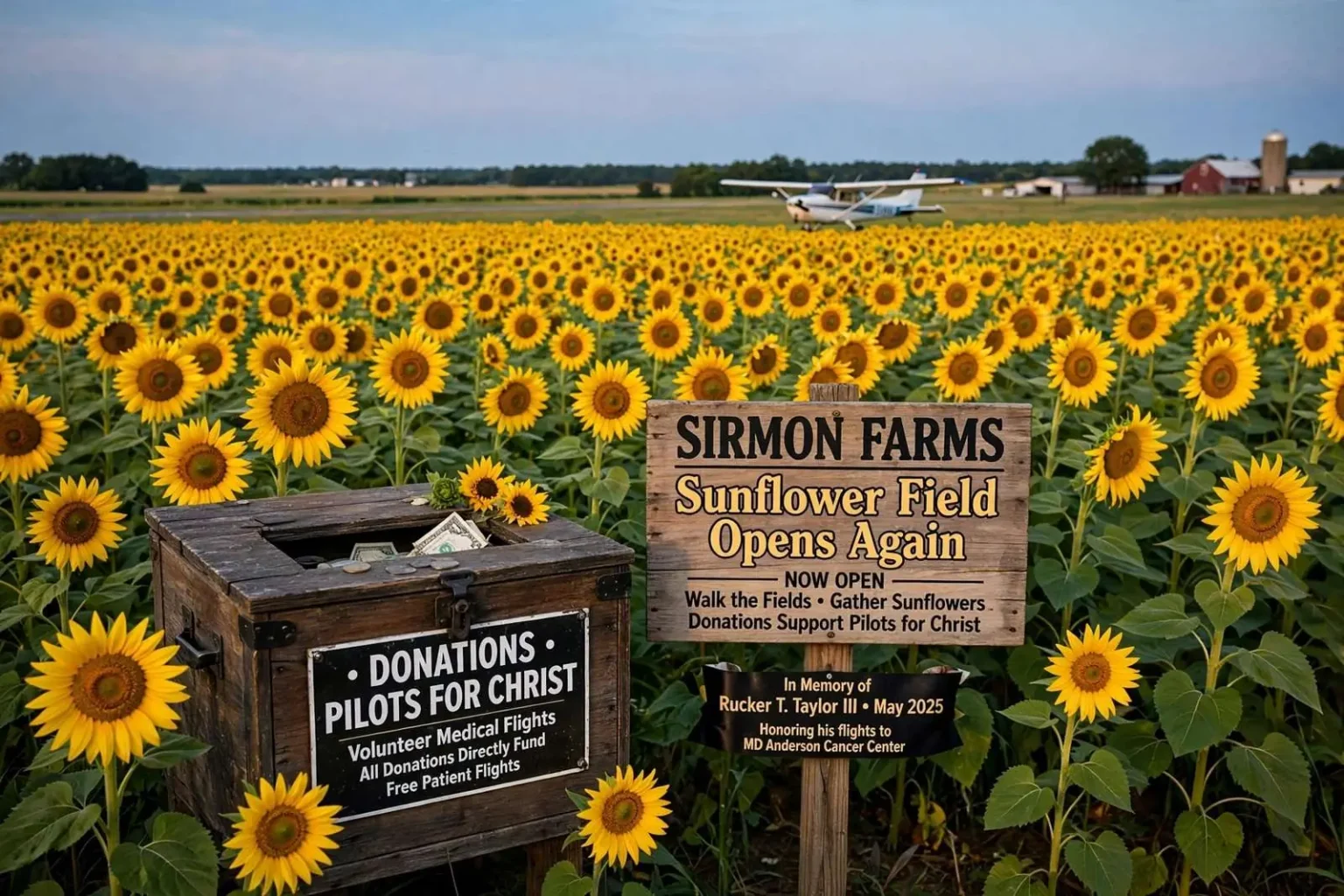
DAPHNE — The sunflower fields at Sirmon Farms are opening to the public again this month, and the money left in the donation boxes scattered across the property will go to an organization that flies patients to cancer treatment for free.
Pilots for Christ is holding its annual Sirmon Sunnies Sunflower Project at the farm on County Road 54 East in Daphne. Visitors are invited to walk through the fields, take in the view and gather sunflowers, with donation boxes placed throughout the property. Every dollar goes directly to Pilots for Christ.
The Man This Year’s Project Honors
This year’s donations will benefit Pilots for Christ in memory of Rucker T. Taylor III, who died in May 2025.
During his treatment, Taylor traveled many times to the University of Texas MD Anderson Cancer Center in Houston with help from Pilots for Christ. That detail is the connection between a sunflower field in Baldwin County and a hospital 600 miles west, and it is the reason the organization is this year’s beneficiary.
MD Anderson is one of the country’s largest and most prominent cancer centers, and it is a common destination for patients from the Gulf Coast whose diagnoses call for specialized treatment or clinical trials not offered closer to home. For a patient in Daphne, Houston is roughly a nine-hour drive each way — a trip that has to be repeated, sometimes many times, over the course of a treatment plan.
What Volunteer Medical Flights Do
Pilots for Christ is part of a broader category of volunteer pilot organizations in the United States: groups whose members donate their own aircraft, fuel and flying time to move patients to medical care at no cost to the patient.
The problem those groups exist to solve is a practical one that rarely makes it into discussions of health care costs. A patient may have insurance that covers the treatment and a hospital willing to provide it, and still be unable to get there. Commercial flights are expensive and, from smaller markets, often require connections that turn a treatment day into a two-day trip. Driving hundreds of miles is physically punishing for someone in active chemotherapy or recovering from surgery, and it consumes vacation days for the family member doing the driving.
Volunteer flights compress that. A general aviation aircraft can leave from a small regional airport near the patient’s home and land at a small airport near the hospital, cutting a full travel day down to a few hours and letting a patient sleep in their own bed the night before and the night after.
The economics are straightforward from the outside and less so from the inside. The patient pays nothing. The pilot absorbs the cost of fuel and aircraft time, which for a several-hour round trip is not trivial. Donations to organizations like this one help offset those costs and keep volunteer pilots flying missions rather than turning them down.
Where to Go
Sirmon Farms is located at 25359 County Road 54 East in Daphne, on the Eastern Shore of Mobile Bay.
The project invites the public to walk through the sunflower fields, enjoy the view and gather sunflowers, with donation boxes placed throughout the farm.
Last Year’s Total
Last year’s Sunflower Project raised more than $10,000 for Pilots for Christ.
That figure is worth pausing on, because it was raised entirely through voluntary donations at unattended boxes. There is no gate, no ticket and no minimum. The model depends on visitors deciding on their own what a walk through a blooming field and an armload of sunflowers is worth, and it has worked well enough to clear five figures.
Why Sunflowers Draw a Crowd
Sunflower fields have become a fixture of late-summer and early-fall agritourism across the South, and the appeal is easy to understand. A mature field is head-high and dense, blooms all at once, and photographs well — which in practice means families, senior portraits, engagement sessions and a steady stream of phone cameras.
The agronomy behind it is less picturesque and more useful. Sunflowers are a warm-season crop with a relatively short growing cycle, they tolerate the heat and heavy soils common on the Gulf Coast, and their deep taproots make them a reasonable rotation crop. The bloom window, however, is narrow. A field peaks for a matter of days to a couple of weeks before the heads begin to droop and dry, which is why events like this one run on short notice and why visitors who wait are often too late.
Making the Trip
Visitors heading out to the farm should plan for a working agricultural property rather than a park. That means uneven ground, dust or mud depending on recent rain, full sun with no shade in the middle of a field, and the insects that come with a flowering crop in south Alabama in September. Closed shoes, water, sunscreen and a morning or late-afternoon visit will make for a better trip than midday in the heat.
Anyone bringing home sunflowers should also bring something to carry them in. Cut stems wilt quickly in a hot car, and a bucket with an inch of water in the floorboard is the difference between an arrangement that lasts a week and one that does not survive the drive home.
How to Give
Donation boxes are placed throughout the farm, and contributions go directly to Pilots for Christ. The project runs this month at Sirmon Farms, 25359 County Road 54 East in Daphne.