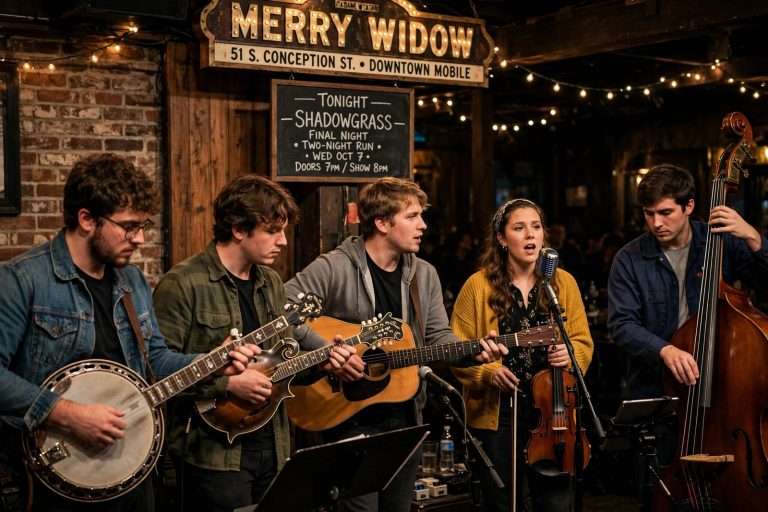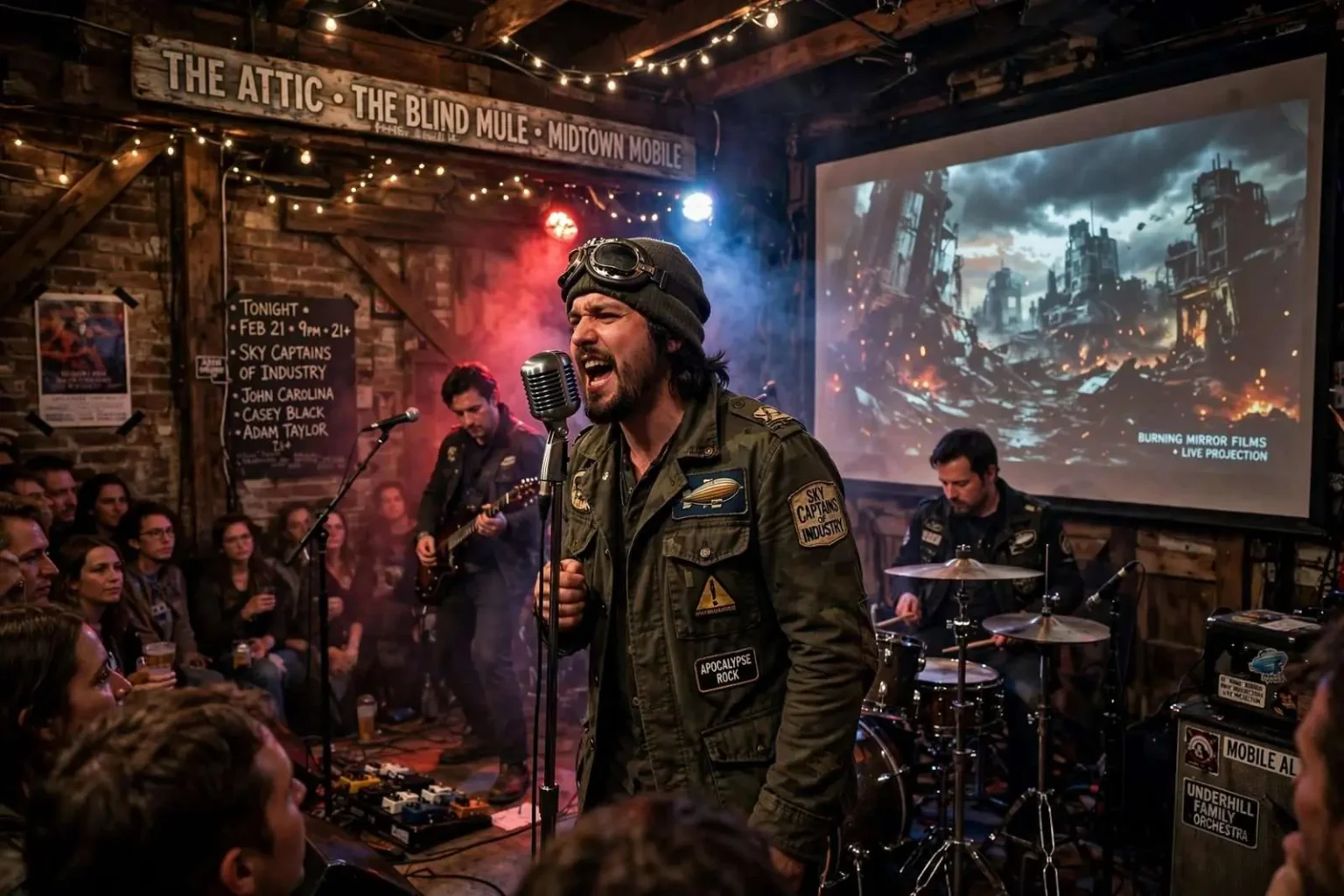
The Attic at the Blind Mule hosted a four-act bill on Friday, February 21 that stretched from Brooklyn apocalypse rock to Mobile singer-songwriter intimacy, with doors opening at 9 p.m. and music starting at 10 for the 21-and-up crowd. The lineup was the kind of genre-crossing bill the Attic built its reputation on: a visiting headliner with a theatrical streak, two songwriting projects with deep local roots, and a Nashville storyteller, all under one roof in midtown Mobile.
The Blind Mule, a longtime midtown institution, has made its Attic space a proving ground for touring acts and local favorites alike. The room rewards the intimate and the loud in equal measure — close enough to the performers that a solo songwriter can hold the audience in his hand, and insulated enough that a full band can push its volume. A four-act night there is a marathon by design, and the February bill was sequenced to build from quiet songcraft to a roaring finale.
Headliners from the future
Headliners The Sky Captains of Industry arrived in Mobile from Brooklyn with a stage persona built around time travel — the band jokes that it has come from the future to warn audiences about the coming apocalypse, or failing that, to rock it to rubble. Their set leaned into that theatrical, high-volume approach. The premise is more than a bit: it shapes the band’s look, its between-song banter and its conceptual swagger, folding a sense of impending doom into an act built for entertainment. Apocalypse rock, in their telling, is not a mood but a mission.
The band’s Brooklyn pedigree placed them in that borough’s long tradition of concept-driven rock bands — acts that treat a show as a narrative event rather than a set of songs. For Mobile audiences, the visit offered a taste of a national touring circuit that rarely detours to the Gulf Coast, and the Sky Captains’ willingness to headline a four-act bill in a midtown venue said something about the Attic’s growing reputation among touring bands working their way through the Southeast.
Their set, arriving last in a long evening, closed the night at maximum volume — the apocalyptic warning delivered, as promised, in rock-and-roll terms.
John Carolina’s folk and swing
The bill also featured John Carolina, the folk-and-swing project of Steven Bryte Laney and Joelle Rosen of Mobile’s Underhill Family Orchestra. The duo pairs harmonic vocals with thought-provoking songwriting, giving local fans an early look at half of one of the city’s most talked-about bands outside their usual full-band setting. The Underhill Family Orchestra has built a following on ambitious, ornate arrangements — a big, orchestral take on Southern folk that fills a stage with players. Stripped to a duo, Laney and Rosen trade that scale for intimacy: two voices, the songs’ bones, and the swing and folk DNA that anchors the full band’s sound.
For fans of the full orchestra, the duo format is both a preview and a reveal — a chance to hear how much of the band’s character lives in its two central voices and its songwriting rather than its arrangements. The harmonic interplay between Laney and Rosen, polished across years of full-band touring, carried the set, and the thought-provoking edge of the material — songs that engage ideas as readily as emotions — gave the performance a substance beyond charm.
Adam Taylor’s unpredictable open
Mobile-area songwriter Adam Taylor opened the night with one of his unpredictable sets. Taylor is known locally for showing up with anything from a pile of noise-making devices to a lone acoustic guitar, delivering evocative personal songs rooted in the blues tradition. That unpredictability is the signature. Audiences at a Taylor show never quite know what instrumentation they will encounter — a rig of homemade percussion and found-sound gadgets, or the starkest possible setup of one guitar and one voice — and the songs themselves carry the same tension between experimentation and tradition.
The blues roots ground him. Whatever devices arrive on stage, the underlying songcraft belongs to the oldest tradition in American music: personal testimony, delivered plainly, with feeling. In a lineup that ran from Brooklyn theatricality to Nashville literary songwriting, Taylor’s opening set set the stakes — proof that the local scene can hold its own with anything rolling through town.
Casey Black’s storytelling
Nashville’s Casey Black brought his literary, storytelling style to the lineup as well. A songwriter who owns more books than records, Black writes conversational songs about optimistic pessimists and the battles between brain and gut, delivered in a gravel-tumbled baritone that critics have praised as a revival of old-school craft songwriting. The description is exact: Black’s songs read like short stories set to chord changes, populated by characters thinking their way through their own contradictions.
The “books over records” ethos places him in a lineage of songwriter’s songwriters — artists for whom the lyric is the engine and the delivery is a craft honed in writing rooms rather than studios. His baritone, worn rather than smooth, suits the material; these are songs narrated by people who have thought things through and arrived somewhere complicated. On a bill that otherwise stretched toward spectacle, Black’s set offered the counterweight: one voice, one instrument, and sentences worth hearing twice.
Video as a fifth performer
Rounding out the evening, filmmaker and video artist Timothy Dixon of Burning Mirror Films shot and projected live video throughout the show, adding a visual layer to the performances. Live-projected video — footage shot during the show itself and thrown onto the screen in real time — turns the audience into part of the production, remixing the evening as it happens. Dixon’s presence reflects the Attic’s openness to multimedia experimentation, and his Burning Mirror Films project has made him a recurring collaborator for acts that want their shows to be seen as well as heard.
By the end of the night, the four acts had traced a full arc — from a lone songwriter’s confessions, through a duo’s harmonies and a Nashville storyteller’s chapters, to a Brooklyn band’s end-of-the-world crescendo — with Dixon’s live imagery binding it together. It was a program that said a great deal about what the Attic at the Blind Mule has become for Mobile: a room where the local and the touring scenes meet, where genres are treated as suggestions, and where a Friday night can hold four different kinds of music and one apocalyptic warning, all before last call.
The Attic and the midtown scene
The Attic has long functioned as midtown Mobile’s listening room, a second-story space that touring acts passing along the Gulf Coast corridor have come to rely on. Its booking pattern — mixing regional singer-songwriters with national indie and roots acts — has filled a gap in the local ecosystem between the brewery stages and the downtown theaters, giving developing artists a professional room and giving audiences a consistent destination for original music. A 21-and-up Friday bill with a 10 p.m. start is the venue’s standard shape, and the February 21 crowd got the full version of it.
The Blind Mule’s own identity helped frame the night. The restaurant-and-bar downstairs and the performance space upstairs work as a single destination — dinner downstairs, show upstairs — which is part of why multi-act bills can hold a crowd from the opening note to the headliner’s encore. By the time the Sky Captains took the stage after midnight’s approach, the room had settled in for the long haul, exactly as a four-act card requires.
Why bills like this matter
For the local musicians, the value of sharing a stage with a touring headliner is practical as much as artistic. Opening slots put a Mobile act in front of an audience that came for someone else, and a strong set converts some of that room into followers — the currency on which a regional band’s touring future is built. John Carolina, in duo form, used the slot to stretch beyond the Underhill Family Orchestra’s established audience; Taylor used his to remind the room that the hometown act can anchor the evening’s first hour with authority.
For the touring bands, a Mobile date on a Southeast run connects the dots between larger markets — New Orleans to the west, the Florida Panhandle to the east — and a room like the Attic has historically earned loyalty from acts that find attentive crowds off the interstate path. The Sky Captains’ theatrical rock found its fullest audience of the night there, playing to listeners who had stayed through three openers to hear it.
And for the audience, the four-act format is simply the best deal in live music: one cover, four perspectives, and a shape that moves from the intimate to the explosive over the course of an evening. Add Dixon’s live-projected video and the night crossed from concert into happening — the kind of show that reminds a city what its small rooms are for.