‘Son of a Son of a Sailor Experience’ Set to Open at Mobile’s Maritime Museum in September
The National Maritime Museum of the Gulf will open its permanent Jimmy Buffett exhibit on Sept. 12, with a Mac McAnally concert and statue unveiling planned for opening weekend.
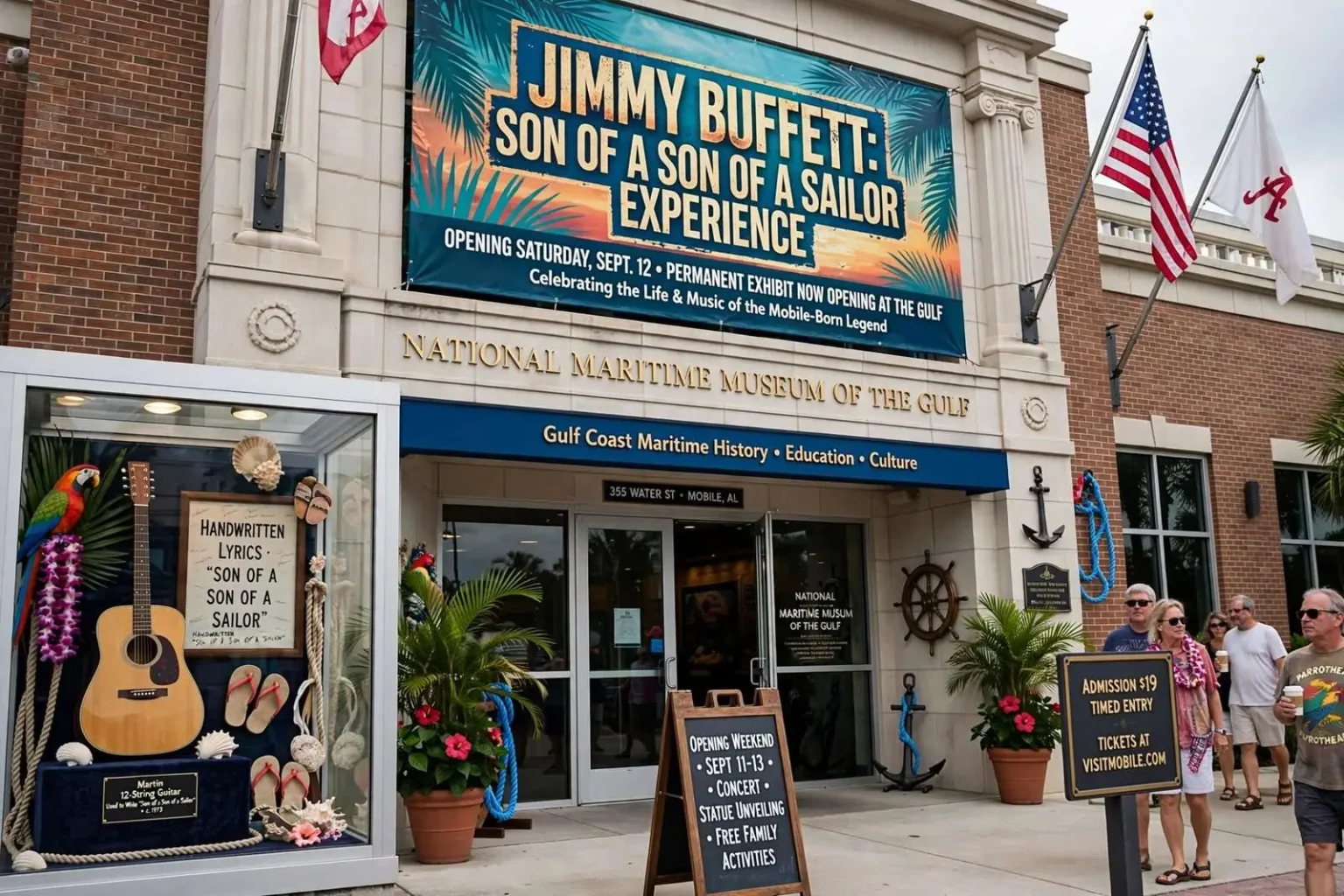
Nearly two years in the making, a permanent exhibit celebrating the life and music of Mobile-born singer Jimmy Buffett is set to open next month at the National Maritime Museum of the Gulf, according to a news release from Visit Mobile.
The “Jimmy Buffett: Son of a Son of a Sailor Experience” will open to the public on Saturday, Sept. 12, filling a permanent 6,000-square-foot gallery with more than 130 items connected to Buffett’s life and career.
Buffett, who helped popularize the “trop rock” genre and built an entertainment and hospitality empire around his music, died in September 2023 at age 76 after a battle with a rare form of skin cancer.
Among the artifacts going on display is the 12-string Martin guitar Buffett used to write his signature song, “Son of a Son of a Sailor,” along with handwritten lyrics, a recreation of his Key West recording studio, and recorded interviews with his family and friends.
Museum Executive Director Karen Poth said the exhibit represents nearly two years of work by the museum’s staff.
“Creating the ‘Jimmy Buffett Experience’ has been an absolute honor for our entire team,” Poth said in a statement. “We have spent nearly two years listening, researching, collecting stories, curating artifacts and working to capture the remarkable life of a man who meant so much to so many people.”
Poth added that the museum intends to keep expanding the collection over time.
“We didn’t get far into this project before we realized this exhibition will never be a finished story,” she said. “It is a living exhibit and it will continue to change and grow as new stories are shared, new artifacts come to light and we learn more about Jimmy and the world he created.”
An opening weekend built for Parrotheads
According to the museum’s website, the opening weekend will include several days of celebration. Buffett collaborator Mac McAnally is scheduled to perform a concert at the Saenger Theatre on Friday, Sept. 11, the night before the exhibit opens. On Saturday, a ceremony will unveil a statue of Buffett near the museum. Festivities are set to continue Sunday, Sept. 13, with food trucks and live music.
The lineup is calibrated to the audience the museum expects will travel for it. McAnally, a longtime member of Buffett’s Coral Reefer Band and a fixture of the Gulf Coast songwriting scene, draws exactly the demographic the exhibit targets — fans who followed Buffett’s touring career for decades and treat his songs as a shared language. A statue unveiling gives the weekend a permanent marker in downtown Mobile, and the Sunday programming opens the door to families rather than only devoted fans.
The museum’s Buffett exhibit has already drawn attention from Mobile city leaders; the City Council recently considered a nearly $28,000 purchase of window wraps for the museum ahead of the September opening.
Update: The Mobile City Council has since approved a $32,623 purchase for a pedestal that will support the exhibit’s Buffett statue, one of the final pieces to fall into place ahead of next month’s opening.
“Almost two years in the making, and we’re getting there,” Poth said.
What the $19 ticket buys
Tickets for the exhibit are already on sale, with timed entry slots included in the museum’s $19 admission price. Timed entry is the operational answer to the crowd the museum anticipates: a permanent gallery devoted to Buffett will draw heavy traffic in its opening months, and admission slots let the museum manage flow through 6,000 square feet of exhibit space without turning visitors away at the door.
The price point also positions the exhibit as a mainstream attraction rather than a premium fan experience — comparable to a standard museum admission, and folded into the museum’s general ticket rather than sold as a separate upcharge.
Poth said roughly half of the exhibit will function as a concert experience, taking visitors from backstage into a recreated show featuring never-before-seen footage compiled with Buffett’s longtime videographer, along with road cases, stage props and memorabilia collected from his tours.
The backstage-to-stage progression is the exhibit’s centerpiece concept. Visitors move through the working apparatus of a touring operation — the cases, the props, the staging — before arriving at the recreated performance itself, built from footage shot across years of touring that has never been publicly shown. For fans, the closest parallel is a Buffett concert’s own structure: the anticipation, the crowd, the show.
Additional rooms will display gold records and several more of Buffett’s guitars.
A section dedicated to Buffett’s devoted fanbase, the Parrotheads, will include a small room designed to resemble the back door of his Key West home, along with an interactive kiosk where visitors can record their own Jimmy Buffett memories.
The Parrothead section acknowledges a fact of Buffett’s career that statistics alone cannot: his audience functioned as a community, organizing around concerts the way fans of no other single songwriter quite have, complete with its own dress conventions, tailgating culture and traditions passed across generations. The recorded-memory kiosk turns that community into part of the collection itself, with each visitor’s story potentially becoming exhibit material as the display grows.
The maritime roots the museum is built to tell
The exhibit also highlights Buffett’s maritime roots — both of his parents worked for the Alabama Drydock and Shipbuilding Co., and his grandfather was a boat captain.
That biography is why the exhibit sits in a maritime museum rather than a music hall. Buffett’s music returned to the water throughout his career — boats, beaches, harbors and the life that gathers around them — and the museum’s telling connects the songs to a childhood in a port city where shipyards and working vessels were the family business. The National Maritime Museum of the Gulf, which documents the Gulf’s maritime history, treats Buffett as a chapter of that story rather than a celebrity guest in it: the son of shipyard workers and a captain’s grandson who turned the Gulf’s culture into a worldwide brand.
Mobile’s claim on Buffett runs deeper than his birthplace. The city appears in his songs and his autobiographical writing as a touchstone of childhood, and fans have long noted the Gulf Coast geography woven through his catalog — a geography that stretches from Mobile Bay through the Florida keys he made famous. The exhibit gives that geography a physical home.
Keeping visitors in Mobile
“Social media is already filled with folks who are planning their trips and figuring out how to come here,” Poth said. “We honestly think we finally have something that will keep people from just getting on the bridge or in the tunnel and headed to the beach. I think they’re gonna stop in Mobile for a while.”
Poth’s framing speaks to a challenge Mobile’s tourism leaders have articulated for years: the city’s geography makes it a corridor rather than a destination, with Interstate 10 traffic flowing through downtown toward the beaches of Baldwin County and Florida. A permanent Buffett exhibit is designed as a reason to break the drive — an attraction with a recognizable name, a Gulf Coast theme and enough depth to fill a half-day.
The Buffett exhibit will eventually be joined by another new addition, “Delta Mosaic: A Confluence of Life,” an immersive walkthrough exhibit focused on the Mobile-Tensaw Delta.
The pairing is deliberate. The Delta exhibit anchors the museum’s educational and natural-history mission, documenting the river delta north of Mobile that feeds the bay, while the Buffett gallery carries the popular-culture weight that drives attendance. Together they give the museum two distinct draws — one for school groups and nature travelers, one for music fans — in the same downtown visit.
For the museum itself, the Buffett gallery represents a wager on what a regional maritime institution can be. The National Maritime Museum of the Gulf opened with a mission to document five Gulf states of maritime history — commerce, shipbuilding, fisheries, storms and the cultures built on the water — and a permanent gallery devoted to a musician born to shipyard workers fits that mission more naturally than it first appears. Buffett’s career is, in its way, a maritime export: a Gulf Coast sensibility packaged and shipped to listeners who have never stood on a sandbar, supported by an empire of restaurants, radios and resorts that sells the water to the landlocked.
The 130-plus items gathered for the gallery also represent a gathering of materials that no other institution could have assembled. Buffett’s estate and family lent their cooperation to the project during its two years of development, and the recorded interviews with family and friends give the exhibit a documentary layer that survives beyond the artifacts themselves — testimony gathered while the people closest to Buffett could still be asked questions directly.
What happens after September will measure whether the wager pays. Museums live on repeat visitation and school traffic as much as on opening-weekend crowds, and Poth’s “living exhibit” language is the strategy for both: rotating stories, new artifacts and the kiosk-collected memories of visitors themselves keep a fixed 6,000-square-foot gallery from going stale. For Mobile, the hope is simpler — that a city long treated as the last stop before the beach becomes, for a few hours or a weekend, the destination itself.