South Alabama Coach Applewhite Previews Jaguars’ Upcoming Football Season
South Alabama football coach Major Applewhite previewed the Jaguars' upcoming season at Sun Belt Football Media Days, discussing new coaching hires, quarterback development and the team's West Division outlook.
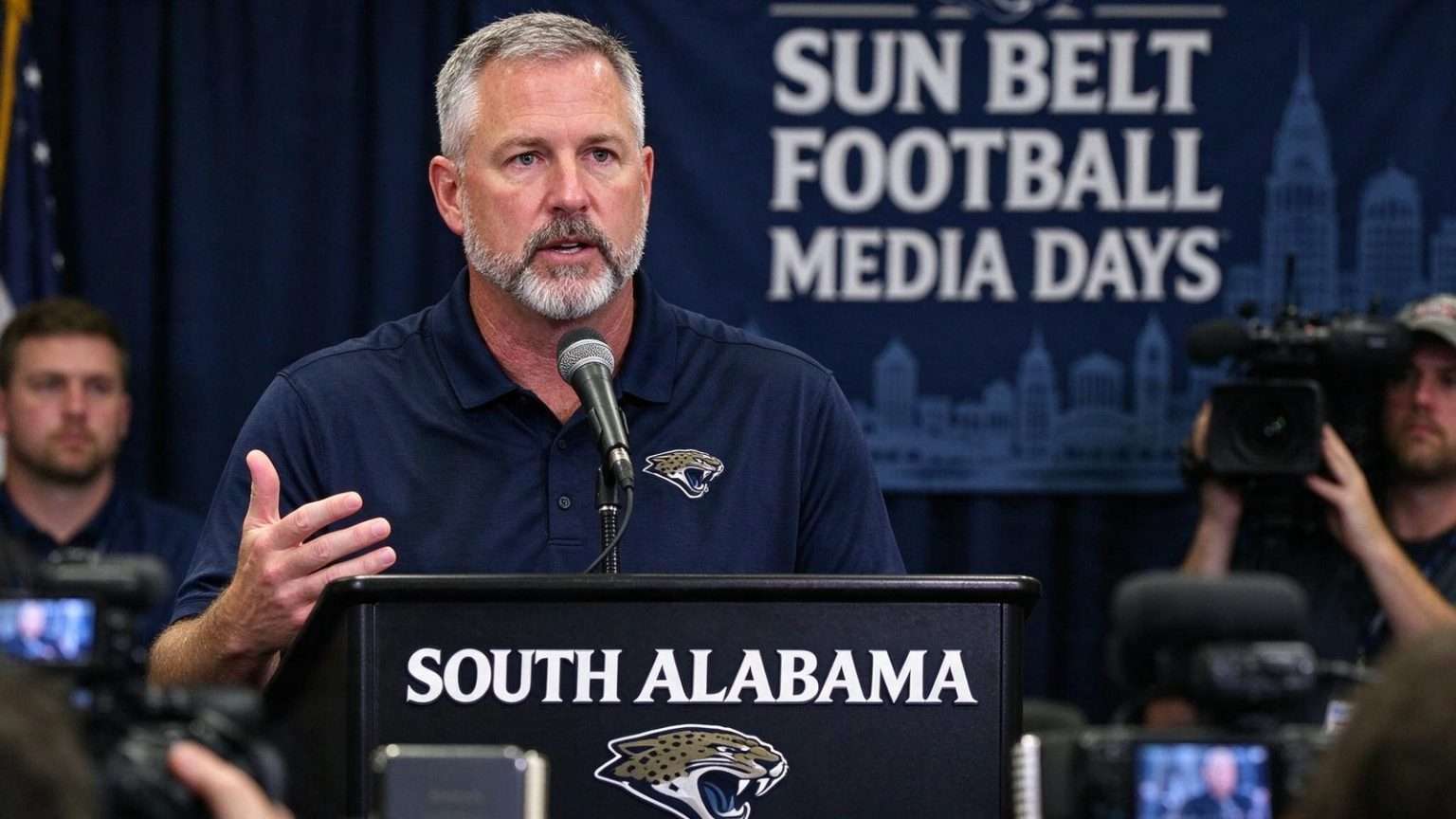
South Alabama head football coach Major Applewhite addressed reporters this week as the Sun Belt Conference kicked off its annual Football Media Days event in New Orleans, where the Jaguars were picked to finish sixth in the seven-team West Division in a preseason poll of the league’s head coaches. The three-day gathering brings together coaches, players and reporters from across the conference each summer to preview the coming season, and it doubles as the unofficial starting line for a fall that Applewhite hopes will move his program up the standings.
Applewhite, entering his third season leading the program and his sixth overall with South Alabama, said he feels good about the team’s chemistry heading into fall camp, which begins in three weeks. The Jaguars have spent the summer in conditioning work and informal player-led practices, the stretch of the offseason when rosters coalesce long before the first whistle of preseason drills.
“I really feel good about a lot of things, but the two things that really stood out to me is the connection to this football team and their ability to tackle work,” he said. He added that he does not sense many players looking elsewhere for other opportunities, a notable statement in an era when the transfer portal has made offseason movement a constant undercurrent on every roster in the sport.
Coaches’ preseason polls are rarely kind to programs coming off uneven seasons, and a sixth-place projection in a seven-team division leaves the Jaguars with the kind of external skepticism that staffs routinely use as bulletin-board material. Applewhite did not campaign against the prediction, but his remarks centered on a roster he described as connected and eager to work rather than on where outsiders expect the team to finish.
South Alabama’s football program, which plays its home games on the university’s Mobile campus, has built its identity on regional recruiting and steady development, and Applewhite’s staff has continued that approach. The coming weeks of fall camp will settle starting jobs on both sides of the ball before the opener, with the staff emphasizing fundamentals and competition at every position group.
Media Days marks the moment the offseason turns toward the season. Broadcasters set their storylines, reporters file their previews, and the players who accompany their coaches to the podium answer the same questions their head coaches fielded moments earlier. For a Mobile program, the event is also a chance to project its brand across a conference whose footprint stretches from the Carolinas through the Gulf Coast, where every recycled highlight and quote builds familiarity with fans who may never have made the drive to a game.
A retooled coaching staff
Applewhite spoke at length about the program’s new coaching additions, headlined by defensive coordinator Todd Orlando, with whom he previously worked at Houston. The two coaches share an offensive and defensive pedigree from their time together on the Cougars’ staff, and their reunion in Mobile reunites a partnership Applewhite trusts to run the defense without daily supervision.
He said all of the new assistants, including Tyson Kee, Chris Acuff, Tim Rattay, Bryant Ross and Adam Mann, were brought in for their character, confidence and ability to connect and communicate with players. Rattay, a former collegiate and professional quarterback, adds a veteran teacher’s voice to the offensive side of the ball, while the rest of the group fills out position rooms that saw significant turnover in the offseason.
New assistant coaches bring more than schematic variety to a staff. Each hire resets the relationships inside a position group, and Applewhite’s emphasis on communication suggests he wanted teachers who could earn buy-in quickly, with fall camp compressed into the few weeks remaining before the season opener. Players who thrived under the previous staff will need to re-establish themselves, and newcomers on the roster get a fresh evaluation from a new set of eyes.
On quarterback Bishop Davenport, Applewhite said the development focus has centered on where Davenport’s eyes and feet are positioned during plays, along with improving his pocket presence. He called Davenport a talented athlete with strong character, the combination most quarterback coaches consider the foundation for growth at the position.
Quarterback development tends to be measured in small mechanical gains before it shows up on the scoreboard. Eye discipline — knowing where to look first on a pass concept — and footwork in the pocket determine whether a young quarterback trusts his progressions under pressure, and Applewhite’s comments indicate the staff is working on those fundamentals rather than rebuilding the player’s skill set from scratch.
The quarterback competition and the rest of the depth chart will get their first real test when fall camp opens in roughly three weeks. Camp practices give the staff padded work it cannot replicate in the summer, and they will be the first extended look at how the new coordinators and assistants teach their systems to a roster that has spent the offseason learning the terminology.
Applewhite also touched on the addition of Louisiana Tech to the Sun Belt, saying he does not have strong opinions on conference realignment but respects the program’s tradition. Conference membership has shifted repeatedly across college football in recent years, and the Bulldogs’ arrival reshapes the West Division schedule and adds another regional opponent to the league’s footprint.
Asked about the transfer portal and roster rules, he said his focus stays on preparing his current roster rather than dwelling on offseason movement across college football. The stance reflects a practical reality of the modern offseason: rosters change until well into the summer, and staffs that spend their energy on the players in the building are generally better positioned when camp opens than those tracking the ones who left.
Regional rivals within a short drive
Looking at the West Division, Applewhite noted that South Alabama’s regional opponents, including Troy, Southern Miss, Louisiana, Louisiana-Monroe and Louisiana Tech, are all within a relatively short drive of Mobile, which he said fosters familiarity and rivalry across the division. Few conferences in the country can match that geographic compression, and it shapes everything from recruiting battles to the size and makeup of visiting crowds on game days.
The compact footprint means Jaguar fans can travel to most conference road games by bus or a short car trip, and opposing fan bases return the favor. Troy, the program’s oldest and closest rival, sits less than an hour and a half up U.S. 231, while the Louisiana schools and Southern Miss line the Gulf Coast corridor within an afternoon’s drive. The rivalry games double as recruiting showcases, with high school prospects from the I-10 corridor watching programs compete for players who grew up within a few hours of every campus in the division.
The compact footprint also compresses the standings race. With so many programs so close together, home-field advantages matter and road wins carry added weight in a division where the differences between second and sixth place can come down to a handful of plays spread across a season. Applewhite’s familiarity argument cuts both ways: opponents know the Jaguars as well as the Jaguars know them, which places a premium on execution rather than surprise.
On what the Jaguars need to improve, Applewhite pointed to taking better care of the football, generating more takeaways and being more aggressive offensively early in games. The three items map directly onto the margins that separate close losses from wins: turnovers committed, turnovers forced and points on the board before opponents settle into a game plan.
Ball security and takeaways are typically the most coachable of the bunch, drilled daily in camp through strip-sack periods, turnover circuits and emphatic celebrations whenever the defense comes away with the ball. The offensive aggression question is more structural, involving play-calling tendencies in the first quarter and a willingness to push the ball downfield before conservative scripts take over.
Fall camp will also settle the quieter competitions that decide seasons: the specialists, the second-team offensive line and the depth pieces on defense who see the field in long drives and late-game situations. Teams picked sixth in their division rarely lose because of their starters; they lose because of the margins, and Applewhite’s staff has three weeks to build depth across the roster before the season begins.
South Alabama opens its season against Southeastern Louisiana, an in-state opponent from Hammond, Louisiana, that gives the Jaguars a manageable first test before conference play arrives. Non-conference openers carry extra weight for programs picked near the bottom of their division, since a convincing start can recalibrate expectations that a preseason poll has set low.
For Applewhite, the third season has long been treated in college football as the measuring stick for a coaching tenure, the point at which a staff’s recruits fill the two-deep and the program’s trajectory becomes clear. His comments at Media Days framed the upcoming camp as a continuation rather than a rebuild, with a connected roster, an established staff and a schedule that keeps nearly every conference game within reach of the Mobile fan base.
The Jaguars will learn soon enough whether the coaches’ poll underestimated them. Fall camp opens in three weeks, the opener against Southeastern Louisiana follows, and the West Division schedule — from Troy to Louisiana Tech — will give South Alabama every chance to climb from sixth in the eyes of its peers to a higher finish on the field.