
Sperm Whale Spotted Heading Farther North Into Mobile Bay
A sperm whale was sighted moving north into Mobile Bay, the Dauphin Island Sea Lab reports. Boaters should stay 500 yards away and report sightings.
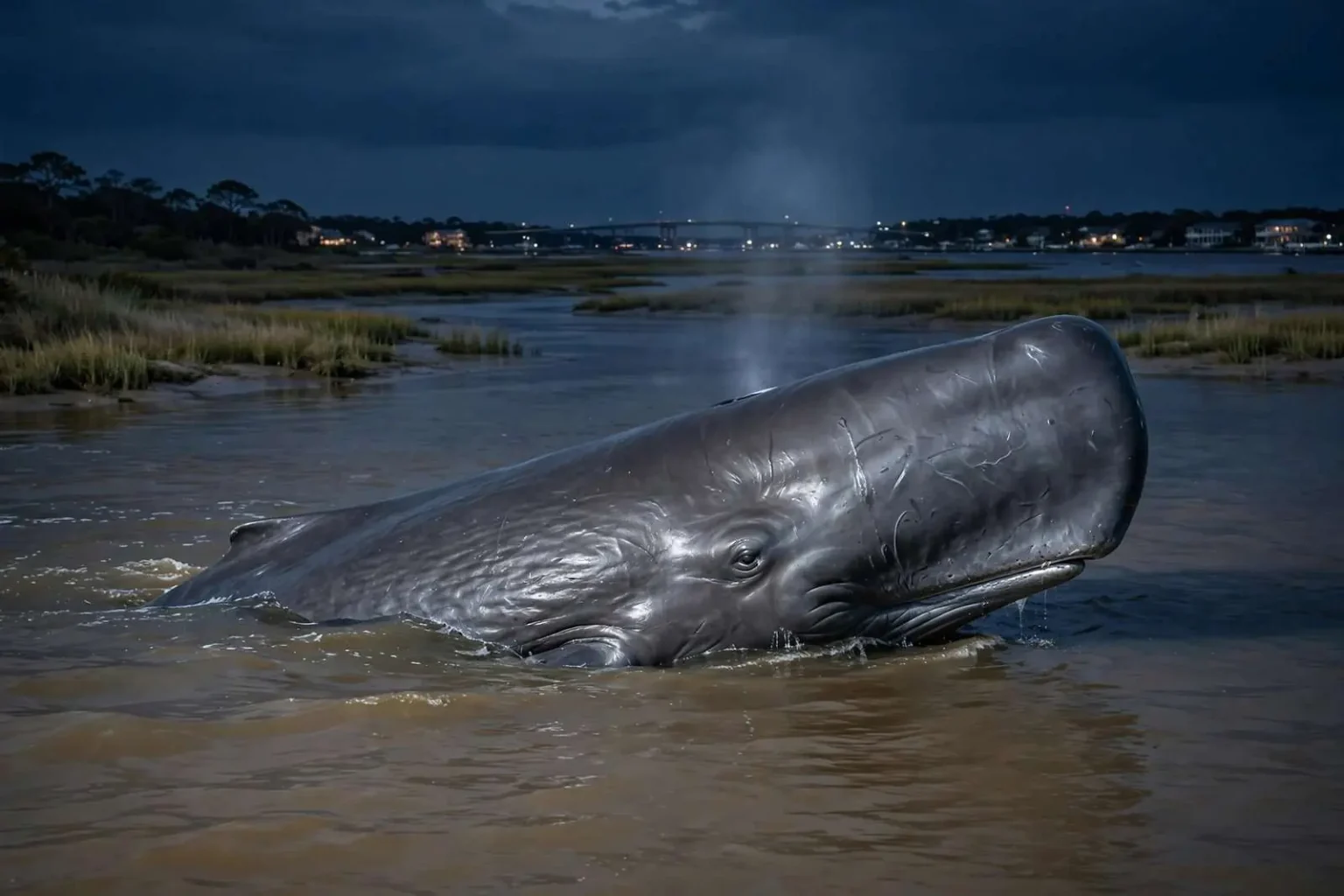
Marine researchers on Dauphin Island are keeping close watch on a sperm whale that has wandered well beyond its usual deep-water home, with the animal pushing even farther north into Mobile Bay. The Dauphin Island Sea Lab reported that the whale moved overnight and was sighted around midnight Sunday traveling north through the bay, confirming the animal was continuing its unusual journey inland rather than turning back toward the open Gulf, where the deep-diving species normally lives. For the scientists at the Sea Lab, whose staff track marine mammal activity along the Alabama coast, a sperm whale inside the bay is about as far outside the norm as sightings get.
Sperm whales are the largest of the toothed whales, instantly recognizable by the massive, squared-off head that houses the spermaceti organ long prized by whalers and by scientists studying the animal’s remarkable diving ability. The species can hold its breath for well over an hour on a single dive, descending in darkness to hunt squid by sound. Their social structure is centered on family groups of females and calves in warmer waters, while larger males range more widely — a pattern that sometimes brings individual animals into waters where they have no business being, and one reason scientists pay close attention whenever a sperm whale appears far from the deep Gulf.
An Extraordinary Event for the Alabama Coast
Sperm whales are deep-water animals typically found far offshore, which makes a prolonged appearance inside Mobile Bay an extraordinary event for the Alabama coast. The species is built for the open ocean: sperm whales routinely dive thousands of feet in search of squid and other deep-sea prey, and they are most at home along the continental shelf and its drop-offs, where the seafloor plunges to depths a shallow bay cannot approach. In the Gulf of Mexico, they are generally associated with deep water beyond the shelf edge, far from the barrier islands and estuarine waters that fringe Alabama’s coastline.
Mobile Bay, by contrast, is a shallow, sediment-rich estuary where the Mobile River system meets the Gulf. Its waters are turbid, its depth profile is nothing like the deep basins sperm whales hunt in, and its salinity varies dramatically with river flow and tide. Why a sperm whale would leave suitable deep-water habitat and push north into an estuary is a question scientists can only speculate about, but whales that end up in shallow, nearshore waters are often sick, disoriented, or following something wrong in their internal navigation. That is precisely why responders treat each new report of the animal’s position as important data rather than idle curiosity.
Overnight Movement North
The Sea Lab reported that the whale was sighted around midnight Sunday traveling north through the bay, meaning the animal continued its inland push while most of the coast was asleep. Overnight tracking is difficult work; even with reports coming in from boaters and shoreline observers, a whale at the surface after dark is hard to keep eyes on, and its course can change quickly. Each confirmed sighting helps researchers plot the animal’s progress and anticipate where it might turn up next, whether that is a bend in the ship channel, a stretch of open bay near the causeway, or a turn back south toward the barrier islands.
Keeping a Safe Distance
Officials with the Sea Lab are urging boaters and residents who spot the whale to keep their distance. The public is asked to stay at least 500 yards away and never approach or touch the animal, both for human safety and the whale’s own wellbeing. A sperm whale is an enormous animal — adults of the species can weigh many tons — and even a healthy one can injure people or damage small craft with a single movement of its tail. A stressed or sick whale is more dangerous still, and crowding it with boats only adds pressure to an animal that responders may already be worried about.
The 500-yard guidance also reflects federal law. Under the Marine Mammal Protection Act, it is illegal to harass, harm, or attempt to feed marine mammals, and sperm whales in the Gulf of Mexico receive additional protection because the Gulf population is listed as endangered under the Endangered Species Act. Harassment includes anything that changes the animal’s natural behavior, so racing a boat alongside the whale, positioning directly in its path, or trying to swim to it all fall on the wrong side of the law. Federal authorities can and do pursue penalties for vessels that disregard approach rules when protected marine mammals are involved.
What Boaters Should Do
Anyone who sees the whale is asked to report the sighting right away to the Alabama Marine Mammal Stranding Network at 1-877-942-5343 so responders can track its movements. Callers should be ready to describe where the animal was seen, the direction it was traveling, and roughly how many boats were around it, along with the time of the sighting. A photograph taken from a safe distance can also help researchers identify the animal and assess its visible condition, but no photo is worth moving closer for.
The Alabama Marine Mammal Stranding Network operates as the state’s frontline response system for whales, dolphins, and manatees, with the Dauphin Island Sea Lab playing a central role in coordinating that response. When a large whale is involved, the network works alongside federal partners and other stranding network members to decide how to monitor the animal, whether intervention is possible, and what conditions on the water allow for safe observation. Large whales generally cannot be herded or handled the way smaller dolphins can, which makes patient tracking and public cooperation the most valuable tools responders have.
Coastal residents along Alabama’s beaches and bayfront communities are accustomed to occasional visits from manatees in summer and the ever-present dolphins that work the bay’s shallows, but a sperm whale is a different category of event entirely. News of the animal’s presence has drawn attention up and down the coast, and researchers stress that public reports — made from a respectful distance — are the best way to help track an animal moving as unpredictably as this one has so far.
Why the Bay Is a Concern
A deep-diving whale in shallow estuarine water faces real risks. Sperm whales feed on squid found near the seafloor in deep water, and Mobile Bay offers nothing resembling that habitat. Extended time in shallow water can leave a whale unable to feed properly, and the stress of navigation through the bay’s channels, ship traffic, and recreational boat activity can wear the animal down. Stranded or disoriented whales that linger in shallow environments can suffer physical harm as their body weight presses on them in water that is not deep enough, and the longer an animal stays off course, the more its condition tends to deteriorate.
The bay’s heavy boat traffic adds another layer of concern. Mobile Bay is a working estuary, home to commercial shipping headed to the Port of Mobile, shrimp and oyster boats, charter fishing vessels, and weekend recreational traffic. Large ships cannot maneuver quickly, and a whale surfacing in the shipping channel is exposed to vessel strikes and propeller injuries. That combination — an animal out of its element, in water too shallow to support its normal behavior, sharing space with industrial and recreational traffic — is why the Sea Lab has emphasized that monitoring is active and ongoing rather than a matter of casual interest.
The Sea Lab’s Role on the Coast
The Dauphin Island Sea Lab has spent decades as Alabama’s marine science hub, combining research and education programs with its role in responding to marine mammal incidents along the coast. Its researchers regularly study dolphins in Mobile Bay and the surrounding sound systems, and its staff coordinates with the stranding network when unusual species appear. An event like this mobilizes that entire structure: researchers plotting sightings, educators fielding questions from the public, and responders standing ready depending on where the whale travels next.
Updates will follow as monitoring continues, the Sea Lab says. Officials have thanked the boaters and residents who have already called in sightings, noting that those reports are what allowed researchers to confirm the overnight movement north. For now, the message to the public is consistent: admire the animal from a distance, keep boats far away, and call in new sightings promptly to the stranding network line. Sightings from residents and boaters are often the most current information responders have, and each report helps scientists understand where the whale is heading and whether its condition is changing. Whether the animal turns back toward the Gulf in the coming days or continues its unusual inland journey, researchers on Dauphin Island intend to follow it every step of the way.


